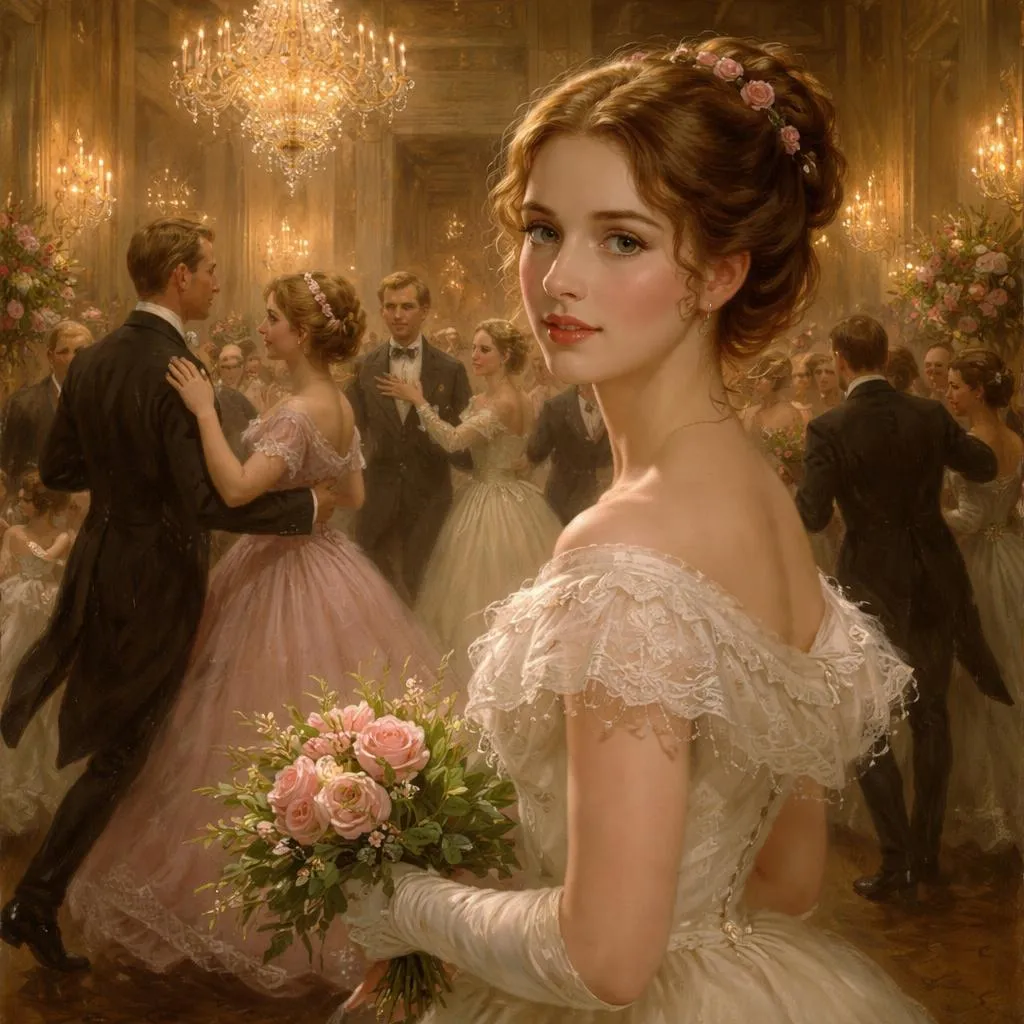

At eighteen, Miss Murray was to emerge from the quiet obscurity of the schoolroom into the full blaze of the fashionable world—as much of it, at least, as could be had out of London; for her papa could not be persuaded to leave his rural pleasures and pursuits, even for a few weeks’ residence in town. She was to make her debut on the third of January, at a magnificent ball, which her mamma proposed to give to all the nobility and choice gentry of O—– and its neighbourhood for twenty miles round. Of course, she looked forward to it with the wildest impatience, and the most extravagant anticipations of delight.
‘Miss Grey,’ said she, one evening, a month before the all–important day, as I was perusing a long and extremely interesting letter of my sister’s—which I had just glanced at in the morning to see that it contained no very bad news, and kept till now, unable before to find a quiet moment for reading it,—’Miss Grey, do put away that dull, stupid letter, and listen to me! I’m sure my talk must be far more amusing than that.’
She seated herself on the low stool at my feet; and I, suppressing a sigh of vexation, began to fold up the epistle.
‘You should tell the good people at home not to bore you with such long letters,’ said she; ‘and, above all, do bid them write on proper note–paper, and not on those great vulgar sheets. You should see the charming little lady–like notes mamma writes to her friends.’
‘The good people at home,’ replied I, ‘know very well that the longer their letters are, the better I like them. I should be very sorry to receive a charming little lady–like note from any of them; and I thought you were too much of a lady yourself, Miss Murray, to talk about the “vulgarity” of writing on a large sheet of paper.’
‘Well, I only said it to tease you. But now I want to talk about the ball; and to tell you that you positively must put off your holidays till it is over.’
‘Why so?—I shall not be present at the ball.’
‘No, but you will see the rooms decked out before it begins, and hear the music, and, above all, see me in my splendid new dress. I shall be so charming, you’ll be ready to worship me—you really must stay.’
‘I should like to see you very much; but I shall have many opportunities of seeing you equally charming, on the occasion of some of the numberless balls and parties that are to be, and I cannot disappoint my friends by postponing my return so long.’
‘Oh, never mind your friends! Tell them we won’t let you go.’
‘But, to say the truth, it would be a disappointment to myself: I long to see them as much as they to see me—perhaps more.’
‘Well, but it is such a short time.’
‘Nearly a fortnight by my computation; and, besides, I cannot bear the thoughts of a Christmas spent from home: and, moreover, my sister is going to be married.’
‘Is she—when?’
‘Not till next month; but I want to be there to assist her in making preparations, and to make the best of her company while we have her.’
‘Why didn’t you tell me before?’
‘I’ve only got the news in this letter, which you stigmatize as dull and stupid, and won’t let me read.’
‘To whom is she to be married?’
‘To Mr. Richardson, the vicar of a neighbouring parish.’
‘Is he rich?’
‘No; only comfortable.’
‘Is he handsome?’
‘No; only decent.’
‘Young?’
‘No; only middling.’
‘Oh, mercy! what a wretch! What sort of a house is it?’
‘A quiet little vicarage, with an ivy–clad porch, an old–fashioned garden, and—’
‘Oh, stop!—you’ll make me sick. How CAN she bear it?’
‘I expect she’ll not only be able to bear it, but to be very happy. You did not ask me if Mr. Richardson were a good, wise, or amiable man; I could have answered Yes, to all these questions—at least so Mary thinks, and I hope she will not find herself mistaken.’
‘But—miserable creature! how can she think of spending her life there, cooped up with that nasty old man; and no hope of change?’
‘He is not old: he’s only six or seven and thirty; and she herself is twenty–eight, and as sober as if she were fifty.’
‘Oh! that’s better then—they’re well matched; but do they call him the “worthy vicar”?’
‘I don’t know; but if they do, I believe he merits the epithet.’
‘Mercy, how shocking! and will she wear a white apron and make pies and puddings?’
‘I don’t know about the white apron, but I dare say she will make pies and puddings now and then; but that will be no great hardship, as she has done it before.’
‘And will she go about in a plain shawl, and a large straw bonnet, carrying tracts and bone soup to her husband’s poor parishioners?’
‘I’m not clear about that; but I dare say she will do her best to make them comfortable in body and mind, in accordance with our mother’s example.’
Antecedentes e Introducción del Autor
Este extracto proviene de una novela clásica del siglo XIX que explora temas de expectativas sociales, deberes familiares y crecimiento personal. La historia se centra en la señorita Murray, una joven que se prepara para entrar en sociedad a través de un baile de debutantes, un evento significativo que marca la presentación de una joven a la élite social. La narrativa captura el contraste entre la emoción de la vida social y las realidades más tranquilas y fundamentadas de la familia y la responsabilidad personal.
La autora, una figura prominente en la literatura victoriana, a menudo escribía sobre la vida de las mujeres que navegaban por los estrictos códigos sociales de su tiempo. Sus obras son conocidas por sus agudas observaciones sobre el carácter y la sociedad, mezclando el humor con reflexiones serias sobre la naturaleza humana y las limitaciones sociales.
Interpretación Detallada y Significado
Este pasaje destaca la tensión entre la anticipación juvenil y la responsabilidad madura. La señorita Murray espera ansiosamente su baile de debut, simbolizando su entrada en el mundo de la moda. Sin embargo, a través del diálogo con la señorita Grey, vislumbramos las realidades prácticas detrás de tales eventos: los lazos familiares, los sacrificios personales y las expectativas puestas en las mujeres.
La conversación sobre el próximo matrimonio de la hermana de la señorita Murray con un modesto vicario introduce temas de clase social y felicidad personal. La elección de la hermana contrasta marcadamente con el glamuroso baile de debut, sugiriendo diferentes caminos que las mujeres de esa época podrían tomar. La discusión sobre el carácter y el estilo de vida del vicario desafía los juicios superficiales, enfatizando virtudes como la bondad, la sabiduría y el contentamiento por encima de la riqueza o la apariencia.
Lecciones y Perspectivas para los Estudiantes
-
Comprender las Expectativas Sociales: La historia ofrece una ventana a las costumbres sociales históricas, ayudando a los estudiantes a apreciar cómo los roles y expectativas sociales dan forma a las elecciones individuales. Reconocer estas influencias fomenta la empatía y el pensamiento crítico sobre las normas sociales actuales.
-
Equilibrar la Ambición y el Deber: La emoción de la señorita Murray por el baile contrasta con la vida más tranquila y responsable de su hermana. Los estudiantes pueden aprender a equilibrar los sueños personales con las obligaciones familiares y la importancia de apoyar a sus seres queridos.
-
Juzgar el Carácter Más Allá de las Apariencias: El diálogo sobre el Sr. Richardson enseña el valor de mirar más allá de los rasgos superficiales como la riqueza o la apariencia para evaluar el verdadero carácter de alguien, una lección esencial para desarrollar relaciones significativas.
-
Apreciación de Diferentes Caminos de Vida: La historia muestra que la felicidad y la realización vienen en muchas formas, ya sea a través del éxito social o de una vida sencilla y virtuosa. Esto amplía las perspectivas de los estudiantes sobre el éxito y el contentamiento.
Aplicando el Espíritu de la Historia en la Vida Diaria
-
En la Escuela: Los estudiantes pueden aprender a respetar los diversos orígenes y elecciones entre sus compañeros, fomentando un ambiente inclusivo. También podrían reflexionar sobre el equilibrio entre los objetivos académicos y la vida familiar y social.
-
En Entornos Sociales: La historia fomenta la amabilidad y la apertura de mente, recordando a los estudiantes que no juzguen apresuradamente a los demás basándose en las apariencias o el estatus social.
-
En el Crecimiento Personal: Abrazar tanto la ambición como la responsabilidad puede ayudar a los estudiantes a desarrollar madurez. Pueden aspirar a logros personales mientras se mantienen centrados y considerados con los demás.
Cultivando Valores Positivos de la Historia
-
Empatía y Comprensión: Al ver diferentes perspectivas dentro de la historia, los estudiantes pueden practicar la empatía, comprendiendo los desafíos y alegrías que enfrentan los demás.
-
Respeto por la Tradición y el Cambio: La narrativa muestra respeto por la familia y la tradición, pero también insinúa la posibilidad de elección personal y felicidad más allá de las expectativas sociales.
-
Sabiduría en el Juicio: Animar a los estudiantes a mirar más allá de las impresiones superficiales fomenta la sabiduría y una mejor toma de decisiones en las amistades y las relaciones futuras.
-
Gratitud y Contentamiento: La aceptación de la hermana de una vida modesta pero feliz invita a la reflexión sobre la gratitud por lo que uno tiene y a encontrar alegría en las cosas simples.
Conclusión
Esta historia es más que un cuento de un baile de debutantes; es una rica exploración de la vida social, los lazos familiares y los valores personales. Para los jóvenes lectores, ofrece lecciones atemporales sobre el carácter, la empatía y las diversas formas en que las personas encuentran la felicidad. Al involucrarse con estos temas, los estudiantes pueden desarrollar una comprensión más profunda de sí mismos y del mundo que les rodea, preparándolos para vidas reflexivas y compasivas.
