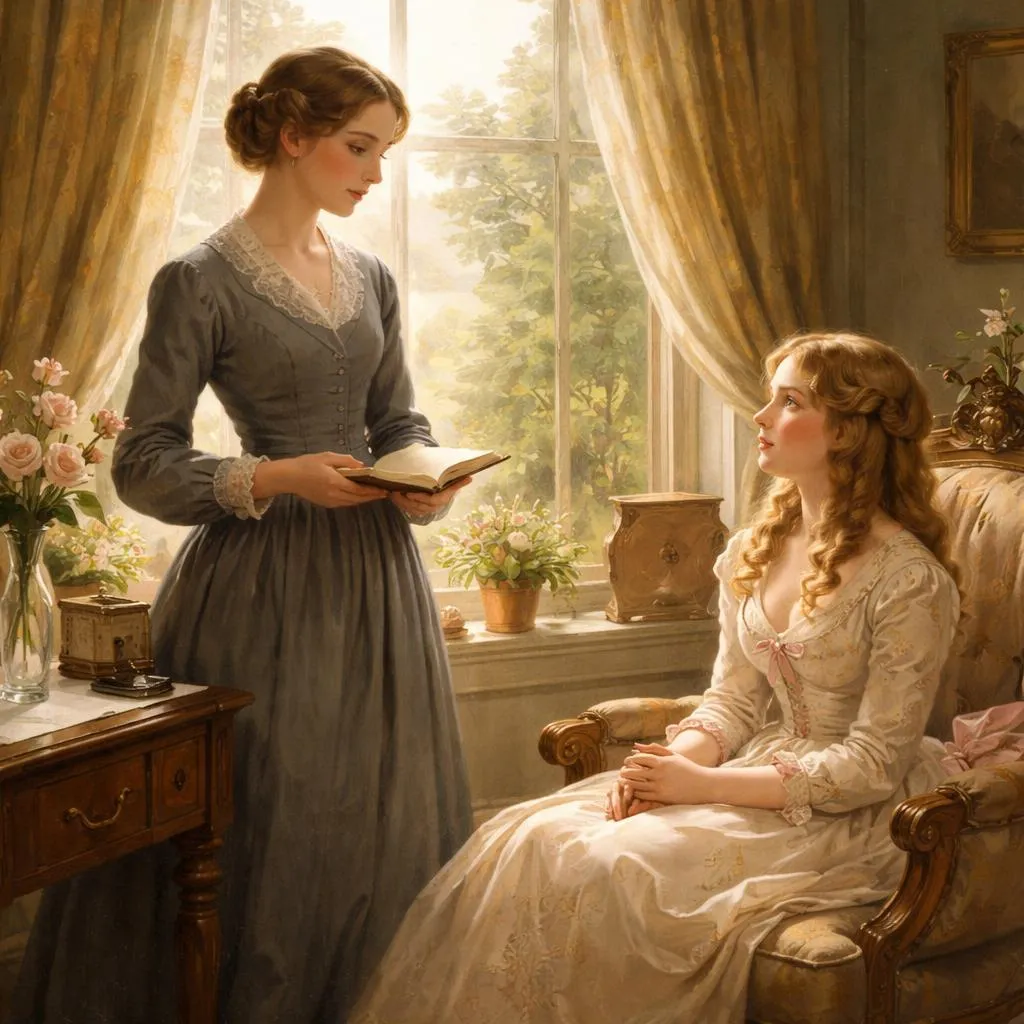

Next Sunday was one of the gloomiest of April days—a day of thick, dark clouds, and heavy showers. None of the Murrays were disposed to attend church in the afternoon, excepting Rosalie: she was bent upon going as usual; so she ordered the carriage, and I went with her: nothing loth, of course, for at church I might look without fear of scorn or censure upon a form and face more pleasing to me than the most beautiful of God’s creations; I might listen without disturbance to a voice more charming than the sweetest music to my ears; I might seem to hold communion with that soul in which I felt so deeply interested, and imbibe its purest thoughts and holiest aspirations, with no alloy to such felicity except the secret reproaches of my conscience, which would too often whisper that I was deceiving my own self, and mocking God with the service of a heart more bent upon the creature than the Creator.
Sometimes, such thoughts would give me trouble enough; but sometimes I could quiet them with thinking—it is not the man, it is his goodness that I love. ‘Whatsoever things are pure, whatsoever things are lovely, whatsoever things are honest and of good report, think on these things.’ We do well to worship God in His works; and I know none of them in which so many of His attributes—so much of His own spirit shines, as in this His faithful servant; whom to know and not to appreciate, were obtuse insensibility in me, who have so little else to occupy my heart.
Almost immediately after the conclusion of the service, Miss Murray left the church. We had to stand in the porch, for it was raining, and the carriage was not yet come. I wondered at her coming forth so hastily, for neither young Meltham nor Squire Green was there; but I soon found it was to secure an interview with Mr. Weston as he came out, which he presently did. Having saluted us both, he would have passed on, but she detained him; first with observations upon the disagreeable weather, and then with asking if he would be so kind as to come some time to–morrow to see the granddaughter of the old woman who kept the porter’s lodge, for the girl was ill of a fever, and wished to see him. He promised to do so.
‘And at what time will you be most likely to come, Mr. Weston? The old woman will like to know when to expect you—you know such people think more about having their cottages in order when decent people come to see them than we are apt to suppose.’
Here was a wonderful instance of consideration from the thoughtless Miss Murray. Mr. Weston named an hour in the morning at which he would endeavour, to be there. By this time the carriage was ready, and the footman was waiting, with an open umbrella, to escort Miss Murray through the churchyard. I was about to follow; but Mr. Weston had an umbrella too, and offered me the benefit of its shelter, for it was raining heavily.
‘No, thank you, I don’t mind the rain,’ I said. I always lacked common sense when taken by surprise.
‘But you don’t LIKE it, I suppose?—an umbrella will do you no harm at any rate,’ he replied, with a smile that showed he was not offended; as a man of worse temper or less penetration would have been at such a refusal of his aid. I could not deny the truth of his assertion, and so went with him to the carriage; he even offered me his hand on getting in: an unnecessary piece of civility, but I accepted that too, for fear of giving offence. One glance he gave, one little smile at parting—it was but for a moment; but therein I read, or thought I read, a meaning that kindled in my heart a brighter flame of hope than had ever yet arisen.
‘I would have sent the footman back for you, Miss Grey, if you’d waited a moment—you needn’t have taken Mr. Weston’s umbrella,’ observed Rosalie, with a very unamiable cloud upon her pretty face.
‘I would have come without an umbrella, but Mr. Weston offered me the benefit of his, and I could not have refused it more than I did without offending him,’ replied I, smiling placidly; for my inward happiness made that amusing, which would have wounded me at another time.
The carriage was now in motion. Miss Murray bent forwards, and looked out of the window as we were passing Mr. Weston. He was pacing homewards along the causeway, and did not turn his head.
‘Stupid ass!’ cried she, throwing herself back again in the seat. ‘You don’t know what you’ve lost by not looking this way!’
‘What has he lost?’
‘A bow from me, that would have raised him to the seventh heaven!’
I made no answer. I saw she was out of humour, and I derived a secret gratification from the fact, not that she was vexed, but that she thought she had reason to be so. It made me think my hopes were not entirely the offspring of my wishes and imagination.
‘I mean to take up Mr. Weston instead of Mr. Hatfield,’ said my companion, after a short pause, resuming something of her usual cheerfulness. ‘The ball at Ashby Park takes place on Tuesday, you know; and mamma thinks it very likely that Sir Thomas will propose to me then: such things are often done in the privacy of the ball–room, when gentlemen are most easily ensnared, and ladies most enchanting. But if I am to be married so soon, I must make the best of the present time: I am determined Hatfield shall not be the only man who shall lay his heart at my feet, and implore me to accept the worthless gift in vain.’
‘If you mean Mr. Weston to be one of your victims,’ said I, with affected indifference, ‘you will have to make such overtures yourself that you will find it difficult to draw back when he asks you to fulfil the expectations you have raised.’
‘I don’t suppose he will ask me to marry him, nor should I desire it: that would be rather too much presumption! but I intend him to feel my power. He has felt it already, indeed: but he shall ACKNOWLEDGE it too; and what visionary hopes he may have, he must keep to himself, and only amuse me with the result of them—for a time.’
‘Oh! that some kind spirit would whisper those words in his ear,’ I inwardly exclaimed. I was far too indignant to hazard a reply to her observation aloud; and nothing more was said about Mr. Weston that day, by me or in my hearing. But next morning, soon after breakfast, Miss Murray came into the schoolroom, where her sister was employed at her studies, or rather her lessons, for studies they were not, and said, ‘Matilda, I want you to take a walk with me about eleven o’clock.’
‘Oh, I can’t, Rosalie! I have to give orders about my new bridle and saddle–cloth, and speak to the rat–catcher about his dogs: Miss Grey must go with you.’
‘No, I want you,’ said Rosalie; and calling her sister to the window, she whispered an explanation in her ear; upon which the latter consented to go.
I remembered that eleven was the hour at which Mr. Weston proposed to come to the porter’s lodge; and remembering that, I beheld the whole contrivance. Accordingly, at dinner, I was entertained with a long account of how Mr. Weston had overtaken them as they were walking along the road; and how they had had a long walk and talk with him, and really found him quite an agreeable companion; and how he must have been, and evidently was, delighted with them and their amazing condescension, &c. &c.
Antecedentes e Introducción del Autor
Este pasaje es de una novela clásica del siglo XIX, que refleja las costumbres sociales, las relaciones y los pensamientos internos de sus personajes durante esa época. La historia está ambientada en una época en la que el estatus social, el cortejo y las apariencias desempeñaban un papel importante en la vida diaria, especialmente entre la nobleza. La autora, cuya identidad no se menciona explícitamente aquí, es probablemente una escritora que explora temas de amor, moralidad y expectativas sociales, a menudo centrándose en los conflictos internos de las mujeres jóvenes que navegan por la sociedad.
Interpretación Detallada y Significado
La escena describe una lluviosa tarde de domingo en la que Rosalie, un personaje decidido, insiste en asistir a la iglesia a pesar del sombrío clima. La narradora, que está profundamente conmovida por la presencia y la voz del Sr. Weston, experimenta una mezcla de admiración y conflicto interno. Lucha con sentimientos de afecto y culpa, dividida entre la devoción espiritual y los deseos terrenales.
El comportamiento de la señorita Murray contrasta marcadamente con la sinceridad de la narradora. Rosalie es retratada como algo vanidosa y manipuladora, con el objetivo de atraer la atención del Sr. Weston para su propia ventaja social. Esta tensión entre el sentimiento genuino y la ambición superficial es un tema central, que ilustra las diferentes formas en que las personas se acercan a las relaciones y a la autoestima.
La historia también destaca las costumbres sociales de la época, como la importancia de las apariencias, el papel de la iglesia como reunión social y los sutiles juegos de poder en el cortejo. Las reflexiones de la narradora sobre la bondad y la pureza sugieren una lección moral sobre la valoración de las cualidades internas por encima del encanto exterior.
Lecciones y Perspectivas para los Estudiantes
-
Comprender el Conflicto Interno: La lucha de la narradora enseña a los estudiantes sobre la complejidad de las emociones humanas, especialmente al equilibrar los deseos personales con las creencias éticas o espirituales. Reconocer tales conflictos ayuda a desarrollar la inteligencia emocional.
-
Observar la Dinámica Social: El contraste entre los personajes muestra cómo el estatus social y las ambiciones personales influyen en el comportamiento. Los estudiantes pueden aprender a identificar las motivaciones detrás de las acciones y a comprender el impacto de las expectativas sociales.
-
Apreciar las Cualidades Genuinas: La admiración de la narradora por la bondad del Sr. Weston por encima de su apariencia fomenta la valoración del carácter y la bondad en los demás, una lección atemporal para construir relaciones significativas.
-
Pensamiento Crítico sobre las Apariencias: Las tácticas manipuladoras de Rosalie sirven como un ejemplo de advertencia sobre los peligros de la superficialidad y el engaño. Los estudiantes pueden reflexionar sobre la importancia de la autenticidad en las amistades y las interacciones sociales.
Aplicación de Estas Lecciones en la Vida y el Aprendizaje
-
En la Escuela: Los estudiantes pueden practicar la empatía considerando los sentimientos y las motivaciones de los demás antes de juzgarlos. También pueden reflexionar sobre sus propios valores y esforzarse por actuar con integridad.
-
En Entornos Sociales: Comprender que las personas pueden tener razones ocultas para su comportamiento ayuda a gestionar las amistades y los conflictos con mayor sabiduría. Reconocer la bondad genuina frente al encanto superficial puede guiar mejores decisiones en las relaciones.
-
En el Crecimiento Personal: La introspección de la narradora fomenta la autoconciencia. Los estudiantes pueden aprender a escuchar su conciencia y a equilibrar sus emociones con la razón y la ética.
Cultivar Rasgos Positivos de la Historia
-
Honestidad y Sinceridad: Emular las reflexiones honestas y los sentimientos genuinos de la narradora en lugar de adoptar comportamientos manipuladores.
-
Respeto por los Demás: Al igual que el respeto de la narradora por la bondad del Sr. Weston, los estudiantes deben apreciar las cualidades internas de los demás más allá de las apariencias.
-
Autorreflexión: Pensar regularmente en los propios motivos y sentimientos para crecer emocional y moralmente.
-
Amabilidad y Consideración: Observar cómo el momento de reflexión de la señorita Murray sobre la cabaña de la anciana demuestra que incluso las personas aparentemente desconsideradas pueden aprender a ser consideradas. Los pequeños actos de bondad importan.
Conclusión
Este pasaje ofrece un rico material para que los jóvenes lectores exploren temas de amor, moralidad, expectativas sociales y autoconciencia. Al analizar las acciones y los pensamientos internos de los personajes, los estudiantes pueden obtener valiosas perspectivas sobre la naturaleza humana y desarrollar habilidades que les ayuden a navegar por sus propios mundos sociales con empatía, integridad y sabiduría.
