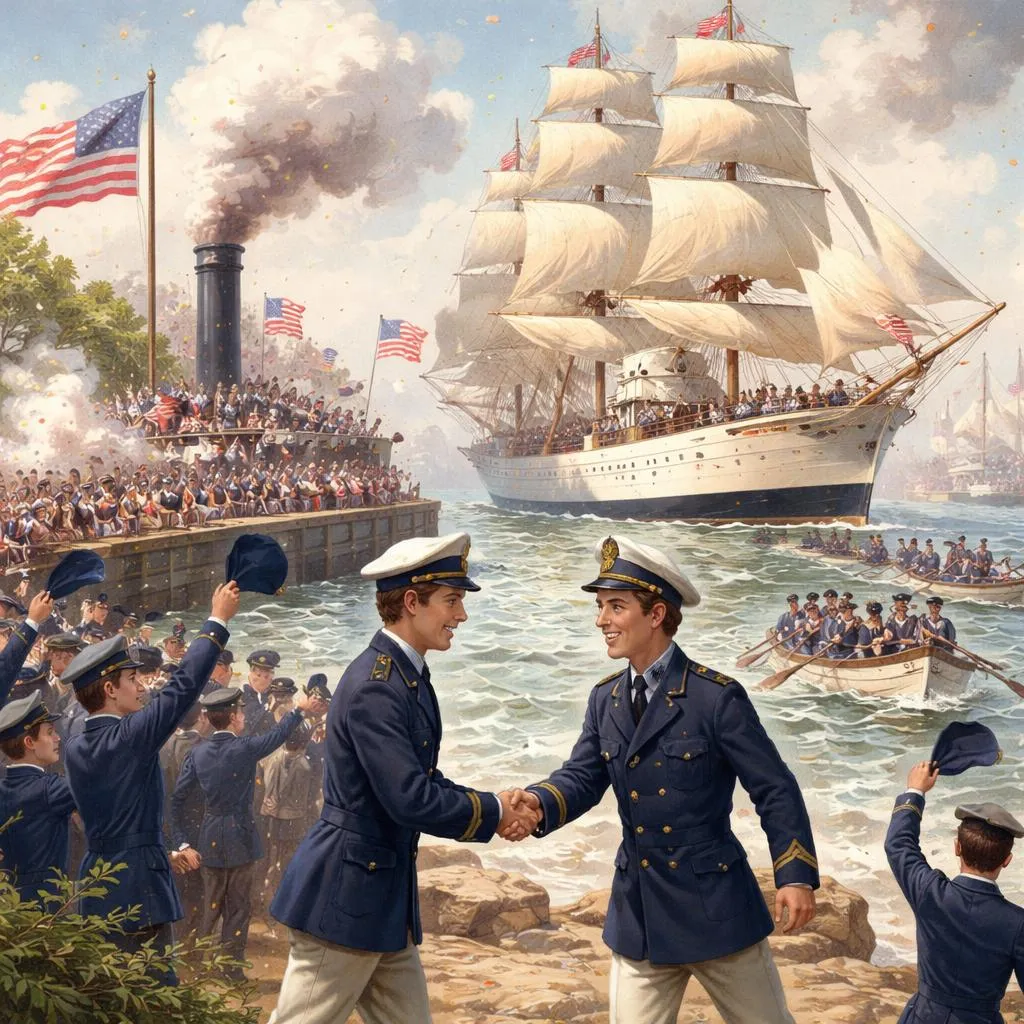

The kindly expressions of feeling which passed between the hosts and their guests were far from being mere compliments, for the Confederate commander and surgeon had made themselves very agreeable. Quite a number of pleasant parties had been given in compliment to them and Christy. But the family felt that they owed a debt of gratitude to their guests which they could not repay; and enemies though they were, the most eminent personages on the Federal side could not have been better treated.
“I am sorry you are going, though I congratulate you on the prospect now before you of returning to your friends,” said Captain Passford, after the conversation had continued for half an hour. “But I did not come in to receive your adieus; only to introduce to you, and to Mrs. Passford and Florry, a new character, who has just stepped upon the stage of action.”
“Draw it mild, papa,” interposed Christy, shrugging his shoulders.
“I have the pleasure of presenting to you Lieutenant-Commander Christopher Passford.”
Captain Rombold and Dr. Davidson set to clapping their hands as though they had suddenly gone crazy. When the former had nearly blistered his own, he rushed to the newly-promoted, and grasped his hands with a pressure which made the recipient of his warm greeting squirm with pain.
“I congratulate you with all my heart and mind, Commander Passford,” he added, with exceeding warmth. “I know that you deserved this promotion, and I was sure you would get it from the moment I saw you in the mizzen rigging of the Bellevite, and within the same minute leaping over the rail of the Tallahatchie, closely followed by thirty or forty of your seamen. I lost all hope of taking your ship then, for almost at the same instant came the discharge of the thirty-pounder I had prepared to lay low half your boarders. I told you this would come, but you seemed to be doubtful of it; and I repeat what I have said before, that God makes some fully-developed men before they are twenty-one.”
The surgeon followed the example of his fellow-prisoner; and then Christy’s mother and sister hugged and kissed him, and he heartily returned their affectionate embraces.
“I have only to add that my son has been appointed to the command of the St. Regis, a steamer of over eight hundred tons, and reputed to have a speed of twenty knots an hour, though I have some doubts in regard to the last item,” said Captain Passford.
“I cannot wish him success in his new command, for that would be treason; but I have no doubt he will damage our cause even more than he has in the past; and so far as he is personally concerned, I can wish him success with all my heart,” added Captain Rombold. “I have kept a list of the names of the vessels in the Federal navy so far as I could obtain them; but it does not include the St.— What you call her? I never heard the name before.”
“The St. Regis, after a river in the Adirondacks,” said Captain Passford, laughing. “But I can assure you, Captain, that you know her better than any of the rest of us, for I never even saw her.”
“The St. Regis?” interrogated the commander, puzzled by the assertion.
“Just now this steamer is something like a newly-married widow, for she is entering upon her third name,” continued the host, very lightly. "Formerly she was the Trafalgar, a highly honored name in British history; but more recently she received the name of Tallahatchie; and now she becomes the St. Regis.”
“I see,” replied the Confederate commander, evidently trying to hide his intense chagrin that the magnificent steamer, purchased by Colonel Homer Passford for him, had so soon become a ship belonging to the Federal navy. “You expressed a doubt in regard to her speed, my dear Captain.”
“I simply doubted if she could make twenty knots an hour, for the Bellevite overhauled her without difficulty.”
“That was because our coal was very bad. The Trafalgar made twenty knots an hour several times when she was under my command.”
“So much the better, Captain; if the speed is in her, her new engineer will get it out of her,” replied the host. “But I must take the next train for New York, and I am going over to see the St. Regis, for she has been put in the best of repair. Perhaps you would like to go with me, Christy.”
“I should, father; I was expecting Charley Graines over this morning, and he would like to see his future home on the deep,” replied the lieutenant-commander.
“He is in the reception-room now, waiting to see you,” said Florry.
“I have his appointment in my pocket, and you may give it to him, my son,” added the captain.
The guests were not to leave at once, and the trio hastened to the train. As soon as they were seated, Christy gave his friend the envelope containing his appointment, and Charley Graines was quite as happy as the future commander of the St. Regis. On the way the latter gave the other all the news that had come out that morning.
“I suppose Paul Vapoor will not come on board till we get to the Gulf, father,” said Christy.
“You will receive your orders to-morrow, as you have been advised; and though I cannot properly inform you where you will be bound, I can tell you where you are not bound; you are not going to the Gulf of Mexico,” answered Captain Passford.
“Not to the Gulf? All my service so far in blockaders has been in the Gulf, and this will be a tremendous change for me. But where shall we pick up our chief engineer?”
“About all the business growing out of the capture of the Tallahatchie, including the promotions, was done very nearly four weeks ago. I was in Washington when Captain Breaker’s very full report came, and the officers were promoted then. The appointments were also made then; but I have been obliged, for reasons not necessary to be named, to keep them to myself. The steamer that carried a cargo of coal, provisions, and stores to the Eastern Gulf squadron, was the bearer of Paul’s appointment to the St. Regis, and Mr. Bolter’s commission as chief engineer of the Bellevite. Your friend was ordered to report at the Brooklyn Navy Yard at once. The steamer in which he came put in at Delaware Breakwater, short of coal. He will be here by to-morrow morning, or sooner.”
After a visit at his office Captain Passford and his companions proceeded to the navy yard. The St. Regis was off the shore at anchor. She was a magnificent steamer; and the captain indulged in an exclamation, which he seldom did, when she was pointed out to him. She was all ready for sea, and would go into commission as soon as her commander presented himself. They went on board of her, and were heartily welcomed by such officers as had already occupied their staterooms.
Captain Passford went all over her, accompanied by Christy, while the new first assistant engineer confined his attention to the engine. The lieutenant-commander informed the proper officer of the yard that he would hoist the flag on board of the St. Regis at noon the next day. The party took their leave, and in the afternoon returned to Bonnydale.
The guests were now relieved from their parole, and they took their leave before night, with a repetition of the good wishes which had been expressed before. The next morning Christy was at the railroad station on the arrival of the train from New York, and the first person that rushed into his arms like a school-girl was Paul Vapoor. Of course Christy was delighted to see him, but he kept watching the steps of the principal car all the time. At last he discovered Bertha Pembroke, and he rushed to her, leaving Paul talking into the air.
He grasped the beautiful maiden by both hands, and both of them blushed like a carnation pink. The young officer was not given to demonstrations in public, and he reserved them to a more suitable occasion. He picked up her hand-bag and bundles which she had dropped when the lover took possession of her, and conducted her to his father’s carriage.
Christy presented her to Paul, who had heard much about her, but had never seen her. He was simply polite, though there was mischief in his eye, and the commander was in danger of being teased very nicely when they were alone together. Both Bertha and Paul were cordially welcomed by Mrs. Passford and Florry, and Christy needed nothing more to complete his happiness.
But there was no time to spare, and Captain Passford hurried them without mercy, and without considering that the lovers had not met before for several months; but the commander of the St. Regis was to hoist his flag at noon, and there was no room for long speeches. Christy and Paul hurried themselves into their new uniforms, not made for the occasion, but kept in store. The engineer’s uniform was all right as it was, for he had before reached the top of the ladder in his profession, but Flurry had changed the shoulder-straps of her brother.
Captain Passford was not remorseless in separating the newly reunited friends; for Paul and Flora had done some blushing, and had crept away into a corner of the great drawing-room as soon as he had put on his best uniform, and he finally insisted that all the ladies should go to the navy yard and witness the ceremony. The company were rather late; but the captain had sent a man to the station in advance, and the train was held for them.
It is hardly necessary to state in what manner the seats in the car were occupied; but the captain and Mrs. Passford had to sit together. A navy yard tugboat was at the foot of Grand Street on the arrival of the party, for it had been telegraphed for early in the morning. Captain Passford was a very distinguished magnate in the eyes of all naval officers, not only on account of his great wealth, but because he was the most influential man in the city at the department.
Half an hour before the time the party were on the deck of the St. Regis. All the officers were now on board; and while Paul was showing the ladies over the vessel, the commander was renewing his acquaintance with Mr. Baskirk, the executive officer. His father introduced Mr. Makepeace to him; and he found him a sturdy old salt, without as much polish as many of the officers, but a gentleman in every respect.
“I am very glad to know you, Captain Passford,” said Mr. Makepeace. “We have one of the most brilliant commanders in the service, and I suppose he will make things hum on board of the St. Regis, if we get into action, as we are likely to do under his lead.”
“I shall try to do my whole duty, and I shall endeavor not to make any sensation about it,” replied Christy, as he turned from the second to greet the third lieutenant, Mr. Drake, who had been his shipmate on board of the Bellevite, and the commander of the Tallahatchie while he was a passenger on board.
The ship’s company had already been mustered on deck. They were dressed in their best uniforms, and they were a fine-looking set of men. They had all heard of Lieutenant Passford, and they were proud and happy to serve under his command. Promptly at noon, as the church bells on shore were striking the hour, Commander Passford mounted a dais, and his commission was read to the ship’s company. He then made a short speech suited to the occasion, and ordered the colors to be run up to the peak. The ship was then in commission, and she was to sail on the tide the next day. The subordinate officers and seamen then gave three cheers, in which every person seemed to put his whole heart.
Christy conducted Bertha to the captain’s cabin, which had been restored to its original condition and refurnished. A lunch was served to the whole party under an awning on the quarter-deck. Mr. Drake, an eye-witness and actor in the battle, fought it over for the benefit of the ladies; and before night they all returned to Bonnydale, where it required at least three rooms to accommodate them during the evening.
Antecedentes e Introducción del Autor
Este extracto proviene de una historia clásica de aventuras navales ambientada durante la Guerra Civil estadounidense, un período marcado por un intenso conflicto entre la Unión (Federal) y la Confederación. La narrativa gira en torno a oficiales navales, sus amistades, ascensos y los desafíos de la guerra en el mar. Historias como esta fueron populares a finales del siglo XIX y principios del XX, a menudo escritas por autores fascinados por la vida marítima y el honor militar. El autor, aunque no se nombra aquí, probablemente tenía un profundo conocimiento de las operaciones navales y buscaba retratar las complejidades de la lealtad, el coraje y el deber en tiempos de guerra.
Interpretación Detallada y Significado
La historia destaca temas de respeto y camaradería incluso entre enemigos, como se ve en las cálidas interacciones entre los oficiales confederados y federales. A pesar de sus bandos opuestos, muestran admiración y amabilidad mutuas, lo que sugiere que el honor personal y la decencia humana pueden trascender el conflicto. El ascenso del teniente comandante Christopher Passford simboliza el mérito y el valor, mientras que la descripción detallada de los barcos y los procedimientos navales sumerge a los lectores en el mundo marítimo.
La narrativa también toca la naturaleza agridulce de la guerra: la alegría del reencuentro, el orgullo por el logro y la tristeza de la separación. Personajes como Christy y Paul encarnan la dedicación juvenil y la carga de la responsabilidad. El escenario de la historia a bordo de magníficos barcos de vapor como el St. Regis refleja el progreso tecnológico y la importancia estratégica del poder naval.
Lecciones e Ideas para Estudiantes
-
Respeto a través de las Diferencias: La historia enseña que el respeto y la amabilidad deben extenderse incluso a aquellos que podemos considerar adversarios. Esta es una valiosa lección de empatía y comprensión en los diversos entornos sociales actuales.
-
Coraje y Deber: Los personajes demuestran valentía y compromiso con sus roles. Los estudiantes pueden aprender la importancia de tomarse en serio la responsabilidad y esforzarse por dar lo mejor de sí en cualquier tarea.
-
Amistad y Lealtad: Los lazos entre personajes como Christy, Paul y Bertha muestran cómo la amistad y el apoyo son cruciales, especialmente en tiempos difíciles. Construir relaciones sólidas y confiables es clave para el crecimiento personal.
-
Adaptabilidad y Cambio: El cambio de nombre y la readaptación de los barcos simbolizan el cambio y la adaptación. Los estudiantes pueden reflexionar sobre cómo la flexibilidad y la resiliencia ayudan a navegar por las incertidumbres de la vida.
Aplicando Estas Lecciones en la Vida Diaria
-
En el Aprendizaje: Emular la dedicación de los personajes abordando los estudios con disciplina y entusiasmo. Comprender que el progreso a menudo requiere persistencia y coraje.
-
En Situaciones Sociales: Practicar la empatía tratando de ver las situaciones desde la perspectiva de los demás, incluso aquellos con diferentes opiniones o antecedentes.
-
En el Crecimiento Personal: Construir amistades confiables y redes de apoyo. Al igual que los personajes que confían unos en otros, los estudiantes deben valorar la colaboración y la amabilidad.
-
Al Enfrentar Desafíos: Aceptar el cambio como una oportunidad de crecimiento. Desarrollar la resiliencia aprendiendo de los contratiempos y adaptándose a las nuevas circunstancias.
Cultivando Rasgos Positivos de la Historia
-
Honor e Integridad: Mantener la honestidad y la justicia en todas las acciones, tal como los oficiales mantienen su dignidad a pesar de la guerra.
-
Valentía: Afrontar los desafíos con confianza y la voluntad de aprender, incluso cuando las situaciones son difíciles.
-
Compasión: Mostrar amabilidad a los demás, reconociendo la humanidad compartida más allá de las diferencias.
-
Liderazgo: Aprender a liderar con el ejemplo, como lo hace Christy, inspirando a otros a través de acciones en lugar de solo palabras.
Conclusión
Esta historia naval ofrece un rico material para la reflexión sobre los valores humanos, la historia y el desarrollo personal. Al interactuar con sus personajes y temas, los estudiantes pueden obtener información sobre el coraje, el respeto y la amistad que son aplicables en la escuela, la vida social y más allá. El cuento anima a los jóvenes lectores a afrontar los desafíos de la vida con honor y amabilidad, construyendo una base para un futuro significativo y exitoso.
