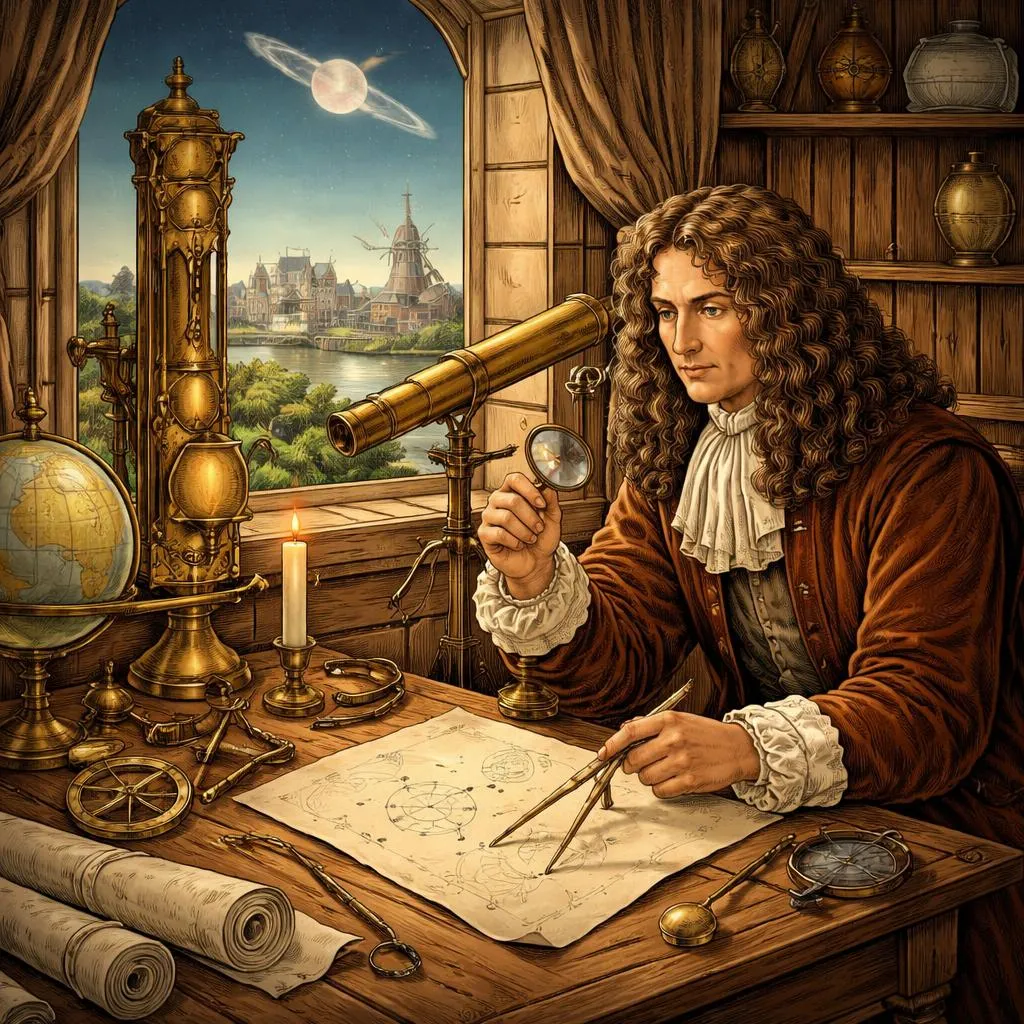

Christian Huygens was born at the Hague on April 14, 1629, and died in the same town on July 8, 1695. He generally wrote his name as Hugens, but I follow the usual custom in spelling it as above: it is also sometimes written as Huyghens. His life was uneventful, and there is little more to record in it than a statement of his various memoirs and researches.
In 1651 he published an essay in which he shewed the fallacy in a system of quadratures proposed by Grégoire de Saint-Vincent, who was well versed in the geometry of the Greeks, but had not grasped the essential points in the more modern methods. This essay was followed by tracts on the quadrature of the conics and the approximate rectification of the circle.
In 1654 his attention was directed to the improvement of the telescope. In conjunction with his brother he devised a new and better way of grinding and polishing lenses. As a result of these improvements he was able during the following two years, 1655 and 1656, to resolve numerous astronomical questions; as, for example, the nature of Saturn's appendage. His astronomical observations required some exact means of measuring time, and he was thus led in 1656 to invent the pendulum clock, as described in his tract Horologium , 1658. The time-pieces previously in use had been balance-clocks.
In the year 1657 Huygens wrote a small work on the calculus of probabilities founded on the correspondence of Pascal and Fermat. He spent a couple of years in England about this time. His reputation was now so great that in 1665 Louis XIV offered him a pension if he would live in Paris, which accordingly then became his place of residence.
In 1668 he sent to the Royal Society of London, in answer to a problem they had proposed, a memoir in which (simultaneously with Wallis and Wren) he proved by experiment that the momentum in a certain direction before the collision of two bodies is equal to the momentum in that direction after the collision. This was one of the points in mechanics on which Descartes had been mistaken.
The most important of Huygens's work was his Horologium Oscillatorium published at Paris in 1673. The first chapter is devoted to pendulum clocks. The second chapter contains a complete account of the descent of heavy bodies under their own weights in a vacuum, either vertically down or on smooth curves. Amongst other propositions he shews that the cycloid is tautochronous. In the third chapter he defines evolutes and involutes, proves some of their more elementary properties, and illustrates his methods by finding the evolutes of the cycloid and the parabola. These are the earliest instances in which the envelope of a moving line was determined. In the fourth chapter he solves the problem of the compound pendulum, and shews that the centres of oscillation and suspension are interchangeable. In the fifth and last chapter he discusses again the theory of clocks, points out that if the bob of the pendulum were, by means of cycloidal clocks, made to oscillate in a cycloid the oscillations would be isochronous; and finishes by shewing that the centrifugal force on a body which moves around a circle of radius r with a uniform velocity v varies directly as v 2 and inversely as r . This work contains the first attempt to apply dynamics to bodies of finite size, and not merely to particles.
In 1675 Huygens proposed to regulate the motion of watches by the use of the balance spring, in the theory of which he had been perhaps anticipated in a somewhat ambiguous and incomplete statement made by Hooke in 1658. Watches or portable clocks had been invented early in the sixteenth century, and by the end of that century were not very uncommon, but they were clumsy and unreliable, being driven by a main spring and regulated by a conical pulley and verge escapement; moreover, until 1687 they had only one hand. The first watch whose motion was regulated by a balance spring was made at Paris under Huygens's directions, and presented by him to Louis XIV.
The increasing intolerance of the Catholics led to his return to Holland in 1681, and after the revocation of the edict of Nantes he refused to hold any further communication with France. He now devoted himself to the construction of lenses of enormous focal length: of these three of focal lengths 123 feet, 180 feet, and 210 feet, were subsequently given by him to the Royal Society of London, in whose possession they still remain. It was about this time that he discovered the achromatic eye-piece (for a telescope) which is known by his name. In 1689 he came from Holland to England in order to make the acquaintance of Newton, whose Principia had been published in 1687. Huygens fully recognized the intellectual merits of the work, but seems to have deemed any theory incomplete which did not explain gravitation by mechanical means.
On his return in 1690 Huygens published his treatise on light in which the undulatory theory was expounded and explained. Most of this had been written as early as 1678. The general idea of the theory had been suggested by Robert Hooke in 1664, but he had not investigated its consequences in any detail. Only three ways have been suggested in which light can be produced mechanically. Either the eye may be supposed to send out something which, so to speak, feels the object (as the Greeks believed); or the object perceived may send out something which hits or affects the eye (as assumed in the emission theory); or there may be some medium between the eye and the object, and the object may cause some change in the form or condition of this intervening medium and thus affect the eye (as Hooke and Huygens supposed in the wave or undulatory theory). According to this last theory space is filled with an extremely rare ether, and light is caused by a series of waves or vibrations in this ether which are set in motion by the pulsations of the luminous body. From this hypothesis Huygens deduced the laws of reflexion and refraction, explained the phenomenon of double refraction, and gave a construction for the extraordinary ray in biaxal crystals; while he found by experiment the chief phenomena of polarization.
The immense reputation and unrivalled powers of Newton led to disbelief in a theory which he rejected, and to the general adoption of Newton's emission theory. Within the present century crucial experiments have been devised which give different results according as one or the other theory is adopted; all these experiments agree with the results of the undulatory theory and differ from the results of the Newtonian theory; the latter is therefore untenable. Until, however, the theory of interference, suggested by Young, was worked out by Fresnel, the hypothesis of Huygens failed to account for all the facts, and even now the properties which, under it, have to be attributed to the intervening medium or ether involve difficulties of which we still seek a solution. Hence the problem as to how the effects of light are really produced cannot be said to be finally solved.
Besides these works Huygens took part in most of the controversies and challenges which then played so large a part in the mathematical world, and wrote several minor tracts. In one of these he investigated the form and properties of the catenary. In another he stated in general terms the rule for finding maxima and minima of which Fermat had made use, and shewed that the subtangent of an algebraical curve f ( x,y ) = 0 was equal to yf y / f x , where f y is the derived function of f ( x,y ) regarded as a function of y . In some posthumous works, issued at Leyden in 1703, he further shewed how from the focal lengths of the component lenses the magnifying power of a telescope could be determined; and explained some of the phenomena connected with haloes and parhelia.
I should add that almost all his demonstrations, like those of Newton, are rigidly geometrical, and he would seem to have made no use of the differential or fluxional calculus, though he admitted the validity of the methods used therein. Thus, even when first written, his works were expressed in an archaic language, and perhaps received less attention than their intrinsic merits deserved.
Antecedentes e introducción del autor
Christian Huygens fue un brillante científico y matemático holandés del siglo XVII, una época en la que el mundo expandía rápidamente su comprensión de la ciencia y el universo. Nacido en 1629 en La Haya, Huygens vivió durante la Revolución Científica, una era marcada por descubrimientos e inventos revolucionarios. Su trabajo abarcó muchos campos, incluyendo la astronomía, la física, las matemáticas y la horología (la ciencia de la medición del tiempo). A pesar de vivir en un período en el que las tensiones religiosas y políticas eran altas, Huygens dedicó su vida a la investigación científica y la innovación.
Huygens es mejor conocido por inventar el reloj de péndulo, que mejoró enormemente la precisión de la medición del tiempo, y por su teoría ondulatoria de la luz, que sentó las bases de la óptica moderna. Sus contribuciones a la mecánica, especialmente sus estudios sobre el movimiento de los cuerpos y las colisiones, desafiaron ideas anteriores y ayudaron a formar los cimientos de la física clásica.
Explicación detallada y significado de la obra de Huygens
La vida y obra de Huygens ilustran el poder de la curiosidad y la observación cuidadosa. Sus mejoras en el telescopio permitieron a los astrónomos ver los cuerpos celestes con mayor claridad, lo que llevó a una mejor comprensión de planetas como Saturno. Al inventar el reloj de péndulo, resolvió un problema crítico en la medición precisa del tiempo, un avance que fue esencial para la navegación y los experimentos científicos.
Una de sus obras más importantes, Horologium Oscillatorium, es una obra maestra de la escritura científica que combina la teoría y la aplicación práctica. En ella, Huygens explica cómo se mueven los péndulos y cómo este movimiento puede utilizarse para regular los relojes. También exploró las propiedades de curvas como la cicloide, que tiene la propiedad única del tautocronismo, lo que significa que los objetos que se deslizan por ella tardan el mismo tiempo independientemente de su punto de partida. Este descubrimiento no solo fue matemáticamente hermoso, sino también prácticamente útil en el diseño de relojes.
La teoría ondulatoria de la luz de Huygens fue revolucionaria. En una época en que la teoría corpuscular de la luz de Isaac Newton era dominante, Huygens propuso que la luz viaja en ondas a través de un medio llamado éter. Esta idea explicaba muchos fenómenos ópticos como la reflexión, la refracción y la polarización mejor que la teoría de Newton. Aunque tardaron siglos en aceptarse por completo las ideas de Huygens, hoy en día forman la base de la física y la óptica modernas.
Qué pueden aprender los estudiantes de la historia de Huygens
-
La importancia de la curiosidad y la persistencia
La vida de Huygens enseña a los estudiantes que el progreso científico a menudo proviene de hacer preguntas y probar ideas cuidadosamente. Su trabajo sobre relojes, luz y mecánica muestra cómo la curiosidad combinada con la persistencia puede conducir a avances. -
El valor del aprendizaje interdisciplinario
Huygens no se limitó a un solo campo; combinó las matemáticas, la física y la ingeniería. Este enfoque anima a los estudiantes a explorar múltiples temas y ver cómo se conectan en la vida real. -
Pensamiento crítico y desafío de ideas establecidas
Huygens desafió las teorías aceptadas de su tiempo, como las ideas de Descartes sobre las colisiones y la teoría de la luz de Newton. Esto muestra a los estudiantes la importancia del pensamiento crítico y de estar abiertos a nuevas evidencias. -
Precisión y atención al detalle
Sus mejoras en el pulido de lentes y la fabricación de relojes destacan cómo los pequeños detalles importan en el trabajo científico. Los estudiantes pueden aprender que el trabajo cuidadoso y la precisión son esenciales en cualquier disciplina.
Cómo aplicar estas lecciones en la vida diaria
- En el aprendizaje: Al estudiar, los estudiantes pueden emular el método de Huygens cuestionando lo que leen, experimentando con ideas y conectando diferentes temas como las matemáticas y la ciencia para profundizar su comprensión.
- En la resolución de problemas: Ya sea en proyectos escolares o en desafíos cotidianos, los estudiantes no deben tener miedo de pensar de manera diferente o probar nuevos enfoques, tal como lo hizo Huygens con sus inventos.
- En las interacciones sociales: La paciencia y la persistencia que mostró Huygens pueden inspirar a los estudiantes a ser pacientes consigo mismos y con los demás, entendiendo que el progreso a menudo requiere tiempo y esfuerzo.
- En el crecimiento personal: Abrazar la curiosidad y el amor por el aprendizaje puede conducir a un crecimiento de por vida y a descubrimientos inesperados, tal como lo hizo Huygens.
Fomentar rasgos positivos del ejemplo de Huygens
- Curiosidad: Pregúntate siempre "por qué" y busca comprender el mundo que te rodea.
- Perseverancia: Sigue trabajando en los problemas incluso cuando las soluciones no sean inmediatamente claras.
- Mentalidad abierta: Estar dispuesto a considerar nuevas ideas, incluso si desafían lo que ya crees.
- Atención al detalle: Pon cuidado en tu trabajo y esfuérzate por la precisión.
- Pensamiento interdisciplinario: Combina conocimientos de diferentes áreas para resolver problemas complejos.
Al estudiar la vida y obra de Christian Huygens, los estudiantes no solo adquieren conocimientos sobre ciencia e historia, sino también valiosas lecciones sobre cómo abordar el aprendizaje y la vida con una mente reflexiva, persistente y abierta. Su legado nos recuerda que los grandes descubrimientos a menudo provienen de una combinación de imaginación, trabajo duro y el coraje de cuestionar el mundo tal como es.
