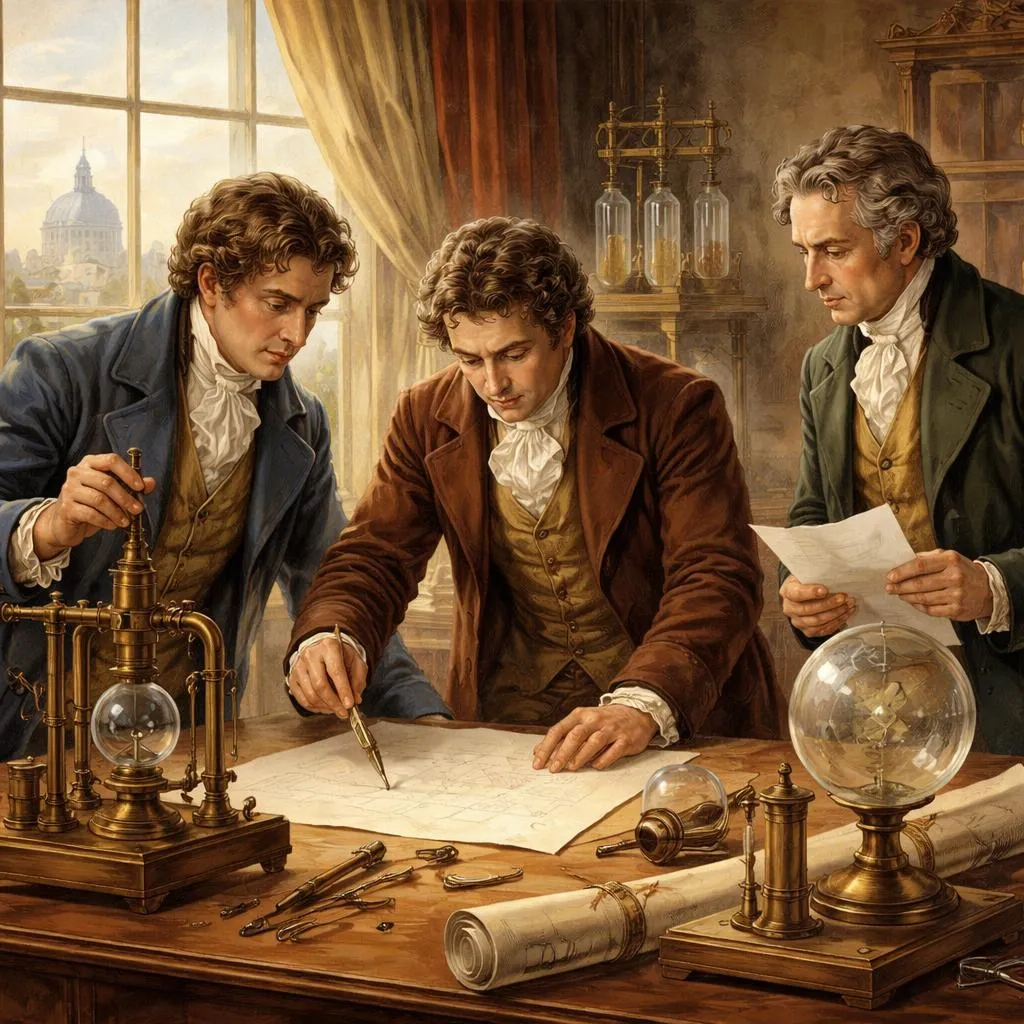

Sadi Carnot
Among Fourier's contemporaries who were interested in the theory of heat the most eminent was Sadi Carnot, a son of the eminent geometrician mentioned above. Sadi Carnot was born at Paris in 1796, and died there of cholera in August 1832; he was an officer in the French army. In 1824 he issued a short work entitled Réflexions sur la puissance motrice du feu , in which he attempted to determine in what way heat produced its mechanical effect. He made the mistake of assuming that heat was material, but his essay may be taken as initiating the modern theory of thermodynamics.
Ampère
André Marie Ampère was born at Lyons on January 22, 1775, and died at Marseilles on June 10, 1836. He was widely read in all branches of learning, and lectured and wrote on many of them, but after the year 1809, when he was made professor of analysis at the Polytechnic school in Paris, he confined himself almost entirely to mathematics and science. His papers on the connection between electricity and magnetism were written in 1820. According to his theory, propounded in 1826, a molecule of matter which can be magnetized is traversed by a closed electric current, and magnetization is produced by any cause which makes the direction of these currents in the different molecules of the body approach parallelism.
Fresnel, Biot
Augustin Jean Fresnel, born at Broglie on May 10, 1788, and died at Ville-d'Avray on July 14, 1827, was a civil engineer by profession, but he devoted his leisure to the study of physical optics. The undulatory theory of light, which Hooke, Huygens, and Euler had supported on a priori grounds, had been based on experiment by the researches of Young. Fresnel deduced the mathematical consequences of these experiments, and explained the phenomena of interference both of ordinary and polarized light. Fresnel's friend and contemporary, Jean Baptiste Biot, who was born at Paris on April 21, 1774, and died there in 1862, requires a word or two in passing. Most of his mathematical work was in connection with the subject of optics, and especially the polarization of light. His systematic works were produced within the years 1805 and 1817; a selection of his more valuable memoirs was published in Paris in 1858.
Arago
François Jean Dominique Arago was born at Estagel in the Pyrenees on February 26, 1786, and died in Paris on October 2, 1853. He was educated at the Polytechnic school, Paris, and we gather from his autobiography that however distinguished were the professors in that institution they were remarkably incapable of imparting their knowledge or maintaining discipline.
In 1804 Arago was made secretary to the observatory at Paris, and from 1806 to 1809 he was engaged in measuring a meridian arc in order to determined the exact length of a metre. He was then appointed to a leading post in the observatory, given a residence there, and made a professor at the Polytechnic school, where he enjoyed a marked success as a lecturer. He subsequently gave popular lectures on astronomy, which were both lucid and accurate ‐ a combination of qualities which was rarer then than now. He reorganized the national observatory, the management of which has long been inefficient, but in doing this his want of tact and courtesy raised many unnecessary difficulties. He remained to the end a consistent republican, and after the coup d'état of 1852, though half blind and dying, he resigned his post as astronomer rather than take the oath of allegiance. It is to the credit of Napoleon III. that he gave directions that the old man should be in no way disturbed, and should be left free to say and do what he liked.
Arago's earliest physical researches were on the pressure of steam at different temperatures, and the velocity of sound, 1818 to 1822. His magnetic observations mostly took place from 1823 to 1826. He discovered what has been called rotatory magnetism, and the fact that most bodies could be magnetized; these discoveries were completed and explained by Faraday. He warmly supported Fresnel's optical theories, and the two philosophers conducted together those experiments on the polarization of light which led to the inference that the vibrations of the luminiferous ether were transverse to the direction of motion, and that polarization consisted in a resolution of rectilinear motion into components at right angles to each other. The subsequent invention of the polariscope and discover of rotatory polarization are due to Arago. The general idea of the experimental determination of the velocity of light in the manner subsequently effected by Fizeau and Foucault was suggested by him in 1838, but his failing eyesight prevented his arranging the details or making the experiments.
It will be noticed that some of the last members of the French school were alive at a comparatively recent date, but nearly all their mathematical work was done before the year 1830. They are the direct successors of the French writers who flourished at the commencement of the nineteenth century, and seem to have been out of touch with the great German mathematicians of the early part of it, on whose researches much of the best work of that century is based; they are thus placed here, though their writings are in some cases of a later date than those of Gauss, Abel and Jacobi.
Introducciones sobre el contexto y el autor
Este texto presenta a varias figuras clave en la historia de la ciencia a finales del siglo XVIII y principios del XIX, centrándose en sus contribuciones a la física, las matemáticas y la óptica. Estos científicos, entre ellos Sadi Carnot, André Marie Ampère, Augustin Fresnel, Jean Baptiste Biot y François Arago, fueron pioneros que sentaron las bases de las teorías y tecnologías científicas modernas. Vivieron en una época en la que la ciencia evolucionaba rápidamente, y su trabajo ayudó a dar forma a campos como la termodinámica, el electromagnetismo y el estudio de la luz.
Sadi Carnot, a menudo llamado el "padre de la termodinámica", fue un oficial del ejército francés cuyo ensayo de 1824 inició la comprensión moderna de cómo el calor puede convertirse en trabajo mecánico. André Marie Ampère, matemático y físico, es conocido por su trabajo sobre la relación entre la electricidad y el magnetismo, que condujo al desarrollo del electromagnetismo. Augustin Fresnel avanzó en la teoría ondulatoria de la luz, explicando fenómenos como la interferencia y la polarización. Jean Baptiste Biot contribuyó significativamente a la óptica, especialmente en la comprensión de la luz polarizada. François Arago fue un astrónomo y físico que hizo importantes descubrimientos sobre el magnetismo y la polarización de la luz y fue conocido por su dedicación a la ciencia y a los ideales republicanos.
Interpretación detallada y significado
Las historias de estos científicos no tratan solo de sus descubrimientos, sino también del espíritu de investigación y perseverancia frente a los desafíos. Por ejemplo, la suposición de Carnot de que el calor era una sustancia material era incorrecta, pero su trabajo fue fundamental. La teoría de Ampère sobre las corrientes moleculares en la materia magnetizada fue un paso clave para la comprensión del electromagnetismo. El trabajo de Fresnel y Biot sobre la luz ayudó a confirmar la naturaleza ondulatoria de la luz, un cambio importante con respecto a las teorías anteriores de partículas.
La historia de la vida de Arago es particularmente inspiradora porque refleja tanto el logro científico como la integridad personal. A pesar de la agitación política y los problemas de salud personales, se mantuvo fiel a sus principios y al avance del conocimiento. Su colaboración con Fresnel en experimentos de polarización de la luz fue crucial para dar forma a la óptica moderna.
Lecciones y conocimientos para los estudiantes
-
Curiosidad y pensamiento crítico: Estos científicos demuestran la importancia de hacer preguntas y cuestionar las ideas existentes. Incluso cuando algunas suposiciones eran erróneas, su disposición a explorar nuevos conceptos condujo a descubrimientos.
-
Persistencia en el aprendizaje: Muchas de estas figuras se enfrentaron a dificultades, ya fueran científicas, políticas o personales, pero continuaron con su trabajo. Esto enseña a los estudiantes el valor de la perseverancia y la resiliencia.
-
Aprendizaje interdisciplinario: Los científicos combinaron conocimientos de diferentes campos (matemáticas, física, ingeniería) para resolver problemas complejos. Los estudiantes pueden aprender a integrar conocimientos en todas las materias.
-
Ética e integridad: La negativa de Arago a prestar juramento contra sus creencias nos recuerda que es importante defender los propios principios, incluso bajo presión.
-
Colaboración: La asociación entre Fresnel y Arago destaca cómo el trabajo en equipo puede conducir a mayores descubrimientos.
Aplicaciones en la vida diaria y el aprendizaje
- En el estudio: Los estudiantes pueden adoptar el hábito de cuestionar y explorar más allá de los libros de texto, como hicieron estos científicos con sus experimentos y teorías.
- En la vida social: La postura ética mostrada por Arago fomenta la defensa de lo que es correcto y la honestidad en las interacciones.
- En la resolución de problemas: La combinación de conocimientos de diversas materias, como hicieron estos científicos, puede ayudar a los estudiantes a abordar los desafíos de forma creativa.
- En el crecimiento personal: Comprender que el fracaso o los errores (como la suposición de Carnot sobre el calor) forman parte del aprendizaje puede motivar a los estudiantes a seguir intentándolo.
Cultivar rasgos positivos a partir de estas historias
- Curiosidad: Fomentar el planteamiento de "por qué" y "cómo" en la vida cotidiana.
- Resiliencia: Aprender a ver los contratiempos como oportunidades para crecer.
- Colaboración: Trabajar con compañeros para compartir ideas y resolver problemas.
- Integridad: Desarrollar una brújula moral fuerte y defender tus valores.
- Aprendizaje permanente: Aceptar el aprendizaje como un viaje continuo, no solo como una tarea escolar.
Al estudiar la vida y la obra de estos científicos pioneros, los estudiantes no solo adquieren conocimientos sobre importantes principios científicos, sino que también aprenden valiosas habilidades y actitudes para la vida que pueden ayudarles a tener éxito académica y personalmente.
