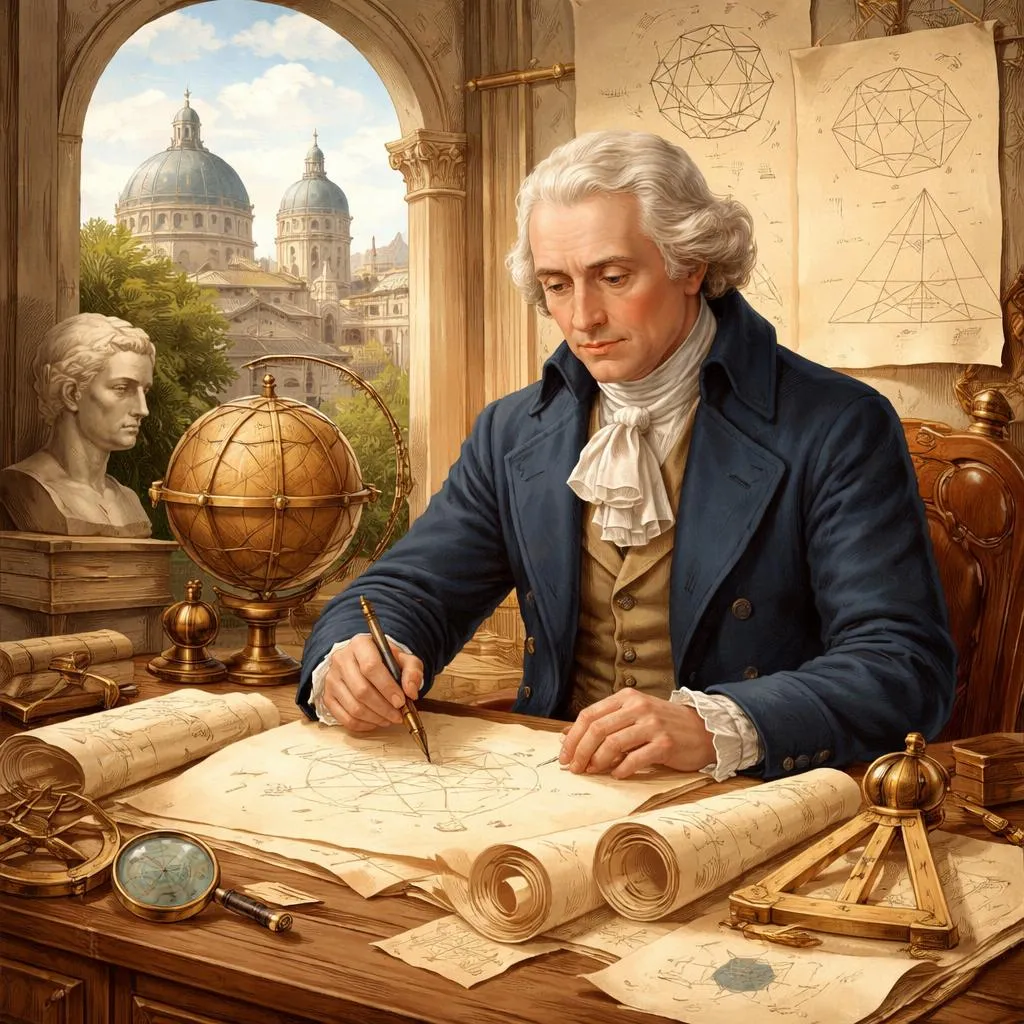

Gaspard Monge was born at Beaune on May 10, 1746, and died at Paris on July 28, 1818. He was the son of a small pedlar, and was educated in the schools of the Oratorians, in one of which he subsequently became an usher. A plan of Beaune which he had made fell into the hands of an officer who recommended the military authorities to admit him to their training school at Mézières. His birth, however, precluded his receiving a commission in the army, but his attendance at an annexe of the school where surveying and drawing were taught was tolerated, though he was told that he was not sufficiently well born to be allowed to attempt problems which required calculation. At last his opportunity came. A plan of a fortress having to be drawn from the data supplied by certain observations, he did it by a geometrical construction. At first the officer in charge refused to receive it, because etiquette required that not less than a certain time should be used in making such drawings, but the superiority of the method over that then taught was so obvious that it was accepted; and in 1768 Monge was made professor, on the understanding that the results of his descriptive geometry were to be a military secret confined to officers above a certain rank.
In 1780 he was appointed to a chair in mathematics in Paris, and this with some provincial appointments which he held gave him a comfortable income. The earliest paper of any special importance which he communicated to the French Academy was one in 1781, in which he discussed the lines of curvature drawn on a surface. These had been first considered by Euler in 1760, and defined as those normal sections whose curvature was a maximum or a minimum. Monge treated them as the locus of those points on the surface at which successive normals intersect, and thus obtained the general differential equation. He applied his results to the central quadrics in 1795. In 1786 he published his well-known work on statics.
Monge eagerly embraced the doctrines of the revolution. In 1792 he became minister of the marine, and assisted the committee of public safety in utilizing science for the defence of the republic. When the Terrorists obtained power he was denounced, and escaped the guillotine only by a hasty flight. On his return in 1794 he was made a professor at the short-lived Normal school, where he gave lectures on descriptive geometry; the notes of these were published under the regulation above alluded to. In 1796 he went to Italy on the roving commission which was sent with orders to compel the various Italian towns to offer pictures, sculpture, or other works of art that they might possess, as a present or in lieu of contributions to the French republic for removal to Paris. In 1798 he accepted a mission to Rome, and after executing it joined Napoleon in Egypt. Thence after the naval and military victories of England he escaped to France.
Monge then settled down at Paris, and was made professor at the Polytechnic school, where he gave lectures on descriptive geometry; these were published in 1800 in the form of a textbook entitled Géométrie descriptive . This work contains propositions on the form and relative position of geometrical figures deduced by the use of transversals. The theory of perspective is considered; this includes the art of representing in two dimensions geometrical objects which are of three dimensions, a problem which Monge usually solved by the aid of two diagrams, one being the plan and the other the elevation. Monge also discussed the question as to whether, if in solving a problem certain subsidiary quantities introduced to facilitate the solution become imaginary, the validity of the solution is thereby impaired, and he shewed that the result would not be affected. On the restoration he was deprived of his offices and honours, a degradation which preyed on his mind and which he did not long survive.
Most of his miscellaneous papers are embodied in his works, Application de l'algèbre à la géométrie , published in 1805, and Application de l'analyse à la géométrie , the fourth edition of which, published in 1819, was revised by him just before his death. It contains among other results his solution of a partial differential equation of the second order.
Antecedentes e introducción del autor
Gaspard Monge fue un notable matemático y científico francés nacido en 1746 en Beaune, Francia. Proveniente de una humilde familia, hijo de un pequeño vendedor ambulante, la historia de vida de Monge es un ejemplo de determinación y brillantez intelectual que supera las barreras sociales. A pesar de los primeros obstáculos debidos a su condición de nacimiento, persiguió la educación con pasión y rápidamente se distinguió en los campos de la geometría y las matemáticas. Su trabajo sentó las bases de la geometría descriptiva, una rama de las matemáticas que nos ayuda a representar objetos tridimensionales en dos dimensiones, una habilidad crucial en ingeniería, arquitectura y arte.
Monge vivió una época turbulenta en la historia de Francia, incluida la Revolución Francesa. No solo fue un científico, sino también un servidor público que utilizó sus conocimientos para apoyar al gobierno revolucionario. Su carrera incluyó roles como profesor, ministro y asesor científico de Napoleón. Sus contribuciones a las matemáticas y la ciencia estuvieron profundamente entrelazadas con los cambios sociales y políticos de su tiempo.
Interpretación detallada y significado
La historia de Gaspard Monge no es un cuento ficticio, sino una narración de la vida real de perseverancia, innovación y el poder de la educación. Su desarrollo de la geometría descriptiva fue un avance en la forma en que visualizamos y resolvemos problemas espaciales. Este método permite comprender formas tridimensionales complejas a través de dibujos bidimensionales, lo cual es fundamental en muchos campos hoy en día.
El trabajo de Monge sobre líneas de curvatura, estática y ecuaciones diferenciales también avanzó significativamente la comprensión matemática. Su enfoque combinó la visión teórica con la aplicación práctica, mostrando cómo las matemáticas abstractas pueden resolver problemas del mundo real. Además, su papel durante la Revolución Francesa destaca cómo la ciencia y la política pueden intersectarse, a veces con un gran riesgo personal.
Lecciones y conocimientos para los estudiantes
Los estudiantes que lean sobre Monge pueden aprender varias lecciones valiosas:
-
Superar obstáculos: La vida temprana de Monge nos enseña que los antecedentes o la condición social no determinan el potencial de uno. Con dedicación y trabajo duro, cualquiera puede lograr la grandeza.
-
La importancia de la educación: El éxito de Monge se basó en su profundo conocimiento y aprendizaje continuo. Esto anima a los estudiantes a valorar su educación y a esforzarse por comprender los temas en profundidad.
-
Innovación y creatividad: Los nuevos métodos de Monge en geometría muestran cómo el pensamiento creativo puede conducir a avances. Se debe alentar a los estudiantes a pensar fuera de la caja y a abordar los problemas desde nuevos ángulos.
-
Ciencia y sociedad: La participación de Monge en la política nos recuerda que la ciencia no está aislada del mundo. El conocimiento puede utilizarse para servir a la sociedad y contribuir a causas importantes.
Aplicaciones prácticas en la vida diaria
-
En el aprendizaje: La geometría descriptiva de Monge puede inspirar a los estudiantes a mejorar sus habilidades de razonamiento espacial, útiles en asignaturas como matemáticas, física y arte.
-
En la resolución de problemas: Su ejemplo anima a los estudiantes a ser pacientes y persistentes cuando se enfrentan a problemas difíciles, sabiendo que las soluciones innovadoras a menudo requieren tiempo y esfuerzo.
-
En la interacción social: Comprender el coraje de Monge ante el peligro político puede inspirar a los estudiantes a defender sus creencias y contribuir positivamente a sus comunidades.
Cultivar cualidades positivas
Para encarnar el espíritu de Monge, los estudiantes pueden:
-
Desarrollar la curiosidad y el amor por el aprendizaje, explorando temas más allá del aula.
-
Practicar la resiliencia viendo los fracasos como oportunidades para aprender.
-
Abrazar la creatividad experimentando con nuevas ideas y enfoques.
-
Reconocer el valor de contribuir a la sociedad, ya sea a través de la ciencia, el arte o la acción social.
Conclusión
La vida y obra de Gaspard Monge ofrecen una rica fuente de inspiración para los jóvenes estudiantes. Su viaje desde un origen modesto hasta convertirse en un pionero de las matemáticas y una figura clave en la historia muestra el poder de la educación, la innovación y el coraje. Al estudiar su historia, los estudiantes pueden obtener no solo conocimientos, sino también la motivación para perseguir sus propios objetivos con determinación e integridad.
