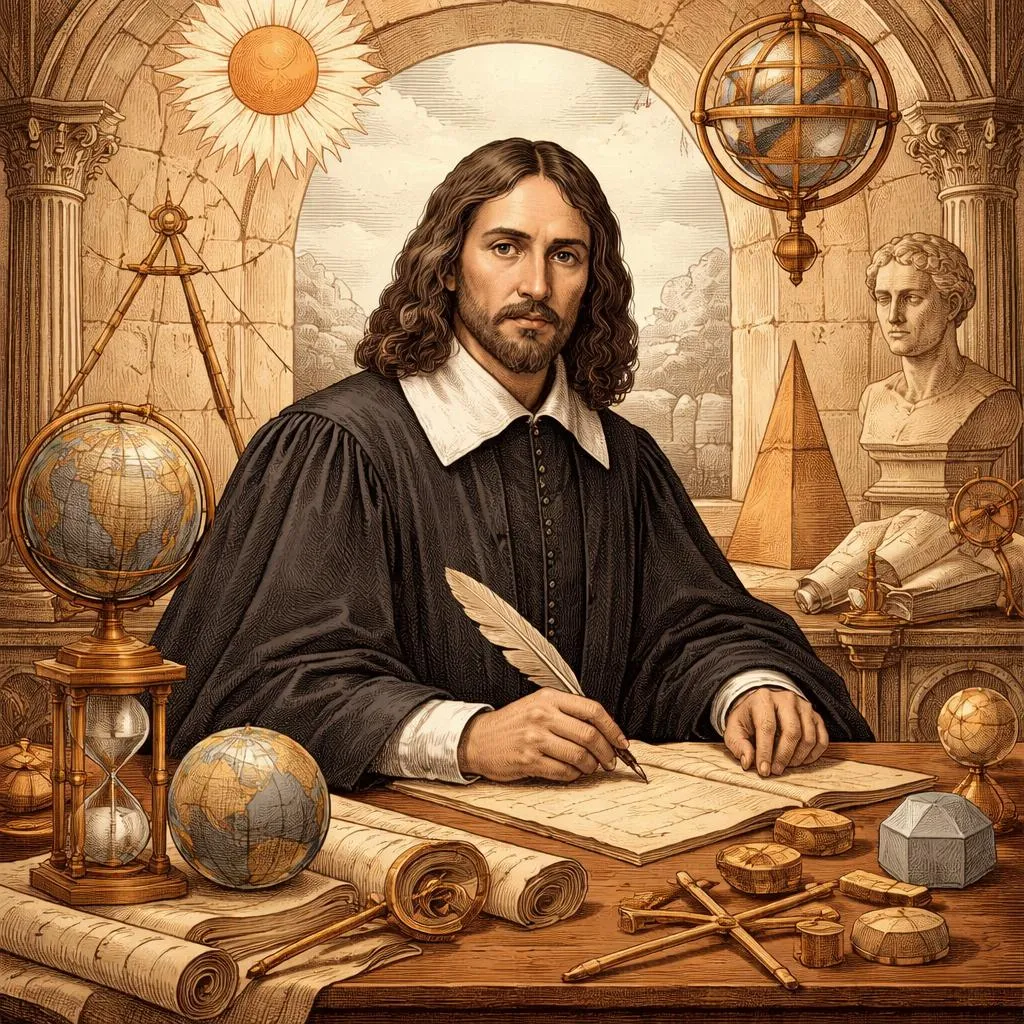

Isaac Barrow was born in London in 1630, and died at Cambridge in 1677. He went to school first at Charterhouse (where he was so troublesome that his father was heard to pray that if it pleased God to take any of his children he could best spare Isaac), and subsequently to Felstead. He completed his education at Trinity College, Cambridge; after taking his degree in 1648, he was elected to a fellowship in 1649; he then resided for a few years in college, but in 1655 he was driven out by the persecution of the Independents. He spent the next four years in the East of Europe, and after many adventures returned to England in 1659. He was ordained the next year, and appointed to the professorship of Greek at Cambridge. In 1662 he was made professor of geometry at Gresham College, and in 1663 was selected as the first occupier of the Lucasian chair at Cambridge. He resigned the latter to his pupil Newton in 1669, whose superior abilities he recognized and frankly acknowledged. For the remainder of his life he devoted himself to the study of divinity. He was appointed master of Trinity College in 1672, and held the post until his death.
He is described as "low in stature, lean, and of a pale complexion," slovenly in his dress, and an inveterate smoker. He was noted for his strength and courage, and once when travelling in the East he saved the ship by his own prowess from capture by pirates. A ready and caustic wit made him a favourite of Charles II., and induced the courtiers to respect even if they did not appreciate him. He wrote with a sustained and somewhat stately eloquence, and with his blameless life and scrupulous conscientiousness was an impressive personage of the time.
His earliest work was a complete edition of the Elements of Euclid, which he issued in Latin in 1655, and in English in 1660; in 1657 he published an edition of the Data. His lectures, delivered in 1664, 1665, and 1666, were published in 1683 under the title Lectiones Mathematicae; these are mostly on the metaphysical basis for mathematical truths. His lectures for 1667 were published in the same year, and suggest the analysis by which Archimedes was led to his chief results. In 1669 he issued his Lectiones Opticae et Geometricae. It is said in the preface that Newton revised and corrected these lectures, adding matter of his own, but it seems probable from Newton's remarks in the fluxional controversy that the additions were confined to the parts which dealt with optics. This, which is his most important work in mathematics, was republished with a few minor alterations in 1674. In 1675 he published an edition with numerous comments of the first four books of the Conics of Apollonius, and of the extant works of Archimedes and Theodosius.
In the optical lectures many problems connected with the reflexion and refraction of light are treated with ingenuity. The geometrical focus of a point seen by reflexion or refraction is defined; and it is explained that the image of an object is the locus of the geometrical foci of every point on it. Barrow also worked out a few of the easier properties of thin lenses, and considerably simplified the Cartesian explanation of the rainbow.
The geometrical lectures contain some new ways of determining the areas and tangents of curves. The most celebrated of these is the method given for the determination of tangents to curves, and this is sufficiently important to require a detailed notice, because it illustrates the way in which Barrow, Hudde and Sluze were working on the lines suggested by Fermat towards the methods of the differential calculus.
Fermat had observed that the tangent at a point P on a curve was determined if one other point besides P on it were known; hence, if the length of the subtangent MT could be found (thus determining the point T), then the line TP would be the required tangent. Now Barrow remarked that if the abscissa and ordinate at a point Q adjacent to P were drawn, he got a small triangle PQR (which he called the differential triangle, because its sides PR and PQ were the differences of the abscissae and ordinates of P and Q), so that
TM : MP = QR : RP.
To find QR : RP he supposed that x, y were the co-ordinates of P, and x - e, y - a those of Q (Barrow actually used p for x and m for y, but I alter these to agree with modern practice). Substituting the co-ordinates of Q in the equation of the curve, and neglecting the squares and higher powers of e and a as compared with their first powers, he obtained e : a. The ratio a/e was subsequently (in accordance with a suggestion made by Sluze) termed the angular coefficient of the tangent at the point. Barrow applied this method to the curves (i) x² (x² + y²) = r²y²;(ii) x³ + y³ = r³; (iii) x³ + y³ = rxy, called la galande; (iv) y = (r - x) tan πx/2r, the quadratrix; and (v) y = r tan πx/2r. It will be sufficient here if I take as an illustration the simpler case of the parabola y² = px. Using the notation given above, we have for the point P, y² = px; and for the point Q, (y - a)² = p(x - e). Subtracting we get 2ay - a² = pe. But, if a be an infinitesimal quantity, a² must be infinitely smaller and therefore may be neglected when compared with the quantities 2ay and pe. Hence 2ay = pe, that is, e : a = 2y : p. Therefore TP : y = e : a = 2y : p. Hence TM = 2y²/p = 2x. This is exactly the procedure of the differential calculus, except that there we have a rule by which we can get the ratio a/e or dy/dx directly without the labour of going through a calculation similar to the above for every separate case.
Antecedentes e introducción del autor
Isaac Barrow fue un notable matemático y teólogo del siglo XVII. Nacido en Londres en 1630, vivió en una época de grandes descubrimientos científicos y cambios intelectuales. Barrow no era solo un erudito, sino también un valiente aventurero, conocido por su fuerza e ingenio. A pesar de su juventud algo rebelde, se convirtió en uno de los principales matemáticos de su época, ocupando prestigiosos cargos académicos en la Universidad de Cambridge. La obra de Barrow sentó importantes bases para el cálculo, una rama de las matemáticas que más tarde sería desarrollada por su famoso alumno, Isaac Newton.
La historia de la vida de Barrow nos enseña sobre la perseverancia, la curiosidad intelectual y la importancia de reconocer y fomentar el talento en los demás. Su decisión de renunciar a su prestigiosa Cátedra Lucasiana a favor de Newton demuestra humildad y un compromiso con el avance del conocimiento más allá de la ambición personal.
Explicación detallada y significado
El texto anterior describe las contribuciones de Barrow a las matemáticas, especialmente en geometría y óptica. Trabajó en problemas relacionados con la reflexión y refracción de la luz, explicando cómo se forman las imágenes a través de lentes, un tema que sigue siendo fundamental en física y óptica hoy en día. Sus conferencias sobre geometría introdujeron nuevos métodos para encontrar tangentes a curvas, que es un concepto clave en el cálculo.
El enfoque de Barrow sobre las tangentes involucraba lo que ahora llamamos el "triángulo diferencial", una ingeniosa herramienta geométrica que le ayudó a aproximar las pendientes de las curvas antes del desarrollo formal del cálculo. Este método fue un trampolín hacia las poderosas técnicas que Newton y Leibniz formalizarían más tarde. El trabajo de Barrow sobre secciones cónicas y su comentario sobre matemáticos antiguos como Apolonio y Arquímedes también ayudó a preservar y avanzar el conocimiento matemático clásico.
Qué pueden aprender los estudiantes
-
Contexto histórico de las matemáticas: Comprender el trabajo de Barrow ayuda a los estudiantes a apreciar cómo evolucionan las ideas matemáticas con el tiempo. Muestra que el cálculo, una materia a menudo considerada difícil, fue desarrollado paso a paso por muchos pensadores que se basaron en los descubrimientos de los demás.
-
Aprendizaje interdisciplinario: Barrow combinó sus intereses en matemáticas, teología y filosofía, demostrando el valor de una educación amplia y la interconexión de diferentes campos.
-
Pensamiento crítico y resolución de problemas: El método de Barrow para analizar curvas y luz enseña a los estudiantes a abordar los problemas de forma creativa y lógica, dividiendo las ideas complejas en partes más simples.
-
Humildad y tutoría: El reconocimiento de Barrow del talento superior de Newton y su disposición a hacerse a un lado es una poderosa lección de humildad y de la importancia de apoyar el crecimiento de los demás.
Aplicaciones en la vida y el aprendizaje
-
En la escuela: Los estudiantes pueden aplicar el ejemplo de Barrow siendo curiosos y persistentes en sus estudios, especialmente en materias desafiantes como matemáticas y ciencias. Aprender la historia detrás de los conceptos puede hacerlos más interesantes y fáciles de entender.
-
En entornos sociales: La historia de Barrow fomenta el respeto por el talento de los demás y la importancia de la tutoría. Ayudar a los compañeros de clase y reconocer sus fortalezas puede construir una comunidad de aprendizaje positiva.
-
En el crecimiento personal: La vida de Barrow muestra que los errores o dificultades tempranas no definen el futuro de una persona. Con esfuerzo y dedicación, cualquiera puede lograr grandes cosas.
Cómo cultivar rasgos positivos de la historia de Barrow
-
Curiosidad: Siempre haz preguntas y busca entender cómo funcionan las cosas, tal como Barrow exploró la naturaleza de la luz y las curvas.
-
Coraje: No tengas miedo de enfrentar desafíos o nuevas experiencias, como hizo Barrow al viajar y enfrentarse a los piratas.
-
Humildad: Reconoce cuándo otros tienen mejores ideas y está dispuesto a aprender de ellas.
-
Conciencia: Esfuérzate por la integridad y el trabajo cuidadoso, como hizo Barrow en su vida académica y personal.
Reflexión y aprecio
Leer sobre Isaac Barrow puede inspirar a los estudiantes a valorar tanto el conocimiento como el carácter. Su combinación de brillantez intelectual y coraje personal lo convierte en un modelo a seguir no solo para los aspirantes a científicos y matemáticos, sino para cualquiera que quiera crecer como un individuo reflexivo, respetuoso y valiente. Al estudiar su vida y obra, los jóvenes estudiantes pueden ver cómo la dedicación al aprendizaje y la amabilidad hacia los demás van de la mano para tener un impacto significativo en el mundo.
