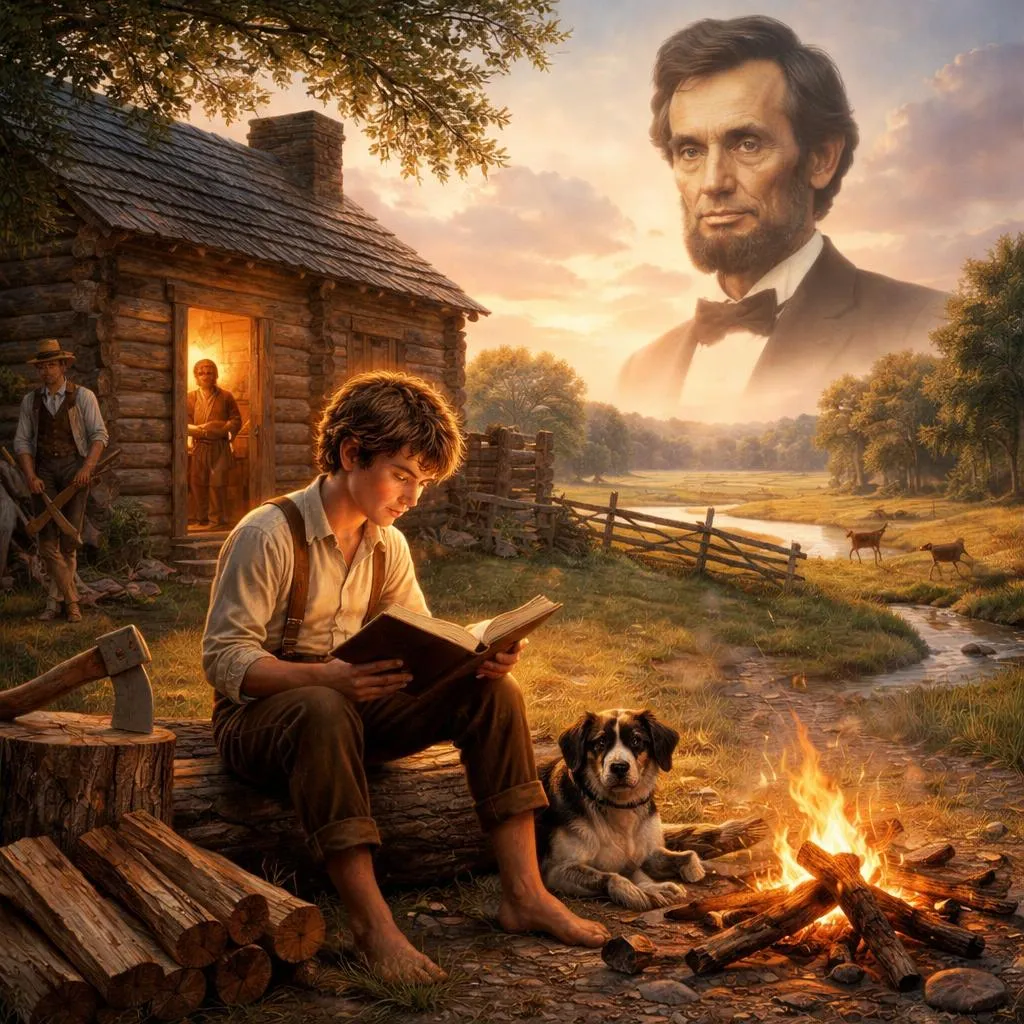

A severe and mysterious sickness broke out in the little Kentucky settlement where the Lincolns lived when Abe was about seven. Nancy Hanks Lincoln, the mother of young Abraham Lincoln died. Meanwhile, Sarah Bush Johnston had married about the time Lincoln’s father married Nancy Hanks. Her husband had died too. She was left with three children. Lincoln’s father went back to his home and married the widow Sarah.
The household goods that she brought with her to the Lincoln home filled a four-horse wagon. Her own three children were well clothed and cared for. She was able to bring little Abraham and his eleven year old sister Sarah comforts they had never known.
The new stepmother quickly became very fond of Abraham. She encouraged him in every way to study and improve himself. Mr. Lincoln once wrote, “It was a wild region, with many bears and other wild animals still in the woods. There I grew up.”
The family moved to Indiana. For two years Lincoln went without schooling of any sort. The school he attended shortly after Sarah came was very simple. The Pigeon Creek settlement had only eight or ten very poor families. They lived deep in the forest. Even if they had the money, it would have been impossible to buy books, slates, pens, ink, or paper.
In Lincoln’s seventeenth year he had more books and better teachers, but he had to walk four or five miles to reach them. We know that he learned to write, and was given pen, ink, a copybook, and a very small supply of writing paper. The instruction he received from his five teachers—two in Kentucky and three in Indiana—stretched over nine years. All together his schooling did not amount to one year.
The fact that he received this instruction, as he himself said, “by littles,” was an advantage. A lazy or not caring boy would have forgotten what was taught him at school. Abraham was neither indifferent or not caring. Every moment of instruction was a precious step to self-help. He worked on his studies with very unusual purpose and determination. He wanted to understand them at the moment. He also wanted to fix them firmly in his mind. His early companions all agree that he employed every spare moment to his studies. His stepmother tells us that “When he came across a passage that struck him, he would write it down on boards if he had no paper. He would keep it there until he did get paper. Then he would rewrite it, look at it, and repeat it. He had a copybook, a kind of scrapbook, in which he put down all things, and thus saved them.” He spent long evenings writing sums on the fire-shovel. Abraham worked his sums by the flickering firelight, making his figures with a piece of charcoal. When the shovel was all covered, he used a drawing-knife to shave it clean again.
He borrowed every book in the neighborhood. The list is a short one: Robinson Crusoe, Aesop’s Fables, Bunyan’s Pilgrim’s Progress, Weems’s Life of Washington, and A History of the United States. When everything else had been read, he began on the Revised Statutes of Indiana, which he visited a neighbor in order to read.
He was a social, sunny-tempered lad, as fond of jokes and fun as he was kindly and industrious. His stepmother said of him: “I can say, what scarcely one mother in a thousand can say, Abe never gave me a cross word or look, and never refused . . . to do anything I asked him. . . I must say . . that Abe was the best boy I ever saw or expect to see.”
He was not only a tall, strong country boy: he soon grew to be a tall, strong, sinewy man. He soon reached the unusual height of six feet four inches. His long arms gave him power as an axman. He usually beat his friends in races and mind puzzles. He could out-run, out-lift, out-wrestle his friends, that he could chop faster, split more rails in a day, carry a heavier log at a “raising,” or beat the neighborhood champion in any frontier athletics made him proud; but stronger than that was his hunger for learning. He felt that using the mind rather than muscle was the key to success. He wished not only to wrestle with the best of them, but also to be able to talk like the preacher, spell and cipher like the schoolmaster, argue like the lawyer, and write like the editor.
Because of his reading and his excellent memory, he soon became the best storyteller among his companions. The training from his studies made his naturally bright mind grow. His wit might be mischievous, but it was never malicious, and his nonsense was never intended to wound. He took no pleasure in hunting. Almost every youth of the backwoods early became an excellent shot and sportsman. The woods still swarmed with game, and every cabin depended largely upon this for its supply of food. But to his strength was added a gentleness, which made him shrink from killing or inflicting pain. The time the other boys spent lying in ambush, he preferred to spend in reading or improving his mind.
In March, 1831, at the end of a terrible winter, Abraham Lincoln left his father’s cabin to seek his own fortune in the world.
Antecedentes e introducción del autor
Esta historia relata la vida temprana de Abraham Lincoln, el decimosexto presidente de los Estados Unidos, conocido por su liderazgo durante la Guerra Civil estadounidense y sus esfuerzos por abolir la esclavitud. La narrativa se basa en relatos históricos y biografías que detallan los humildes comienzos de Lincoln en un asentamiento fronterizo. La historia de la vida de Lincoln se ha contado y vuelto a contar en innumerables biografías, libros infantiles y novelas históricas, enfatizando su perseverancia, autoeducación y carácter moral.
La historia de Abraham Lincoln no se trata solo de un líder famoso, sino del poder de la determinación y el aprendizaje a pesar de las dificultades. El autor de muchas de estas historias biográficas tiene como objetivo inspirar a los jóvenes lectores mostrando cómo Lincoln superó la pobreza, la pérdida y la escolarización limitada para convertirse en un gran hombre.
Interpretación detallada y significado
Esta historia destaca varios temas clave: la resiliencia frente a la adversidad, el valor de la educación y la importancia del carácter. La muerte de la madre de Lincoln y la llegada de una madrastra cariñosa muestran cómo el apoyo familiar juega un papel crucial en el desarrollo personal. A pesar de los recursos y oportunidades limitadas, la sed de conocimiento y superación personal de Lincoln brilla con luz propia.
La historia también revela los desafíos de la vida fronteriza: escasez de escuelas, largas distancias a los maestros y la necesidad de equilibrar el trabajo físico con el estudio. El método de Lincoln de escribir en pizarras y volver a copiar pasajes ilustra su creatividad y determinación para aprender. Su préstamo de libros como Robinson Crusoe y Fábulas de Esopo muestra sus ganas de explorar diferentes ideas e historias.
La fuerza física y el atletismo de Lincoln se equilibran con su naturaleza gentil y su curiosidad intelectual, lo que retrata un personaje completo. Su preferencia por la lectura sobre la caza sugiere una mente reflexiva centrada en el crecimiento en lugar de la mera supervivencia.
Lecciones e ideas para los estudiantes
- Perseverancia y autodisciplina: La historia de Lincoln enseña a los estudiantes la importancia de trabajar duro y aprovechar al máximo cada oportunidad de aprendizaje, incluso cuando las circunstancias son difíciles.
- Valor de la educación: Incluso con menos de un año de escolarización formal, la dedicación de Lincoln a la lectura y la escritura le ayudó a tener éxito. Esto demuestra que la educación no se trata solo del tiempo dedicado a la escuela, sino de la calidad del esfuerzo y la participación.
- Creatividad en el aprendizaje: Usando los materiales disponibles, Lincoln encontró formas de practicar la escritura y memorizar pasajes importantes. Esto anima a los estudiantes a ser ingeniosos y persistentes.
- Carácter y bondad: El comportamiento respetuoso y amable de Lincoln hacia su madrastra y amigos es un ejemplo de buenos modales e interacción social positiva.
- Equilibrio entre fuerza y suavidad: Ser fuerte no significa ser duro; la gentileza de Lincoln junto con su poder físico enseña empatía y respeto por los demás.
Aplicaciones en la vida diaria
- En el aprendizaje: Los estudiantes pueden emular a Lincoln dedicando tiempo a estudiar regularmente, utilizando métodos creativos si los recursos son limitados y buscando conocimientos más allá de los libros de texto.
- En entornos sociales: La actitud respetuosa de Lincoln les recuerda a los estudiantes que deben tratar a los demás con amabilidad y ser cooperativos, lo que ayuda a construir relaciones sólidas.
- Al superar desafíos: Al enfrentar dificultades, los estudiantes pueden recordar el ejemplo de persistencia y optimismo de Lincoln, entendiendo que los contratiempos son parte del crecimiento.
- En el crecimiento personal: Equilibrar las actividades físicas con las actividades intelectuales puede ayudar a desarrollar una personalidad completa, tal como Lincoln combinó la fuerza con el amor por la lectura.
Cultivar rasgos positivos de la historia
- Curiosidad: Animar a hacer preguntas y explorar nuevos temas.
- Diligencia: Establecer metas para el estudio y practicar regularmente.
- Respeto: Mostrar aprecio por la familia, los maestros y los compañeros.
- Resiliencia: Aprender a recuperarse de fracasos u obstáculos.
- Empatía: Comprender los sentimientos de los demás y evitar causar daño.
La historia de la vida temprana de Abraham Lincoln es un poderoso ejemplo para los jóvenes lectores. Muestra que la grandeza comienza con pequeños esfuerzos constantes y que el carácter y la bondad son tan importantes como la inteligencia y la fuerza. Al aprender de su viaje, los estudiantes pueden encontrar inspiración para perseguir sus propios sueños con coraje y corazón.
