
What Is adjective examples?
Adjectives describe people, places, animals, and things. They add color and detail to language. Without adjectives, sentences feel plain and short. With adjectives, sentences become vivid and exciting.
The phrase “adjective examples” refers to many words that describe nouns. These words help build strong communication. They help listeners imagine size, color, feelings, and more.
Learning adjective examples builds expressive speaking and writing. It also supports reading comprehension. When descriptions are clear, stories become easier to understand.
Meaning and Explanation of Adjectives
An adjective is a word that describes a noun. A noun is a person, place, animal, or thing. Adjectives answer questions like “What kind?”, “Which one?”, and “How many?”.
For example, in the sentence “The big dog runs fast,” the word “big” is an adjective. It describes the dog. In the sentence “Three apples are red,” the words “three” and “red” are adjectives.
Adjectives often appear before nouns. Sometimes they appear after verbs like “is,” “are,” “was,” and “were.” For example, “The sky is blue.” The word “blue” describes the sky.
Categories of adjective examples
Adjectives fall into different groups. Each group describes a different feature. These categories help organize learning.
Descriptive adjectives show qualities. Words like happy, tall, fast, and soft belong to this group. They describe how something looks or feels.
Color adjectives show colors. Words like red, blue, yellow, and green belong here. They help describe objects in detail.
Size adjectives show how big or small something is. Words like big, small, tiny, and huge give clear images.
Number adjectives show quantity. Words like one, two, many, and few help count or measure.
Possessive adjectives show ownership. Words like my, your, his, her, and their show who owns something.
Demonstrative adjectives point to something. Words like this, that, these, and those show location or distance.
Daily Life adjective examples
Adjectives appear everywhere in daily speech. Descriptions of food, toys, animals, and weather all use adjectives.
A sentence like “The sweet cake smells good” uses “sweet” and “good.” These words describe taste and smell.
A sentence like “The blue car is fast” uses “blue” and “fast.” These words describe color and speed.
A sentence like “Her small cat sleeps” uses “her” and “small.” These words describe ownership and size.
Adjective examples help describe feelings too. Words like happy, sad, excited, and tired express emotions.
Using adjective examples in Simple Sentences
Short sentences support clarity. Adjectives fit easily into simple structures.
“The tall tree is green.” “The funny clown makes people laugh.” “The cold ice cream melts.” “The new book is interesting.”
Each sentence uses one or two adjectives. The meaning becomes richer and more engaging.
Comparative and Superlative adjective examples
Some adjectives compare things. These forms show differences and extremes.
Comparative adjectives compare two things. Many adjectives add “-er” or use “more.” For example, big becomes bigger, happy becomes happier, and beautiful becomes more beautiful.
Superlative adjectives show the highest degree. Many adjectives add “-est” or use “most.” For example, big becomes biggest, happy becomes happiest, and beautiful becomes most beautiful.
Sentences like “This book is bigger than that book” show comparison. Sentences like “This is the biggest book” show the highest degree.
Printable Flashcards for adjective examples
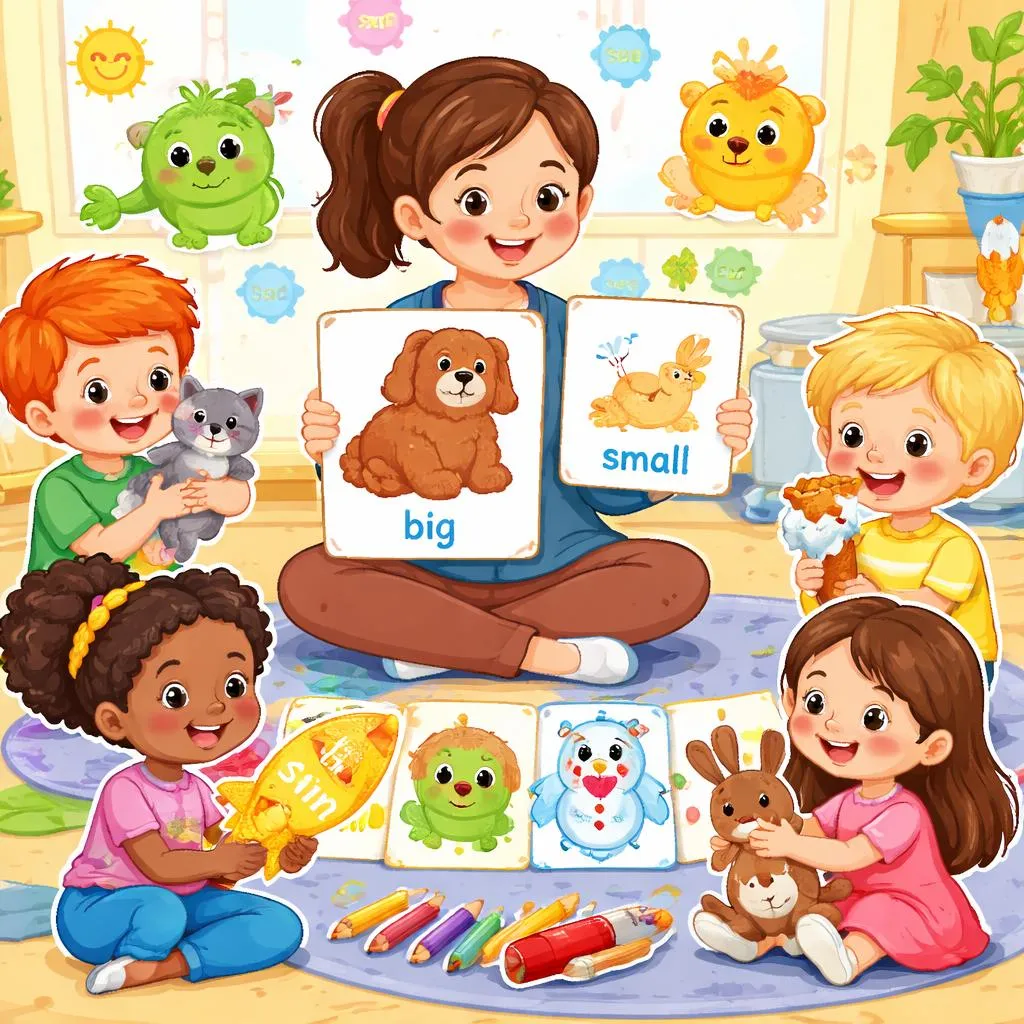
Flashcards help connect words with images. A card can show a smiling face with the word “happy.” Another card can show a giant animal with the word “big.”
Flashcards can show colors, sizes, and feelings. These cards support memory and recognition. Repetition with flashcards strengthens vocabulary recall.
Matching picture cards with word cards builds word-picture connections. This method supports early reading skills.
Learning Activities with adjective examples
Picture description activities support speaking. A picture of a park can lead to sentences like “The green grass is soft” and “The tall trees are beautiful.”
Story building activities encourage creativity. A simple story can grow with adjectives. “The dog runs” can become “The small brown dog runs fast.”
Sorting activities help categorize adjectives. Words can be grouped by color, size, or feeling. This builds classification skills.
Sentence expansion activities strengthen writing. Start with “The cat sits.” Add adjectives to build “The fluffy white cat sits quietly.”
Educational Games for adjective examples
Guessing games encourage listening. One person describes an object with adjectives. Others guess the object. For example, “It is round, red, and sweet.”
Adjective bingo uses words on a grid. When a word is called, it is marked. This supports word recognition.
Charades with adjectives adds movement. Act out “happy,” “angry,” or “sleepy.” This supports comprehension and emotional vocabulary.
Adjective story chains encourage collaboration. Each participant adds one adjective to a shared story. The story becomes rich and imaginative.
Phonics and Pronunciation with Adjectives
Adjectives help practice sounds. Words like big, red, and hot use short vowels. Words like blue, green, and nice use long vowels.
Consonant blends appear in words like small, fast, and strong. Practicing these words supports phonics skills.
Stress patterns in adjectives help rhythm. Multi-syllable adjectives like beautiful and interesting help practice stress and intonation.
Grammar Patterns with adjective examples
Adjectives often appear before nouns. For example, “a happy child,” “a big house,” and “a red apple.”
Adjectives also appear after linking verbs. For example, “The child is happy,” “The house is big,” and “The apple is red.”
Some adjectives come in a specific order. For example, “a small blue box” sounds natural. Adjective order usually follows opinion, size, age, shape, color, and material.
Understanding adjective order supports natural language flow.
Adjectives in Questions
Questions use adjectives to gather details. For example, “Which color do you like?” and “How many books are there?”
Questions like “Is the weather cold?” and “Are the flowers beautiful?” use adjectives to describe conditions.
These question patterns support conversation and comprehension.
Creative Writing with adjective examples
Adjectives enrich stories. A simple sentence like “The dragon lives in a cave” becomes “The huge green dragon lives in a dark cave.”
Descriptive writing activities encourage imagination. Describing a dream house or a magical forest builds vocabulary and creativity.
Journal prompts like “Describe a happy day” encourage emotional expression with adjectives.
Cross-Curricular Connections
Science lessons use adjectives to describe animals and plants. Words like furry, tall, and green describe living things.
Math lessons use adjectives like many, few, and several to describe quantities.
Art lessons use adjectives like bright, dark, and colorful to describe artwork.
These connections show that adjectives appear in every subject.
Listening and Speaking Practice with adjective examples
Listening activities include identifying adjectives in stories. Hearing “The brave knight rides a white horse” helps recognize descriptive words.
Speaking activities include describing pictures, objects, and feelings. Short descriptive sentences build confidence.
Choral speaking with adjective-rich sentences builds rhythm and fluency.
Reading Practice with adjective examples
Reading short stories with many adjectives supports comprehension. Descriptive texts help visualize scenes.
Highlighting adjectives in a story helps identify parts of speech. This builds grammatical awareness.
Shared reading with emphasis on descriptive words supports vocabulary growth.
Writing Practice with adjective examples
Writing tasks can include describing a favorite toy, animal, or place. Adjectives help make writing vivid.
Sentence frames like “The ____ is ____” support early writing. For example, “The dog is friendly.”
Paragraph writing tasks can include describing a day, a trip, or a dream. Adjectives add detail and personality.
Supporting Different Learning Styles
Visual learners benefit from pictures and color-coded adjectives. Auditory learners benefit from songs and chants with descriptive words. Kinesthetic learners benefit from acting out adjectives like happy, tired, or excited.
Differentiation supports inclusive learning.
Digital Tools for adjective examples
Interactive apps show pictures and adjectives together. Tapping a word plays pronunciation.
Online quizzes test recognition and usage. Immediate feedback supports learning.
Recording tools allow practice with speaking. Listening to recordings supports self-correction.
Building a Daily Routine with adjective examples
Start with a warm-up chant using adjectives. Introduce new adjectives with pictures. Practice with sentences and questions. Add creative activities like drawing and storytelling.
This routine supports balanced language development.
Expanding Vocabulary Networks
Adjectives connect to nouns and verbs. For example, “big dog,” “run fast,” and “happy child.”
Word maps show connections. “Happy” can connect to smile, laugh, and joy. “Big” can connect to large, huge, and giant.
These networks deepen understanding and recall.
Simple Assessment with adjective examples
Observation of speaking shows adjective use. Writing samples show descriptive detail. Reading activities show recognition of adjectives.
These assessments guide instruction and support progress.
Adjective examples open doors to expressive language. Descriptive words bring stories, conversations, and ideas to life. Through clear explanations, engaging activities, and creative practice, adjectives become a joyful part of English learning.