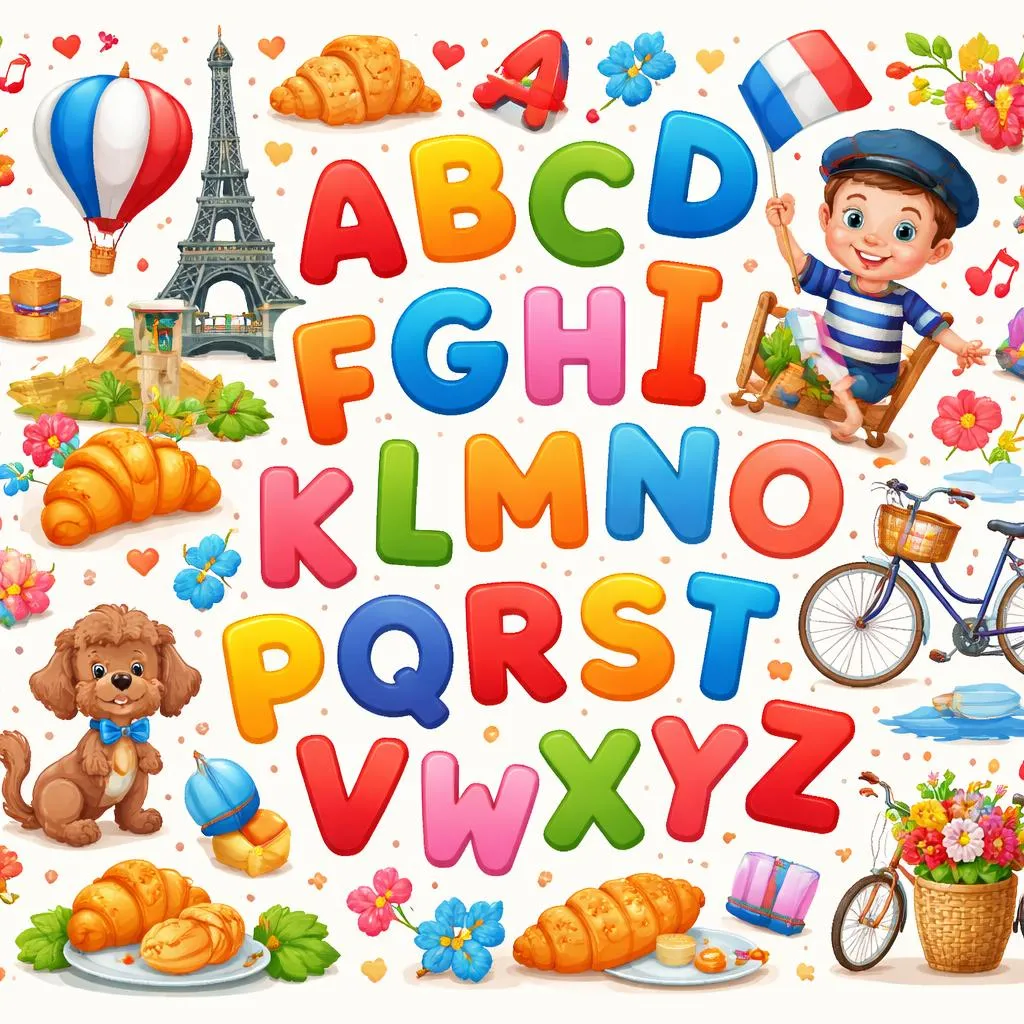

The French Alphabet The French alphabet is similar to the English alphabet, but it has a few special letters and different rules for pronunciation. Understanding the French letters and their sounds is the first step in learning the French language. There are 26 letters in the French alphabet, just like in English, but the sounds they make can be different. Some letters are exactly the same in both languages, but others can be tricky because the French language has some unique sounds that don't exist in English. Additionally, some letters have special accents that change the way they sound. Let’s dive into the French alphabet and discover how each letter is pronounced!
The Letters of the French Alphabet A The letter A is pronounced like "ah" in English.
"ami" (friend) – The A in ami is pronounced like "ah".
B The letter B is pronounced like "b" in English.
"biscuit" (cookie) – The B in biscuit is pronounced like "b."
C The letter C is pronounced differently depending on the letters that follow it.
Before "e," "i," or "y", C is pronounced like "s."
"ciel" (sky) – The C in ciel is pronounced like "s."
Before other letters, C is pronounced like "k."
"chat" (cat) – The C in chat is pronounced like "k."
D The letter D is pronounced like "d" in English.
"dîner" (dinner) – The D in dîner is pronounced like "d."
E The letter E is pronounced like "uh" in English when it is at the end of a word or followed by a consonant.
"le" (the) – The E in le is pronounced like "uh."
When there is an accent on E, it changes the pronunciation:
é is pronounced like "ay" (as in "pay").
"école" (school) – The é is pronounced like "ay."
è is pronounced like "eh" (as in "bet").
"père" (father) – The è is pronounced like "eh."
F The letter F is pronounced like "f" in English.
"fleur" (flower) – The F in fleur is pronounced like "f."
G The letter G is pronounced differently depending on the following letters.
Before "e," "i," or "y," G is pronounced like "zh" (like the "s" in "measure").
"génial" (great) – The G in génial is pronounced like "zh."
Before other letters, G is pronounced like "g" in "go."
"gare" (station) – The G in gare is pronounced like "g."
H The letter H is silent in French, meaning it is not pronounced at all.
"homme" (man) – The H in homme is silent.
I The letter I is pronounced like "ee" in English.
"idée" (idea) – The I in idée is pronounced like "ee."
J The letter J is pronounced like "zh" (similar to the "s" sound in "measure").
"jolie" (pretty) – The J in jolie is pronounced like "zh."
K The letter K is pronounced like "k" in English, but it is not as commonly used in French as in English.
"kilomètre" (kilometer) – The K in kilomètre is pronounced like "k."
L The letter L is pronounced like "l" in English.
"livre" (book) – The L in livre is pronounced like "l."
M The letter M is pronounced like "m" in English.
"maison" (house) – The M in maison is pronounced like "m."
N The letter N is pronounced like "n" in English.
"nom" (name) – The N in nom is pronounced like "n."
O The letter O is pronounced like "oh" in English.
"objet" (object) – The O in objet is pronounced like "oh."
When there is an accent on O, it changes the pronunciation:
ô is pronounced like "oh" (but with a slightly longer sound).
"hôtel" (hotel) – The ô is pronounced like "oh."
P The letter P is pronounced like "p" in English.
"porte" (door) – The P in porte is pronounced like "p."
Q The letter Q is pronounced like "k" in English.
"question" (question) – The Q in question is pronounced like "k."
R The letter R is pronounced differently in French compared to English. It is pronounced from the back of the throat, with a guttural sound.
"rue" (street) – The R in rue is pronounced with a gargled sound, different from the English R.
S The letter S is pronounced like "s" in English.
"saison" (season) – The S in saison is pronounced like "s."
When S is followed by a vowel, it may be pronounced like "z."
"rose" (rose) – The S in rose is pronounced like "z."
T The letter T is pronounced like "t" in English.
"table" (table) – The T in table is pronounced like "t."
U The letter U is pronounced like "oo" in English, but with rounded lips.
"une" (one) – The U in une is pronounced with rounded lips, similar to "oo."
V The letter V is pronounced like "v" in English.
"vache" (cow) – The V in vache is pronounced like "v."
W The letter W is not commonly used in French, but when it is, it is pronounced like "v" or "w" (depending on the word).
"wagon" (wagon) – The W in wagon is pronounced like "v."
X The letter X is pronounced like "ks" in English.
"taxi" (taxi) – The X in taxi is pronounced like "ks."
Y The letter Y is pronounced like "ee" or "i" in English, depending on the word.
"yeux" (eyes) – The Y in yeux is pronounced like "ee."
Z The letter Z is pronounced like "z" in English.
"zéro" (zero) – The Z in zéro is pronounced like "z."
Special French Accents In addition to the basic letters of the alphabet, French uses several accents to change the pronunciation of certain letters. These accents are important to learn because they can change the meaning of words.
- L'accent aigu (é) The accent aigu is used on the letter E. It makes the E sound like "ay" (like in "say").
"école" (school) – The é is pronounced like "ay."
- L'accent grave (è, à, ù) The accent grave is used on E, A, and U. For E, it makes the E sound like "eh" (like in "bet"). The accent grave on A and U doesn’t change the pronunciation, but it can change the meaning of a word.
"père" (father) – The è is pronounced like "eh."
"là" (there) – The à doesn’t change the pronunciation of A, but it changes the word.
- L'accent circonflexe (ê, â, î, ô, û) The accent circonflexe is used on several vowels to indicate that an old letter was removed, usually an S. It doesn’t change the pronunciation of the letter but can change the meaning of the word.
"forêt" (forest) – The ê doesn’t change the sound of E, but it shows the word used to be spelled "forest."
- La cédille (ç) The cedilla is used under the letter C to make it sound like "S", especially when C is followed by A, O, or U.
"garçon" (boy) – The ç makes the C sound like S.
- L'accent tréma (ë, ï, ü, ö) The tréma is used to show that two vowels should be pronounced separately.
"Noël" (Christmas) – The ë tells you to pronounce the O and E separately.
Mastering the French alphabet and its pronunciation is the first step in learning French. Understanding how each letter sounds and how accents can change the meaning of words will help you speak and read French more easily. By practicing the sounds of each letter and learning the special accents, you'll be on your way to becoming a confident French speaker. Keep practicing and enjoy learning the beautiful sounds of the French language!