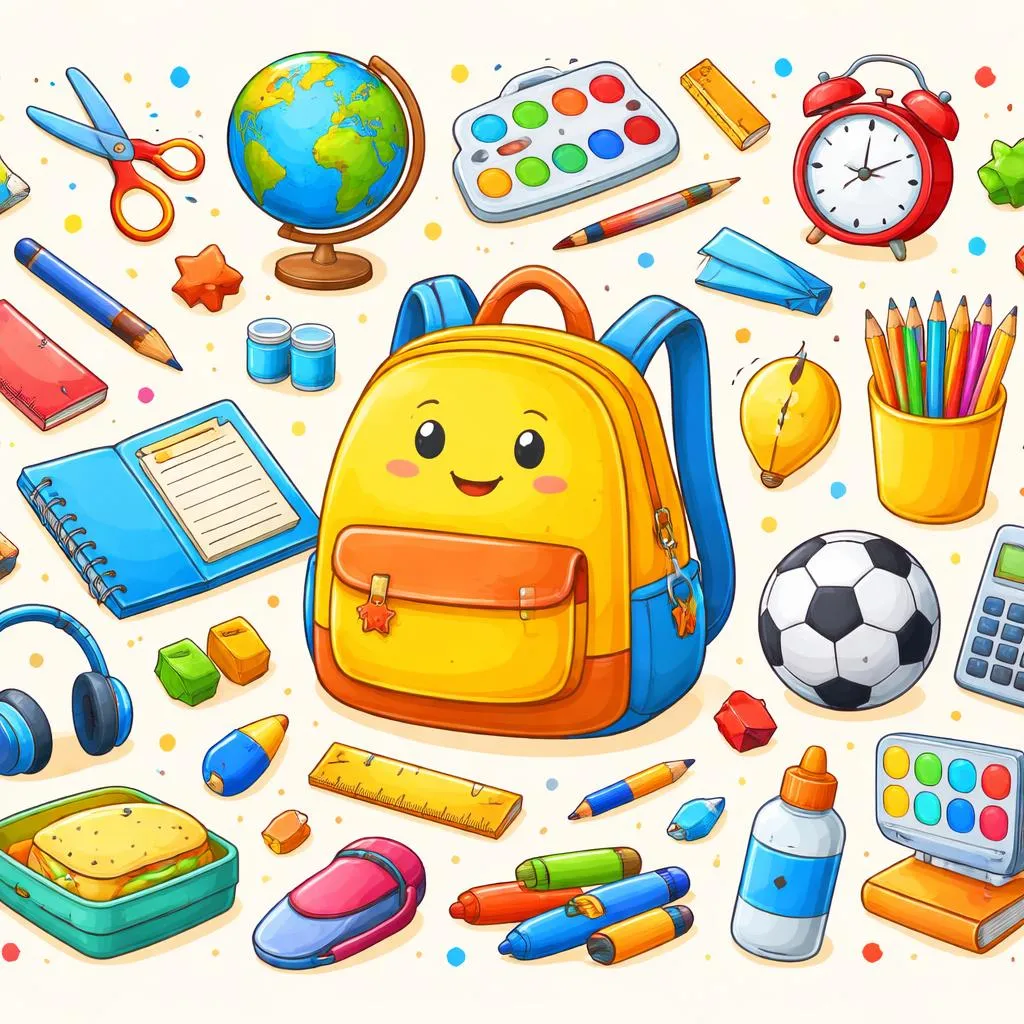

What Are school items.?
School items. are objects used in classrooms and study spaces. These objects help with reading, writing, drawing, and organizing. This topic builds basic classroom vocabulary and supports daily communication in English.
This lesson introduces common school items. with simple explanations and clear examples. The goal is to build confidence with everyday school language.
Meaning and Explanation of school items.
The phrase school items. refers to tools and materials used at school. These include books, pencils, bags, and many classroom tools.
Understanding these words helps with classroom instructions, homework tasks, and daily conversations. Teachers often use these words in class. Learning them early helps children follow directions easily.
Common Categories of school items.
School items. can be grouped into clear categories. Grouping helps memory and understanding.
Writing tools include pencil, pen, marker, and crayon. These tools help with writing and drawing.
Paper products include notebook, workbook, worksheet, and paper. These items store writing and drawings.
Storage tools include backpack, pencil case, folder, and binder. These items keep supplies organized.
Classroom tools include ruler, scissors, glue, and tape. These tools help with crafts and projects.
Books and learning tools include textbook, dictionary, and storybook. These items support reading and learning.
Daily Life Examples with school items.
A pencil is used to write letters and numbers.
A notebook holds notes and drawings.
A backpack carries books and supplies to school.
A ruler measures lines and shapes.
Scissors cut paper for crafts.
A folder stores worksheets and drawings.
A crayon adds color to pictures.
A dictionary explains new words.
These examples connect vocabulary to real classroom routines.
Printable Flashcards for school items.
Flashcards support visual learning. Each card can show a picture and a word.
A flashcard for “pencil” shows a yellow pencil with an eraser.
A flashcard for “notebook” shows a book with blank pages.
A flashcard for “backpack” shows a bag with straps.
A flashcard for “ruler” shows a measuring tool with numbers.
A flashcard for “scissors” shows two blades with handles.
A flashcard for “glue” shows a bottle with a cap.
Flashcards can be printed, colored, and used for games and drills.
Learning Activities with school items.
Classroom object hunts support active learning. A teacher names an item, and learners point to it.
Labeling activities build reading skills. Labels can be placed on classroom objects.
Drawing tasks encourage creativity. A drawing of a classroom can include labeled school items.
Role-play supports speaking. One student asks for an item. Another student hands it over.
Matching games connect words and pictures. Cards with pictures match cards with words.
Educational Games with school items.
A guessing game builds listening skills. A description is given, and the item is guessed.
A memory game strengthens recall. Pairs of picture cards are turned over and matched.
A spelling game practices letters. The name of an item is spelled aloud.
A sorting game groups items by category. Writing tools go in one group. Storage tools go in another group.
A classroom bingo game uses pictures of school items. to practice recognition.
Phonics Focus with school items.
The word pencil begins with the /p/ sound.
The word notebook begins with the /n/ sound.
The word ruler begins with the /r/ sound.
The word scissors begins with the /s/ sound.
The word glue begins with the /g/ sound.
Phonics practice links sounds to objects in the classroom. This supports early reading skills.
Grammar Patterns with school items.
Simple sentences help with communication.
This is a pencil.
That is a notebook.
These are crayons.
Those are scissors.
Question patterns support classroom interaction.
What is this? This is a ruler.
Do you have a pen? Yes, I do.
These patterns help with real classroom conversations.
Classroom Language with school items.
Teachers use school items. in daily instructions.
Take out your notebook.
Put your pencil in the pencil case.
Open your textbook.
Close your folder.
Pass the scissors, please.
Understanding these phrases improves classroom participation.
Story-Based Learning with school items.
Short stories can include school objects. A story about a backpack adventure can introduce vocabulary. A story about a lost pencil can teach problem-solving language.
Stories make vocabulary memorable and fun.
Creative Projects with school items.
Craft projects use scissors, glue, paper, and crayons.
A paper classroom model can include labeled school items.
A mini book project can describe favorite classroom tools.
These projects combine language learning and creativity.
Parent and Teacher Tips for school items.
Repetition supports memory. Daily review of words builds confidence.
Visual aids help understanding. Real objects work better than abstract explanations.
Context improves retention. Words learned during real classroom tasks stay longer.
Positive feedback encourages participation and motivation.
School items. form a core part of early English vocabulary. Clear explanations, real-life examples, and interactive activities build strong classroom language skills. Learning these words supports communication, reading, and daily school routines in a natural and engaging way.