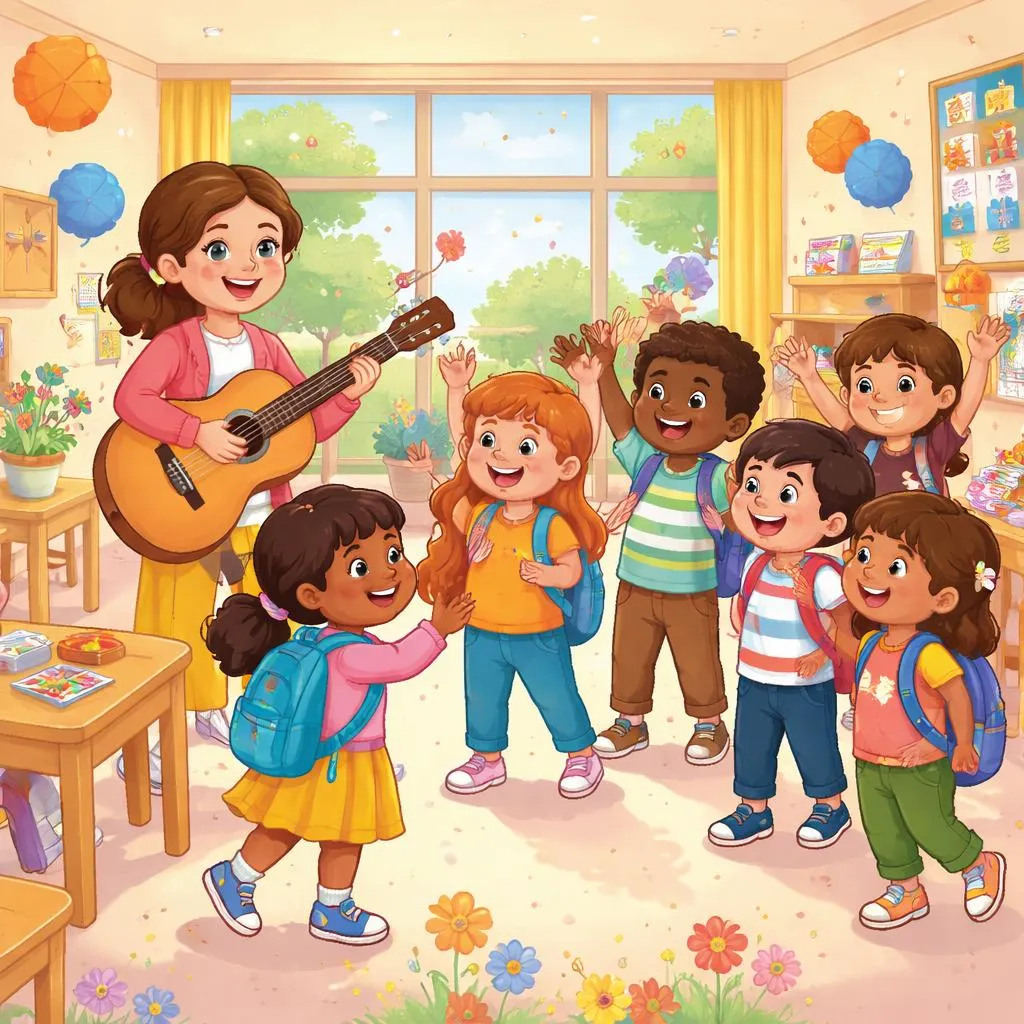

What Is the Goodbye Song?
The phrase “goodbye song” refers to short and friendly songs used at the end of a class, a day, or an activity. These songs mark the closing moment in a warm and predictable way. Music signals that learning time is ending and a new routine will begin.
In early English learning, the goodbye song supports listening skills, speaking practice, and emotional comfort. Repetition and melody help remember words and phrases. A consistent ending song also builds structure and confidence.
Common Goodbye Song Lyrics
Many versions of the goodbye song exist. One popular version uses simple and clear language.
Goodbye, goodbye, See you again. Goodbye, goodbye, See you, my friends.
It is time to go, Time to say goodbye. Goodbye, goodbye, See you next time.
These lines use basic vocabulary and a strong rhythm. The melody is easy to follow. This makes it suitable for early learners and group singing.
Vocabulary Learning with the Goodbye Song
The goodbye song introduces high-frequency words. “Goodbye” expresses a farewell. “See you” expresses future meeting. “Again” and “next time” show repetition and future time. “Friends” names people in a social group.
These words appear in daily conversations. Using them in a song builds natural understanding. Songs also create emotional meaning for words. “Goodbye” becomes friendly instead of sad.
The phrase “It is time to go” connects language with real-life transitions. This phrase can appear in classroom routines, daily schedules, and family activities.
Phonics Points in the Goodbye Song
The word “goodbye” includes the long vowel sound /aɪ/ in “bye.” This sound also appears in “my,” “time,” and “fly.” Singing helps hear and practice this vowel pattern.
The word “see” includes the long vowel sound /iː/. This sound appears in “me,” “tree,” and “be.” Repetition in the song strengthens recognition.
Rhyming words such as “go” and “hello” can connect with the song in extended activities. Rhythm supports syllable awareness. Each line follows a predictable beat. Clapping or tapping helps develop phonemic awareness.
Grammar Patterns in the Goodbye Song
The goodbye song uses present simple tense. “See you again” expresses a future meaning with a present form. This shows how English uses context to express time.
The sentence “It is time to go” uses the structure “It is + noun + to + verb.” This structure appears often in daily English. For example, “It is time to eat” or “It is time to sleep.”
The phrase “See you next time” uses a time expression. “Next time” signals the future. This introduces future reference without complex grammar.
Learning Activities with the Goodbye Song
Singing with gestures helps connect language and movement. Waving hands during “goodbye” strengthens meaning. Pointing to the door during “time to go” connects words with actions.
Role-play activities extend the song. Pretending to leave a classroom, a park, or a party builds situational language. Saying “Goodbye” in different roles supports social communication.
Drawing activities encourage creativity. Drawing a classroom, friends, and a waving hand connects images with words. Labeling drawings with “goodbye” and “friends” supports early writing.
Printable Materials for the Goodbye Song
Printable lyric sheets help with reading practice. Highlighting keywords such as “goodbye,” “see,” and “friends” supports sight word recognition.
Flashcards with farewell phrases support vocabulary recall. Cards can show “Goodbye,” “See you,” and “Next time.” Matching words with pictures supports comprehension.
Routine charts with a goodbye song icon help visualize daily schedules. This supports predictability and emotional security.
Coloring pages with farewell themes add an artistic element. Coloring while listening to the song supports multisensory learning.
Educational Games with the Goodbye Song
A gesture game can assign actions to words. Wave for “goodbye,” clap for “see you,” and point forward for “next time.” This reinforces comprehension.
A memory game can include farewell phrases. Matching pairs of cards with “goodbye” and “see you” builds word recognition.
A role-play game can involve greeting and goodbye scenarios. Acting out short dialogues builds speaking confidence.
A rhythm game can involve clapping patterns with each line. This strengthens timing, listening, and pronunciation.
Listening and Speaking Practice
Listening practice involves playing different versions of the goodbye song. Slow versions help beginners. Faster versions build listening stamina. Different voices expose learners to varied accents.
Speaking practice includes repeating lines, chanting, and singing. Call-and-response formats support participation. One voice sings a line, and others repeat it.
Pair practice includes short dialogues. “Goodbye.” “See you tomorrow.” These exchanges support conversational skills.
Reading Practice with the Goodbye Song
Reading the lyrics in print supports word recognition. Tracking text while singing builds print awareness.
Highlighting key words such as “goodbye” and “friends” supports sight word learning.
Shared reading encourages pointing to each word. This supports left-to-right reading direction and word boundaries.
Writing Practice with the Goodbye Song
Writing simple farewell sentences supports early writing. Examples include “Goodbye, friends” and “See you again.”
Creating a goodbye card supports functional writing. Writing a short message and adding drawings connects language with real-life communication.
Composing new verses builds creativity. Adding lines like “Goodbye, teacher” or “Goodbye, class” expands vocabulary and sentence structure.
Emotional Learning Through the Goodbye Song
Songs support emotional regulation. A consistent goodbye song signals closure and transition. This reduces uncertainty and stress.
Singing together creates a sense of community. Shared routines strengthen group identity and belonging.
Farewell language also supports social skills. Saying goodbye politely is a key part of communication. The song models friendly and respectful farewells.
Cross-Curricular Connections
Music education includes rhythm, melody, and tempo. Exploring slow and fast versions of the song supports musical awareness.
Art education includes drawing farewell scenes and designing goodbye posters. This supports creativity and fine motor skills.
Social studies connections include learning about daily routines and social interactions. Understanding greetings and farewells supports cultural competence.
Math connections include counting beats and claps. Counting lines and syllables integrates numeracy with language.
Supporting Different Learning Styles
Visual learners benefit from lyric charts, flashcards, and illustrations.
Auditory learners benefit from repeated listening and singing.
Kinesthetic learners benefit from gestures, dancing, and role-play.
Combining these approaches supports inclusive learning environments and diverse needs.
Digital Tools for the Goodbye Song
Interactive apps animate characters waving goodbye. Tapping characters plays the song and highlights words. This supports engagement and pronunciation.
Online karaoke videos highlight lyrics in real time. This supports reading fluency and word recognition.
Recording tools allow singing and playback. Listening to recordings supports self-monitoring and pronunciation improvement.
Building a Daily Routine with the Goodbye Song
A daily routine can end with the goodbye song. This signals the transition from learning time to free time or home time.
A structured routine may include review, reflection, and the goodbye song. This creates a predictable flow.
Visual schedules with a goodbye song icon support time awareness and independence.
Expanding Vocabulary Networks
The word “goodbye” connects to other farewell phrases like “bye,” “see you,” and “farewell.”
The word “friends” connects to social words like “classmate,” “teacher,” and “family.”
The phrase “next time” connects to time expressions such as “tomorrow,” “next week,” and “later.”
Building these networks deepens understanding and supports flexible language use.
Simple Assessment Ideas
Listening checks include identifying words in the song. For example, pointing to “goodbye” when hearing it.
Speaking checks include repeating lines with clear pronunciation.
Reading checks include matching printed words with sung words.
Writing checks include short farewell messages or labeled drawings.
The goodbye song offers a gentle and joyful way to close learning sessions. It supports vocabulary, phonics, grammar, and social communication. Through music, movement, reading, and creative tasks, English learning becomes structured, meaningful, and emotionally supportive.