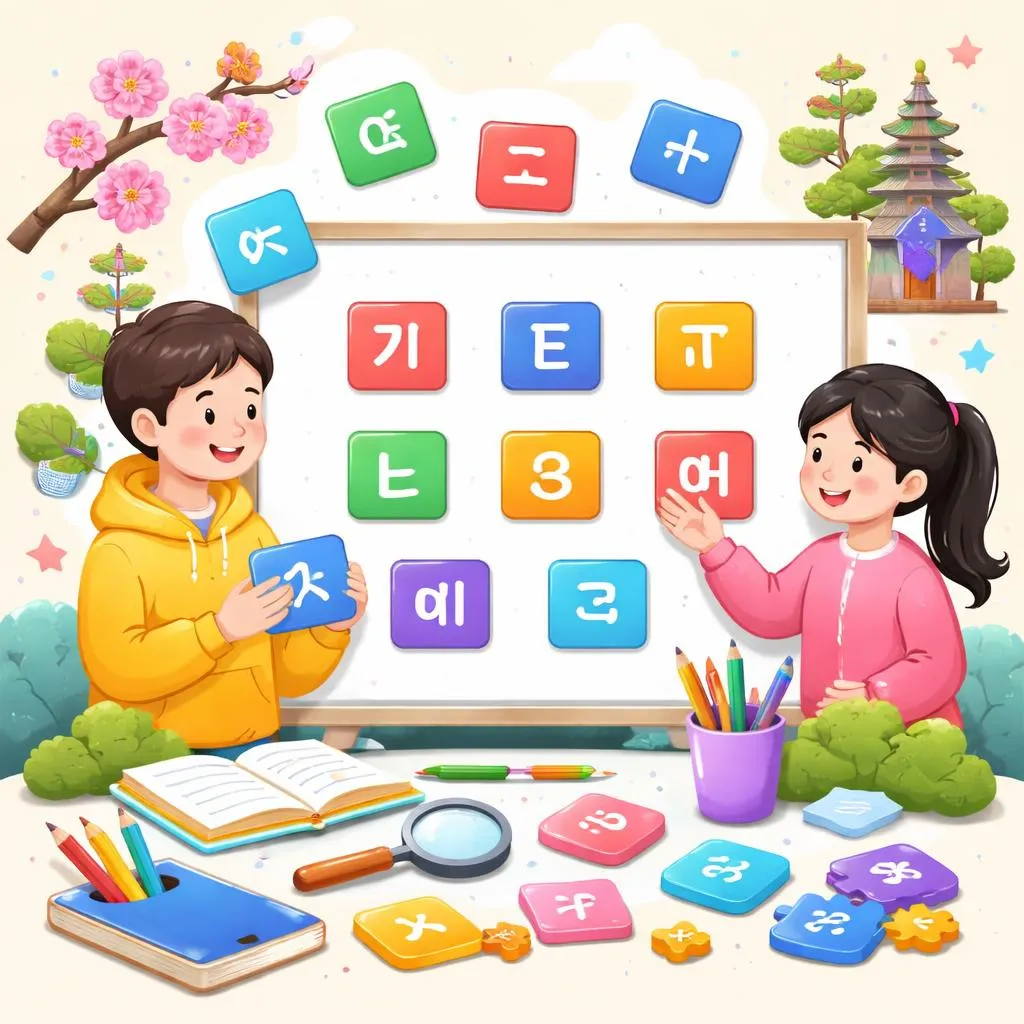

What is Hangul? Hangul is the writing system used for the Korean language. It was created in the 15th century by King Sejong the Great and his scholars. Hangul is unique because it was designed to be easy to learn.
Hangul is the alphabet of the Korean language.
The Structure of Hangul Hangul is made up of 14 basic consonants and 10 basic vowels. The consonants represent sounds made with the mouth, while vowels represent sounds made with the throat. By combining consonants and vowels, you can create syllables.
Hangul syllables are made by combining consonants and vowels.
How Hangul Works In Hangul, each syllable is made up of a block. Each block contains a consonant and a vowel, and sometimes a final consonant. For example, the syllable “한” (han) is made of “ㅎ” (h), “ㅏ” (a), and “ㄴ” (n).
Syllables in Hangul are formed in blocks.
Hangul Consonants There are 14 basic consonants in Hangul. Some examples are “ㄱ” (g/k), “ㄴ” (n), “ㄷ” (d/t), and “ㅁ” (m). Each consonant represents a different sound, and they combine with vowels to form syllables.
Consonants are the building blocks of Hangul syllables.
Hangul Vowels There are 10 basic vowels in Hangul. Some examples are “ㅏ” (a), “ㅓ” (eo), “ㅗ” (o), and “ㅜ” (u). Vowels are combined with consonants to form different sounds in words.
Vowels are used with consonants to make syllables.
Reading Hangul Reading Hangul is simple once you know the basic consonants and vowels. Each syllable block is read from left to right, top to bottom. For example, “한” (han) is read as “h,” “a,” and “n” in sequence.
Hangul is read from left to right and top to bottom.
Writing Hangul Writing Hangul involves creating blocks from consonants and vowels. For example, “하” (ha) is made of “ㅎ” (h) and “ㅏ” (a). Hangul writing is known for its simplicity and efficiency.
Writing Hangul is easy once you learn the blocks.
The Importance of Hangul Hangul is an important part of Korean culture and identity. It allows people to communicate in writing and preserve their language. Hangul is used in daily life, including in newspapers, books, and advertisements.
Hangul is an essential part of Korean culture.
The Creation of Hangul King Sejong the Great created Hangul in 1446 to make it easier for common people to read and write. Before Hangul, Koreans used Classical Chinese characters. Hangul was designed to be simple, so everyone could learn it.
Hangul was created to make literacy more accessible.
The Legacy of King Sejong King Sejong the Great is remembered for creating Hangul and improving literacy in Korea. His creation of Hangul helped make the Korean language more accessible to the people. Hangul continues to be a symbol of Korean pride and innovation.
King Sejong is celebrated for creating Hangul.
The Role of Hangul in Modern Korea Hangul is used in modern Korean society for education, media, and business. It has become an essential tool for communication. Today, Hangul is taught in schools and used in all aspects of life in Korea.
Hangul is used for communication in modern Korea.
Hangul in Technology Hangul is used in digital technology like smartphones, computers, and websites. For example, the Korean keyboard allows users to type Hangul characters easily. Hangul is integrated into modern technology for everyday use.
Hangul is part of modern technology.
Hangul and Korean Culture Hangul plays a big role in expressing Korean identity and culture. It is used in everything from pop culture to historical texts. Through Hangul, people can express themselves and preserve their cultural heritage.
Hangul is deeply tied to Korean culture.
The Use of Hangul in North and South Korea Both North and South Korea use Hangul as their official writing system. However, there are some differences in the way it is used in each country. Despite these differences, Hangul remains a strong symbol of unity for the Korean people.
Hangul unites North and South Korea.
Learning Hangul as a Beginner Learning Hangul is one of the first steps in learning the Korean language. By starting with the basics, such as the consonants and vowels, you can begin reading and writing Korean. Hangul is easy to learn compared to other writing systems like Chinese characters.
Hangul is beginner-friendly and easy to learn.
Hangul in Everyday Life In Korea, Hangul is everywhere—on signs, products, and in conversations. It is used in stores, advertisements, and even in personal communications like text messages. Hangul makes communication simple and effective.
Hangul is used in everyday communication.
The Future of Hangul Hangul will continue to be an important part of Korean culture and language. As technology and global communication grow, Hangul will be more widely recognized and used. It will continue to play a key role in preserving the Korean language.
Hangul will remain a central part of Korean culture.
: Mastering Hangul Learning Hangul is a key step in understanding and speaking Korean. By mastering Hangul, you can read, write, and communicate more effectively in Korean. It’s a fun and rewarding experience to learn this simple and efficient writing system.
Mastering Hangul is essential for learning Korean.
Hangul and Its Role in Korean Identity Hangul is not just a writing system but also a symbol of Korean identity. It was created by King Sejong the Great to make literacy accessible to all. Today, Hangul is a source of pride for Koreans, both in South Korea and North Korea.
Hangul is a symbol of national pride.
The Evolution of Hangul Since its creation, Hangul has evolved in terms of usage and style. Originally, Hangul was seen as a simple system compared to the complex Chinese characters. Today, it is used for everything from digital communication to literature.
Hangul has changed and adapted over time.
Hangul and the Korean Alphabet System Hangul is unique because it is not an alphabet in the traditional sense. Rather, it is a system of syllables. Each block of Hangul represents one syllable, formed by combining consonants and vowels.
Hangul is a syllabic writing system.
The Simplicity of Hangul One of the most important features of Hangul is its simplicity. It was designed to be easy for people to learn, even for those who could not read or write. Unlike other complex writing systems, Hangul has a small number of characters and rules.
Hangul was designed to be easy to learn.
Learning Hangul Quickly Learning Hangul is much faster than learning some other writing systems. For example, you can learn to read Hangul in just a few days with practice. The letters and sounds are consistent, which makes it easy to learn to read and write.
Hangul can be learned quickly with practice.
Hangul and the Korean Language Hangul represents the sounds of the Korean language. Each character in Hangul corresponds to a specific sound. This makes reading and pronunciation easier for Korean learners.
Hangul represents the sounds of the Korean language.
Hangul in the Digital Age In the digital age, Hangul is used on smartphones, computers, and other technology. Korean keyboards have Hangul characters for easy typing. Social media and texting in Hangul are common among Korean speakers worldwide.
Hangul is widely used in technology.
Hangul and Korean Literature Korean literature, from poetry to novels, is written using Hangul. The language of Hangul allows for rich expression in writing. Many famous works of literature in Korea are written entirely in Hangul.
Hangul is central to Korean literature.
Hangul and the Global Korean Community Koreans all over the world use Hangul to communicate. Whether in Korea or abroad, Hangul helps maintain Korean culture and language. Korean communities in countries like the U.S. use Hangul to preserve their heritage.
Hangul connects the global Korean community.
Hangul and Korean Pop Culture Korean pop culture, including K-pop, movies, and TV shows, plays a role in spreading Hangul globally. Many K-pop songs are written in Hangul, making it more popular worldwide. Fans of Korean pop culture often learn Hangul to better understand the music and lyrics.
Hangul is popular in K-pop and Korean media.
The Role of Hangul in Education In South Korea, Hangul is taught from an early age. Children learn to read and write Hangul before learning other complex subjects. Hangul is the foundation of Korean literacy.
Hangul is the foundation of education in Korea.
The Importance of Pronunciation in Hangul Hangul has a direct connection between the written characters and their pronunciation. This makes it easier to understand how a word is said just by reading it. Unlike English, where letters can be silent or change pronunciation, Hangul is more predictable.
Hangul pronunciation is straightforward.
Hangul and the Korean Dialects While the writing system remains the same, there are many dialects of the Korean language. Hangul helps unify different dialects by providing a standard way to write. Though people may speak differently in various regions, they can all use Hangul to communicate in writing.
Hangul unites different Korean dialects.
Hangul and the Global Learning Community People worldwide are learning Hangul to connect with the Korean culture. Online resources, language apps, and books make it easier to learn Hangul. Many students of the Korean language start by mastering Hangul.
Hangul is taught to people all over the world.
Hangul as a Tool for Language Preservation Hangul plays a key role in preserving the Korean language. It allows for the documentation of Korean history, culture, and knowledge. Without Hangul, much of Korean heritage could have been lost to history.
Hangul helps preserve the Korean language and culture.
Hangul in North and South Korea Despite political differences, both North and South Korea use Hangul as their writing system. However, the way it is used and some vocabulary can differ between the two countries. Despite these differences, Hangul remains a symbol of shared identity.
Hangul is used in both North and South Korea.
: The Power of Hangul Hangul is more than just a writing system—it is a symbol of Korean identity, culture, and pride. Learning Hangul opens up the world of Korean language and culture to people everywhere. By mastering Hangul, you gain access to the heart of the Korean language and people.
Mastering Hangul connects you to Korean culture.