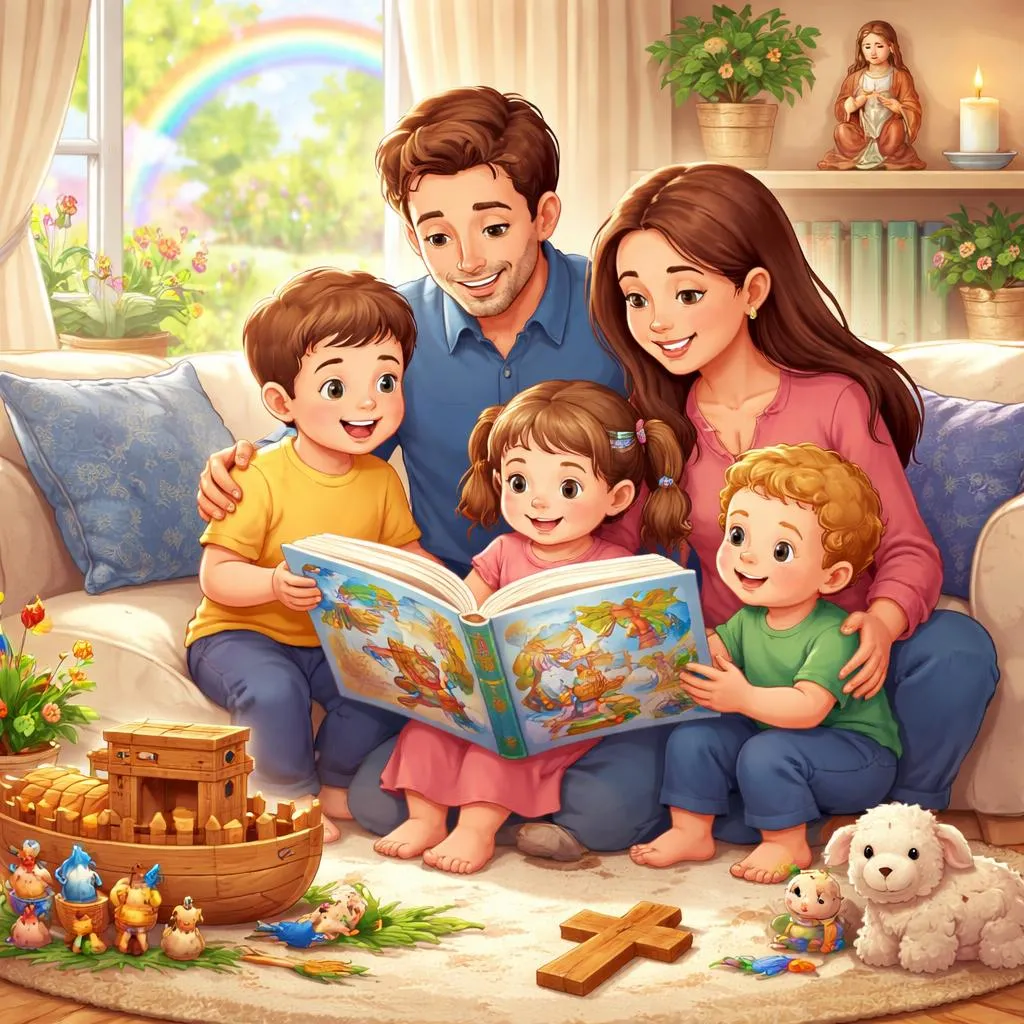

Evening light softens the room as a child snuggles close, ready for a story. For many families, this quiet time includes tales from a special book. The Bible holds stories that have guided people for thousands of years. When we share Catholic children's Bible stories with our little ones, we pass along more than just narratives. We share our faith, our values, and our hope.
These stories speak to children in ways that simple lessons cannot. They feature heroes and miracles, challenges and triumphs. Let us explore together how to make these ancient tales come alive for young hearts today.
<h2>What is the story?</h2> Catholic children's Bible stories often begin with the very beginning. The story of creation appears in the first book of the Bible. God creates light and dark, sky and sea, plants and animals. Finally, God creates people in his own image. This story appears simple but carries deep meaning.In a children's version, we might read, In the beginning, everything was dark and empty. Then God said, Let there be light. And light appeared. God looked at the light and saw it was good. Each day God made something new. On the seventh day, God rested and looked at all the beautiful things he had made.
Children love the rhythm of this story. They enjoy hearing about each day of creation. They can imagine the world forming step by step. The repetition helps them remember and retell the story themselves.
<h2>The message of the story</h2> Every Catholic children's Bible story carries a message about God's love. The creation story tells children that they are part of God's beautiful world. God looked at everything he made and saw it was good. This includes each child. They are good because God made them.The story also teaches about rest and gratitude. God rested on the seventh day. This shows that rest matters. We can thank God for our world and take time to enjoy it. When we rest, we follow God's example.
Later stories build on this foundation. Noah's ark shows God's protection. David and Goliath shows courage with God's help. Jonah and the whale shows God's mercy. Each tale adds another layer to a child's understanding of faith.
We can ask our children, What part of God's world are you most thankful for today? This helps them connect the ancient story to their own lives.
<h2>Vocabulary learning</h2> Catholic children's Bible stories introduce special words that children will hear in church and prayer. These words carry important meanings that we can explain gently.In the creation story, children meet the word firmament. This old word means the sky or heavens. We can say, The firmament is that big blue dome we see above us. God put it there to separate the water above from the water below.
Other stories introduce words like covenant, which means a special promise between God and people. Ark means a big boat, but also a special box that held the Ten Commandments. Prophet means someone who speaks for God.
We can use these words in our daily talk. When your child makes a promise, you might say, That sounds like a covenant. When you speak up for someone, you might say, You are being a prophet today, speaking up for what is right.
<h2>Phonics points</h2> The names in Catholic children's Bible stories give us wonderful phonics practice. Many biblical names come from Hebrew and have sounds children can explore.Take the name Adam. It starts with a short A sound. Aaa-dam. Can you hear that first sound? What other names start with A? Abraham starts the same way. So does Aaron.
The name Eve starts with a long E sound. Eee-ve. This sound appears in many words like eat and see. We can find words that share this sound as we read.
Longer names like Goliath give us syllable practice. Go-li-ath. Let's clap the parts together. This helps children hear word structure. Names like Nebuchadnezzar offer wonderful stretching practice for young tongues.
We can play with these sounds by finding other words that begin the same way. Goliath starts with G, like giant and goat. What other G words can we think of?
<h2>Grammar patterns</h2> Bible stories often use special language patterns that differ from everyday speech. Catholic children's Bible stories retold for young readers keep some of this beauty while making it understandable.We see phrases like, And God said, Let there be light. This structure with let there be appears throughout the creation account. It shows God's power to speak things into existence. Things happen just because God says so.
We also see past tense forms that might seem unusual. In some versions, we read, The Lord spake unto Moses. The word spake is an old form of spoke. We can explain that people long ago talked this way, just like we use different words in different times.
The stories use and to connect events. And Noah built the ark. And the animals came two by two. This simple connector creates a flowing rhythm that carries children through the tale.
<h2>Learning activities</h2> After sharing Catholic children's Bible stories, we can extend the experience through gentle activities. These help children internalize the stories and their meanings.For the creation story, take a nature walk together. Notice the sky, the plants, the animals. Talk about each as something God made. Collect small treasures like leaves or smooth stones. At home, arrange them in order of creation. Monday we saw light. Tuesday we saw sky. Your collection grows through the week.
For Noah's ark, gather pairs of animal toys. Line them up two by two. Talk about how Noah cared for each creature. Why did God want Noah to save the animals?
For David and Goliath, collect five smooth stones like David used. Practice your aim with soft balls instead of real stones. Talk about how David felt brave because God was with him.
These activities make the stories real and personal. Children remember what they do even more than what they hear.
<h2>Printable materials</h2> Many wonderful printable materials exist for Catholic children's Bible stories. These can enrich your family reading time without requiring special preparation.Look for coloring pages showing scenes from the stories. A page with Noah's ark lets children color the animals while you talk about the story. A page with David and his sling leads to conversations about courage.
You can find printable sequencing cards for many Bible stories. These show events in order. Your child can arrange them while retelling the tale. This builds comprehension and narrative skills.
Some websites offer printable mini-books that children can fold and color. These become their own Bible story collections. Children feel proud to own books they helped create.
You might also find simple crossword puzzles or word searches using Bible vocabulary. These feel like games while reinforcing new words.
<h2>Educational games</h2> Games based on Catholic children's Bible stories make learning active and joyful. These work well for family time or quiet afternoons.Play a memory matching game with pairs of cards showing Bible scenes or characters. Turn them face down and take turns finding matches. When someone finds a match, they tell something about that story.
Play Bible story charades. Act out a story without words while others guess. This works especially well with action-filled tales like Daniel in the lions' den or Jonah being swallowed by the great fish.
For younger children, play a simple sorting game. Gather pictures of animals, people, and objects from different stories. Can your child sort which things belong to which story? The ark animals go with Noah. The sling goes with David.
Create a story dice game. On a large cube, tape pictures representing different Bible stories. Your child rolls the dice and tells something about the story that appears. This builds recall and confidence.
These games show that faith learning can feel like play. Children absorb the stories while having fun together. They remember the laughter as well as the lessons.
The Bible contains many stories, but Catholic children's Bible stories choose those most suited for young hearts. They focus on God's love, protection, and guidance. They show people making mistakes and God offering forgiveness. They reveal a God who walks with us through every moment.
When we share these stories, we give our children a foundation for life. They learn that they belong to a story much larger than themselves. They join a family that stretches back thousands of years. They discover that God knows them by name and calls them good.
So find a children's Bible with beautiful pictures. Choose a quiet time when you will not rush. Let the words wash over both of you. The stories of faith will sink deep into your child's heart, and into yours as well. These moments around a book become holy ground, where love and learning meet.