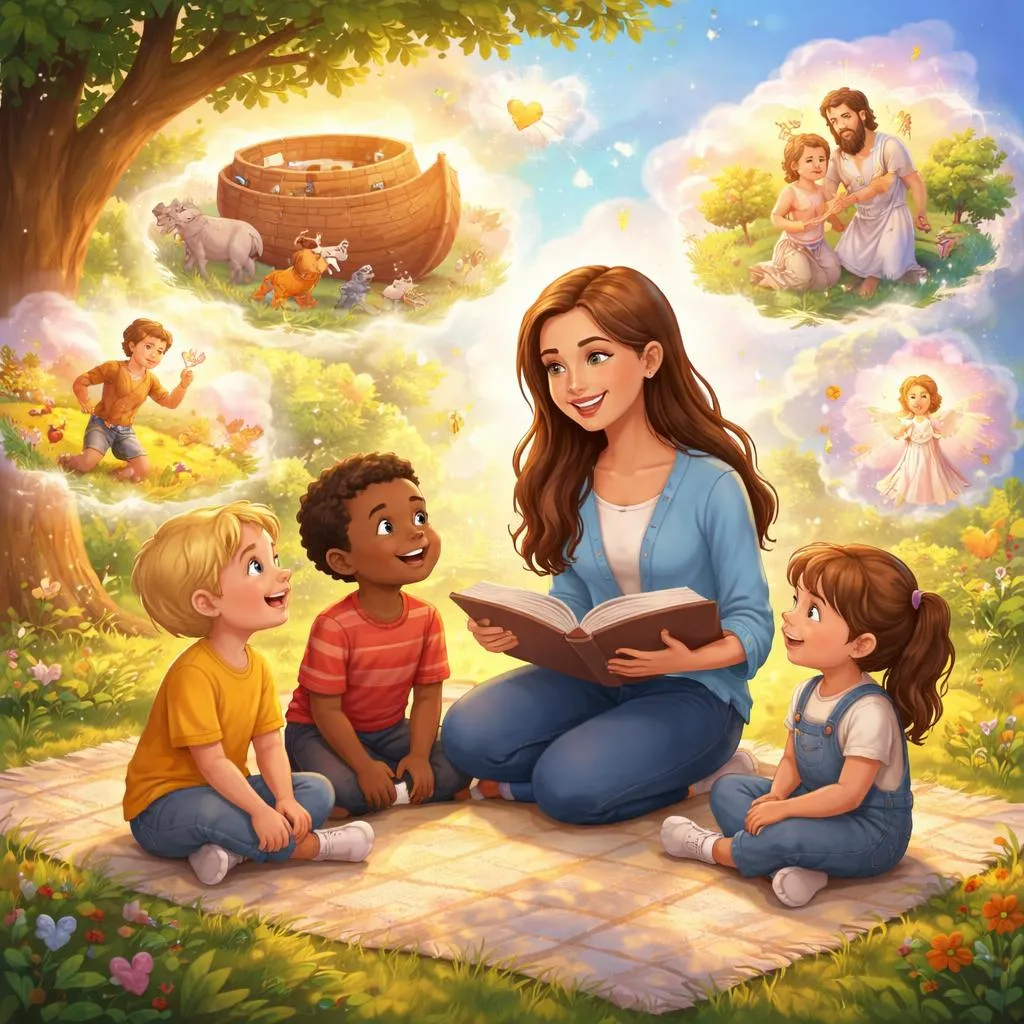

Stories carry meaning beyond words. They shape how children see the world. They introduce values and beliefs. They provide language for discussing faith. Children's christian stories serve these purposes. They tell of God's love. They share examples of faith. They explain complex ideas simply. For language learners, these stories offer rich vocabulary about hope, kindness, and belief. They introduce words not found in everyday conversation. They provide narratives that connect to family traditions and church experiences. Let us explore how these stories support both language development and spiritual understanding in early childhood.
What Are Children's Christian Stories?
These are narratives written for young children that share Christian themes and values. Some come directly from the Bible. Noah's ark. David and Goliath. The birth of Jesus. Others are original stories that teach Christian lessons. A story about sharing might connect to Jesus's teachings. A tale about forgiveness might reflect the Lord's Prayer. These stories use simple language. They feature relatable characters. They end with clear messages. The goal is both entertainment and spiritual formation. Children learn about God's love. They learn how to treat others. They learn words for their faith.
Categories of Children's Christian Stories
Understanding different story types helps in selecting appropriate materials for specific learning goals.
Bible Stories: These retell narratives from scripture. Creation, Noah, Moses, David, Daniel, Jonah, Jesus, the disciples. They introduce key biblical figures and events. They build religious vocabulary and cultural literacy.
Parables and Teachings: Stories based on Jesus's parables. The good Samaritan. The prodigal son. The lost sheep. These focus on how to live. They teach about kindness, forgiveness, and God's love.
Character Stories: Original tales featuring children or animals learning Christian values. A child who learns to share. An animal who forgives a friend. These make abstract concepts concrete through relatable characters.
Holiday Stories: Narratives tied to Christian celebrations. Christmas stories about Jesus's birth. Easter stories about his resurrection. These connect faith to family traditions and seasonal observances.
Saint Stories: Tales about the lives of saints and faithful people. Stories of kindness, courage, and devotion. These provide historical and inspirational examples.
Vocabulary Learning from Christian Stories
These narratives introduce vocabulary across multiple domains. Words connect to faith, values, emotions, and actions.
Faith Words: God, Jesus, Holy Spirit, Bible, prayer, faith, believe, trust, worship, praise, thank, amen. Value Words: love, kindness, forgive, share, help, care, give, serve, obey, honor, respect, gentle. Bible Words: angel, prophet, disciple, apostle, scripture, covenant, promise, miracle, parable, temple. Emotion Words: joy, peace, hope, comfort, gratitude, wonder, awe, sorry, forgiven, loved, blessed. Action Words: pray, sing, read, tell, learn, grow, follow, trust, obey, share, give, help.
Each story introduces words in meaningful contexts. A parable teaches value vocabulary. A miracle story introduces wonder words. Prayer stories teach worship vocabulary.
Phonics Points in Christian Stories
Specific sound patterns emerge through key vocabulary. Identifying these helps build decoding skills.
The /g/ sound: God, good, gift, garden, glory. The central figure starts with this sound. Practice saying God words together.
The /j/ sound: Jesus, joy, journey, Jerusalem. Jesus is central. Joy is a fruit of faith. The sound appears frequently.
The /l/ sound: love, light, life, Lord, lamb. Love is the greatest commandment. Light overcomes darkness. Life is a gift.
The /p/ sound: pray, praise, promise, parable, prophet. Prayer connects to God. Praise expresses joy. Promises give hope.
Rhyming words: pray/day, love/above, care/share, light/night. Simple rhymes help children remember key concepts.
Grammar Patterns in Christian Stories
Children's christian stories model various grammatical structures within their narratives.
Past Tense Narrative: Bible stories use past tense. "God created the world." "Moses led the people." "Jesus healed the man." This provides extensive past tense modeling.
Present Tense Truth: Stories about God's love often use present tense. "God loves you." "Jesus cares for everyone." "Angels watch over us." This expresses eternal truths.
Future Tense Hope: Stories of heaven and promises use future language. "We will see God one day." "Jesus will come again." "We will live forever." This models future meaningfully.
Imperative Sentences for Living: Stories teach how to live using commands. "Love your neighbor." "Forgive others." "Share with those in need." This models instruction language positively.
Questions to God: Characters ask questions. "Why me, God?" "How can this be?" "What do you want me to do?" Questions model prayer language.
Learning Activities for Christian Stories
Active engagement helps children internalize vocabulary and themes through hands-on learning.
Prayer Journal: Create simple prayer journals. Each day, draw or write one thing to thank God for. Use gratitude vocabulary. "Thank you for my family." "Thank you for food." This builds written expression and faith language.
Thankful Tree: Create a tree from paper or branches. Add leaves with things children are thankful for. Read together. Use thankful language. "I am thankful for my home." "I am thankful for friends."
Good Deeds Chart: Track kind actions during the week. Share stories of helping others. Connect to Jesus's teaching about love. Use action vocabulary. "I shared my snack." "I helped a friend." "I said sorry."
Story Retelling with Puppets: Use simple puppets to retell Bible stories or parables. This builds narrative skills and makes stories memorable.
Prayer Hands Craft: Trace children's hands. On each finger, write someone or something to pray for. Family, friends, teachers, world, self. Use prayer vocabulary.
Learning Activities for Group Settings
Collaborative learning builds language through interaction and shared experiences.
Story Sequencing with Pictures: Create picture cards showing main events from a Bible story. Groups arrange in order and retell together. This builds narrative skills and teamwork.
Character Interviews: Students take turns playing Bible characters. Classmates interview them. "Noah, was it hard building the ark?" "David, how did you feel facing Goliath?" "Mary, what did the angel say?" This builds question formation and perspective.
Verse Memory Circle: Learn simple Bible verses together. Say them in a circle. Pass a special object while saying the verse. This builds memorization and community.
Kindness Challenge: Challenge the class to perform kind acts. Share stories of kindness at the end of each day. Connect to Jesus's teaching. This builds action vocabulary and character.
Educational Games for Christian Stories
Games make learning playful and memorable.
Bible Bingo: Create bingo cards with Bible story pictures. Ark, dove, lion, giant, stone, fish, star, manger, cross. Call out words or descriptions. Students cover matching pictures.
Memory Match with Bible Cards: Create pairs of cards with Bible pictures. Noah/Noah. David/David. Jesus/Jesus. Place face down. Students flip two looking for matches. Name pictures when flipping.
Who Am I? Game: Describe a Bible character. Students guess who it is. "I built an ark." (Noah) "I fought a giant." (David) "I was born in a stable." (Jesus) This builds listening and Bible knowledge.
Fruit of the Spirit Sort: Create cards with fruit of the Spirit words. Love, joy, peace, patience, kindness, goodness, faithfulness, gentleness, self-control. Discuss what each means. Sort actions under each fruit.
Printable Materials for Christian Stories
Ready-to-use printables extend learning beyond story time.
Bible Vocabulary Flashcards: Create cards with Bible pictures on one side and words on the other. Ark, dove, lion, giant, stone, fish, star, manger, cross, angel. Use for matching games or quick review.
Story Sequencing Cards: Create cards showing main events from specific Bible stories. Students arrange in order and retell using complete sentences. This builds narrative skills.
Bible Coloring Pages: Print outline drawings of Bible story scenes. Noah's ark. David and Goliath. Daniel and lions. Jesus with children. Students color while discussing with partners.
Prayer Cards: Create simple prayer cards with prompts. "Today I thank God for..." "Today I pray for..." "God, please help..." Students complete during prayer time.
Verse Cards: Create cards with simple Bible verses. "God is love." "Jesus loves me." "Be kind to one another." Practice reading together. Memorize as a class.
Daily Life Connections to Christian Stories
Linking story themes to daily experiences makes learning relevant and personal.
Thankful Moments: Throughout the day, pause to notice things to thank God for. Sunshine. Food. Friends. A fun game. Use thankful language naturally.
Kindness Observations: Notice when children show kindness. Name it. "That was kind like Jesus taught." "You shared just like the good Samaritan." This connects behavior to faith language.
Forgiveness Practice: When conflicts arise, practice forgiveness language. "I forgive you." "Let's try again." "Jesus wants us to forgive." This builds social-emotional and faith vocabulary.
Wonder and Awe: Notice beautiful things together. A sunset. A flower. A baby. Use wonder language. "God made such beautiful things." This builds gratitude and observation.
Printable Flashcards from Christian Stories
Effective flashcards support multiple learning styles.
Picture-Word Cards: Front shows simple Bible story drawing or printed image. Back shows word in English. God, Jesus, Bible, angel, ark, dove, lion, giant, stone, star, manger, cross.
Character Cards: Create cards for each Bible character with simple descriptions. "Noah: built an ark." "David: killed a giant." "Daniel: prayed to God." "Mary: Jesus's mother." "Jesus: God's son." Students match characters to descriptions.
Fruit of the Spirit Cards: Create cards for each fruit. Love, joy, peace, patience, kindness, goodness, faithfulness, gentleness, self-control. Discuss what each means. Practice using in sentences.
Verse Cards: Create cards with simple Bible verses. "God is love." (1 John 4:8) "Jesus loves me." (Bible basis) "Be kind." (Ephesians 4:32) Practice reading and memorizing.
Phonics Practice from Christian Words
Use Christian vocabulary for targeted phonics instruction.
Initial Sound Sort: Provide Bible picture cards. God, Jesus, angel, ark, dove, lion, stone, star, manger, cross. Students sort by beginning sound. G words. J words. A words. D words. This builds phonemic awareness.
Syllable Clapping: Clap syllables in Christian vocabulary. God (1). Je-sus (2). Bi-ble (2). An-gel (2). Cre-a-tion (3). For-give-ness (3). This builds phonological awareness.
Rhyming Word Hunt: Find words that rhyme with Christian words. Love/above/dove. Pray/day/say. Light/night/bright. Save/cave/brave. Create rhyming pairs and use in sentences.
Vowel Sound Sort: Sort Christian words by vowel sounds. God has short /o/. Jesus has long /e/ in first syllable. Love has short /u/. Light has long /i/. This builds vowel discrimination.
Grammar Patterns Practice
Use Christian story sentences to practice specific grammar structures.
Past Tense Practice: Write sentences with missing verbs. "Noah ___ an ark." Students choose from "build" or "built." "David ___ Goliath." Choose from "fight" or "fought." "Jesus ___ the people." Choose from "teach" or "taught." Discuss correct choices.
Present Tense Truths: Practice present tense using faith statements. "God loves me." "Jesus cares for everyone." "Angels watch over us." Students create their own faith statements using present tense.
Question Formation: Practice asking questions about faith and Bible stories. "Who created the world?" "What did Jesus teach?" "Where is God?" "Why should we forgive?" Students ask and answer with partners.
Because Sentences: Practice causal sentences using "because." "Noah built the ark because God told him." "David won because God helped him." "We forgive because God forgives us." Students create because sentences.
The Faith and Language Connection
Children's christian stories offer unique value in language classrooms, particularly in faith-based settings. They provide vocabulary for discussing belief. They introduce narratives that shape moral understanding. They model language of love, forgiveness, and hope. Children learn words for their faith experiences. They gain language for prayer and worship. They understand stories their families share. For educators in Christian settings, these stories are essential resources. They combine language development with spiritual formation. They teach English while teaching faith. They prepare children to participate in their religious communities. The stories make abstract concepts concrete through narrative. They prove that language learning and faith formation can happen together, each enriching the other.