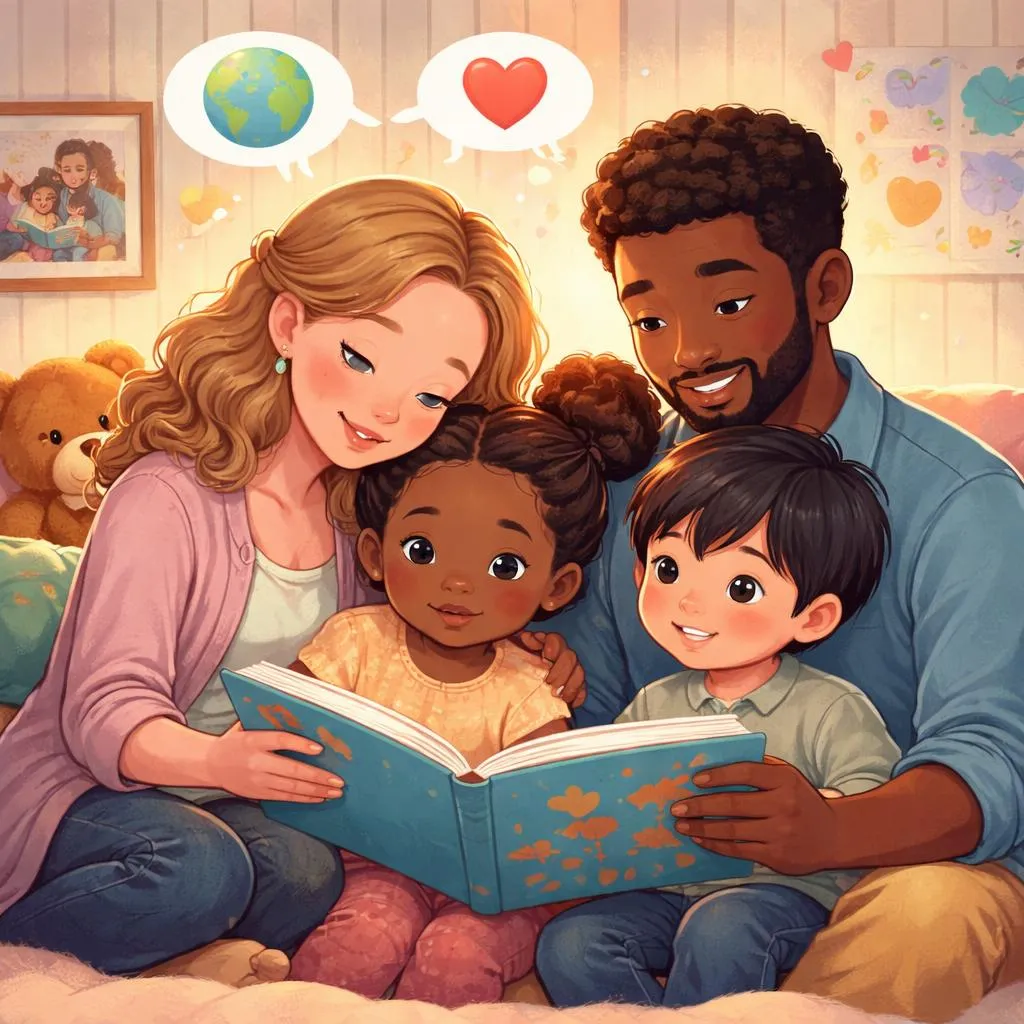

Families form in many beautiful ways. Adoption represents one path to parenthood. Children's stories about adoption help explain this journey. They use simple language for complex topics. They validate diverse family experiences. This article explores practical teaching applications for these special books. The focus remains on language development through adoption narratives. Let us examine how these stories support English learning.
What Are Children's Stories About Adoption? Children's stories about adoption are narratives that feature adoption themes. Some tell how a child joined their family. Others explore feelings about being adopted. Many celebrate family love regardless of biological connection.
These books serve multiple purposes. They help adopted children see their stories reflected. They teach non-adopted children about family diversity. They provide vocabulary for discussing adoption. They normalize different paths to parenthood. The common thread involves celebrating love as the foundation of family.
Vocabulary Learning from Adoption Stories Children's stories about adoption introduce vocabulary for discussing family formation. Adoption-specific words appear throughout. "Adoption," "birth mother," "adoptive parents," "chosen," "forever family," and "origin" name key concepts. Students learn these terms through story context.
Family words expand beyond traditional definitions. "Family," "parents," "mother," "father," "sister," "brother," and "relative" appear with broader meanings. Students understand that families look different ways.
Emotion words carry the adoption experience. "Loved," "wanted," "chosen," "special," "hopeful," and "grateful" describe positive feelings. "Confused," "curious," "sad," "worried" acknowledge complex emotions. Students build emotional vocabulary through character experiences.
Action words describe the adoption process. "Wait," "hope," "travel," "meet," "hold," "promise," and "celebrate" show adoption events. Students learn verbs associated with family formation.
Phonics Points in Adoption Stories Children's stories about adoption contain useful phonics patterns. The "op" sound appears in key words. "Adoption," "option," and "hop" share this pattern. Students practice this sound in meaningful contexts.
The "ch" sound appears in emotion words. "Chosen," "cheer," "church," and "chance" occur frequently. Students practice this digraph while discussing positive adoption language.
Long vowel sounds appear in family words. "Mother" contains the short "u" sound. "Father" contains the short "a" sound. "Family" contains multiple vowel sounds. Students encounter these in familiar contexts.
Word families extend from story vocabulary. "Love" connects to "dove" and "above." "Home" connects to "dome" and "roam." Students extend patterns from family words.
Grammar Patterns in Adoption Stories Children's stories about adoption model specific grammatical structures. Past tense tells the adoption story. "We waited for a long time." "The phone rang one day." "We traveled to meet you." Students encounter past forms in personal narrative contexts.
Present tense describes current family life. "We love you very much." "You are part of our family." "We belong together." Students see present tense for ongoing truths.
Future tense expresses hopes and plans. "We will always be your family." "You will grow and thrive." "We will celebrate together." Students learn future forms expressing commitment.
Question forms address common adoption questions. "Where did I come from?" "Why was I adopted?" "Do I have another mother?" Students hear question patterns that matter deeply.
Learning Activities with Adoption Stories Several activities work well with children's stories about adoption. Family tree projects celebrate diverse structures. Provide templates that accommodate various family forms. Adoptive, blended, single-parent, and extended families all fit. Students draw and label their families.
Emotion charts track character feelings throughout stories. List story events in one column. List character emotions in another. Discuss why feelings change. This builds emotional vocabulary and comprehension.
Wish writing explores hopes for families. Students write about what they wish for their families. Adopted or not, all children have family wishes. This builds expressive language.
Classroom family diversity discussions normalize different structures. Read multiple adoption stories. Discuss how families form in various ways. All families share love. This builds inclusion vocabulary.
Printable Flashcards for Adoption Vocabulary Flashcards reinforce key vocabulary from children's stories about adoption. Create cards for family members. "Mother," "father," "parent," "child," "sister," "brother," "grandparent." Use simple drawings on one side, words on the reverse.
Adoption-specific cards build specialized vocabulary. "Adoption," "birth mother," "adoptive parents," "chosen," "forever family," "origin." Students learn these terms through discussion.
Emotion word cards support feeling vocabulary. "Loved," "wanted," "chosen," "special," "hopeful," "grateful," "curious," "worried." Match each feeling to story moments.
Action word cards capture adoption events. "Wait," "hope," "travel," "meet," "hold," "promise," "celebrate." Students connect actions to adoption stories.
Educational Games with Adoption Stories Games transform children's stories about adoption into interactive experiences. Family bingo works well. Create cards with diverse family elements. Mother, father, sibling, grandparent, adoption, chosen. Call out descriptions. Students mark matches.
Match game pairs family members with roles. Create cards with family member names and cards with what they do. Students match each member to typical family roles.
Feelings charades engages emotional learning. Write feeling words on cards. Students act out emotions while others guess. Connect feelings to adoption story moments.
Story sequencing with adoption narratives builds comprehension. Provide sentence strips from adoption stories. Students arrange in correct order. This builds understanding of adoption narrative structure.
Printable Materials for Adoption Story Lessons Printable materials support structured learning with adoption stories. Family diversity worksheets celebrate different structures. Provide pictures of various family types. Students label family members and describe relationships.
All about me pages help students share their own stories. Provide prompts about family, origins, and what makes each child special. All children complete regardless of family structure.
Emotion journals track feelings about family. Students draw and write about family moments. This builds emotional vocabulary and self-expression.
Comprehension questions check understanding of adoption stories. Create questions about characters, feelings, and family relationships. Students answer verbally or in writing.
Emotional Vocabulary Development Children's stories about adoption uniquely support emotional vocabulary. Adoption involves complex feelings. Characters experience joy, anticipation, curiosity, and sometimes sadness. Students encounter this emotional range.
Positive emotion words abound. "Loved," "cherished," "wanted," "celebrated," "welcomed." Students build vocabulary for positive family experiences.
Complex emotion words acknowledge difficulty. "Confused," "uncertain," "longing," "wondering." Students learn that mixed feelings are normal. They gain words for these experiences.
Emotional vocabulary supports all students. Every child has feelings about family. Adoption stories provide language for discussing these feelings safely.
Family Diversity Understanding Adoption stories naturally teach about family diversity. Families form through birth, adoption, fostering, and blending. All are valid. All center on love.
Students learn that families look different. Some have two moms. Some have two dads. Some have one parent. Some have grandparents as parents. Adoption stories often include this diversity.
Respect for different family structures develops through stories. Students see families like theirs and unlike theirs. Both receive positive portrayal. This builds acceptance vocabulary.
Discussion questions explore family diversity. "What makes a family?" "Who loves you?" "Who takes care of you?" Students discover commonalities across diverse structures.
Character Education Through Adoption Stories Adoption stories naturally support character education. Love appears as the foundation of family. Characters love across biological connection. Students discuss what love means in families.
Commitment features prominently. Adoptive parents commit to children. They promise forever care. Students explore what commitment means.
Patience appears in adoption waiting. Families wait to be matched. They wait to meet children. Students discuss patience in their lives.
Gratitude emerges in adoption stories. Characters feel grateful for families. Students explore gratitude for their own families and caregivers.
Creating Inclusive Classroom Communities Adoption stories help build inclusive classrooms. All family structures receive validation. Students feel seen and respected. This psychological safety supports language learning.
Classroom language shifts toward inclusion. "Your family" replaces assumptions about "mom and dad." Students learn inclusive vocabulary naturally.
Family celebration events include all structures. Mother's Day and Father's Day acknowledge various caregivers. Adoption stories provide language for this inclusion.
Peer understanding develops through stories. Non-adopted children learn about adoption. They become allies and friends. This builds classroom community.
Home Connection Through Adoption Stories Adoption stories create home-school connections. Families share their own stories. Adoptive families find resources. All families discuss what makes theirs special.
Take-home books extend learning. Students borrow adoption stories to read at home. Families discuss together. This doubles language exposure.
Family history projects involve caregivers. Students learn and share their family stories. All stories valued equally. This builds pride and language skills.
Conversation starters emerge from stories. "How did our family form?" "What makes our family special?" Families discuss these questions naturally after reading.
Children's stories about adoption provide rich material for language development and social-emotional learning. They introduce vocabulary for family diversity. They build emotional vocabulary through character experiences. They validate all family structures. Young learners acquire English while exploring what makes families special. The combination of linguistic and emotional learning creates powerful educational experiences. All children benefit from understanding that love, not biology, defines family.