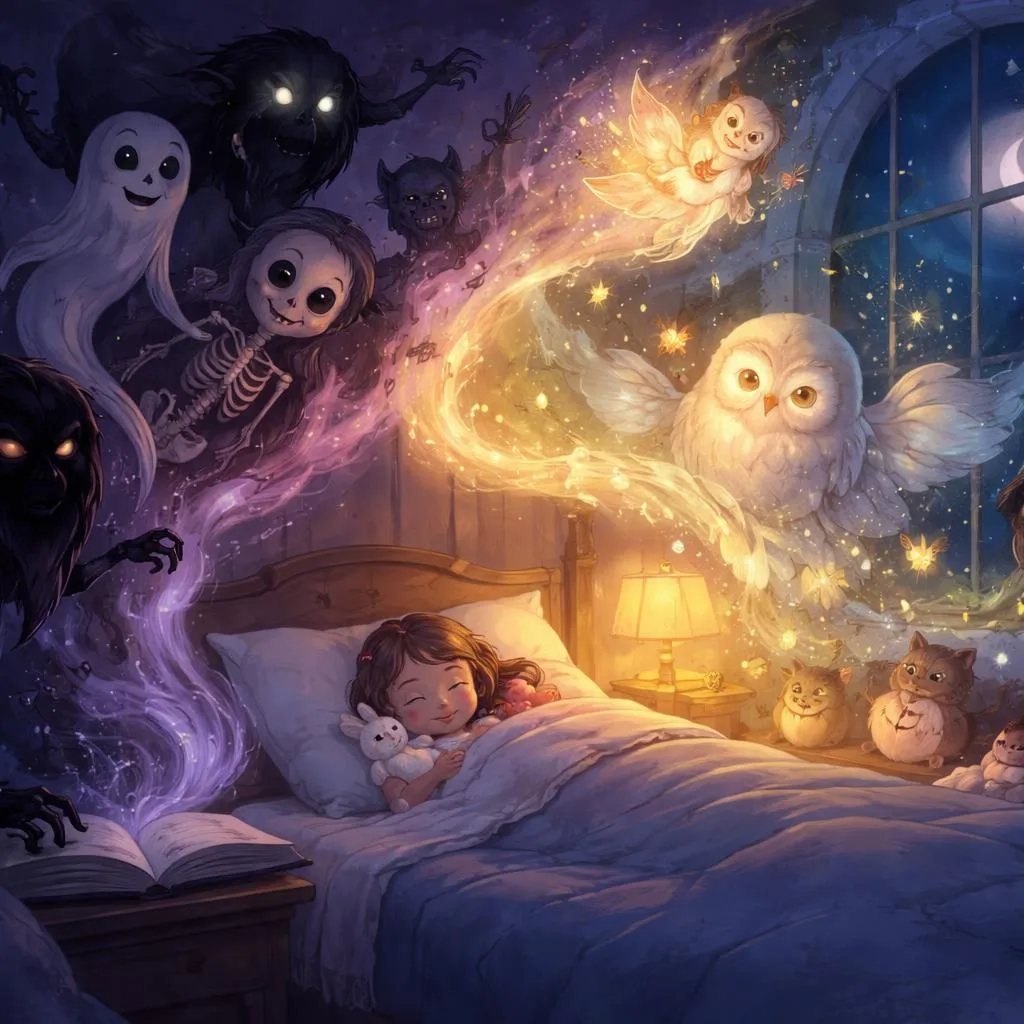

The word “creepy” often conjures images of things that go bump in the night, of shadows that move just outside the corner of the eye, a feeling of vague, prickling unease. In our search for calm, why would we ever invite such a feeling in? But consider this: the true weight that keeps us awake is often not outright terror, but a low-grade, persistent creepiness of the mind—the nagging thought that won’t resolve, the subtle anxiety about tomorrow, the eerie feeling of disconnection after a day spent in digital noise. What if we could use the very structure of a story to meet that feeling, not to run from it, but to sit with it, examine it under a soft light, and watch it lose its power? This is the purpose of the narrative that follows. It is not a scary story, but a story about the sensation of “creepy” itself. We will personify that faint unease, walk alongside it, and in doing so, disarm it completely, transforming the experience into a pathway to profound peace. Let this be your guided meditation, a different kind of creepy bedtime story designed not to frighten, but to liberate.
First, settle in. Feel the weight of your body being fully supported, welcomed by your bed. Notice the points where you touch the sheets, the pillow. There is safety here, a defined boundary. Now, take a breath that feels a little deeper than the one before. As you exhale, imagine releasing the tension you can name—the tightness in your shoulders, the clench in your jaw. With the next exhale, release the tension you can’t name—that background hum, that faint static. We are creating a clean, quiet space within. Into this space, we will gently invite a metaphor for that lingering, creepy feeling. We will give it a form, and in giving it form, we will see it for what it truly is: often just a lonely, misunderstood thought, waiting to be acknowledged and released.
Begin by imagining a place you know well. Perhaps it is the hallway of your childhood home late at night, or a familiar, cozy living room in a cabin after the lights are turned off. The space is safe, it is yours, but it is also different in the dark. The familiar contours of a chair become soft, hulking shapes. The pattern on the wallpaper seems to shift and swim if you stare too long. This is the stage we are setting. You are standing in this room. The air is cool, still, and carries the settled scent of wood, old books, and a hint of chamomile tea from a cold cup. You hear the house settling—a soft creak from the ceiling, a gentle tick from a cooling radiator. These sounds are the heartbeat of the place. They are not threats; they are the sounds of a structure resting. A good creepy bedtime story for adults doesn’t invent monsters; it simply asks you to listen more closely to the ordinary, until it becomes extraordinary, and then peaceful again.
You feel that familiar, faint sensation—a tiny, cool thread of “creepy” running down your spine. It’s the feeling of being alone in a quiet space. Instead of resisting it, you decide to follow it, with a gentle curiosity. You imagine this feeling as a physical presence, but not a frightening one. Picture it as a small, shadowy cat, made of the same shifting grey mist you see in the corners of the room. It is elusive, silent, and it watches you with eyes that are not menacing, but simply old and deep. It is the embodiment of all those half-formed worries, the “what-ifs,” the memories that feel itchy and strange. It is not evil. It is just… there. This is the central character of our creepy bedtime stories reimagined: the quiet, persistent ghost of daily anxiety.
You don’t run. You simply sit down in the large, comfortable armchair you know is there. You sink into its embrace. You look at the shadow-cat. “It’s okay,” you think, not with words, but with a feeling. “You can be here too.” The cat-like mist blinks slowly. It pads silently across the floor, its form barely disturbing the dust motes dancing in a sliver of moonlight coming through the window. The moonlight is your ally. It is a silver-blue river pouring across the wooden floor, illuminating particles in the air like tiny, slow-moving stars. The “creepy” feeling begins to change. The unknown in the shadows is just furniture, just shapes. The sound is just the house breathing. The mist-cat is just a figment of your tired, overactive mind, given permission to exist.
Now, the shadow-cat approaches. It doesn’t pounce. It simply curls up on the rug at your feet, in a pool of moonlight. As the light touches it, something beautiful happens. The grey mist begins to sparkle, as if filled with minuscule specks of starlight. Its form becomes less defined, more ethereal and beautiful. The “creepy” sensation you felt transforms, in this moment of acceptance, into a feeling of profound melancholy, and then into a deep, deep quiet. This is the alchemy we seek in these specialized adult tales. We are not fighting the dark; we are learning to see the soft light that always exists within it.
You close your eyes in your imagined chair. The room is still there, safe and known. The shadow is now a shimmering, quiet companion at your feet. You listen to the sounds again. The creak becomes the house stretching its joints before sleep. The tick becomes a gentle, rhythmic metronome. From far away, you hear the low, resonant call of a train whistle—a lonely, beautiful sound that speaks of distances and journeys, but not your own. It is a reminder that the world is vast, and your worries are small within it. Your breathing synchronizes with these soft, nocturnal rhythms. Inhale for the count of the tick. Exhale for the long, slow fade of the creak. This mindful engagement with the atmosphere is the true heart of effective creepy bedtime stories; they use the tension of the unknown to bring you utterly into the present, into your body, into your breath.
The mist at your feet, now full of soft, internal light, begins to dissipate. It doesn’t vanish with a pop, but gently rises, like heat haze off summer pavement, or like dandelion seeds taking flight. Each sparkling particle floats upward, joining the other dust motes in the moonbeam, becoming part of the beautiful, ordinary air of the room. The “creepy” feeling is gone. In its place is a spacious, hollowed-out calm. It was never an intruder; it was just a form of energy, stuck and seeking release. By not fearing it, by observing it with a story’s gentle framework, you allowed it to transform and depart.
You feel heavy in the chair, wonderfully heavy. The moonlight seems to wash over you, not cold, but cool and soothing, like liquid silver. The boundaries of your body feel soft. The story has done its work. It provided a container—a safe, familiar room—and a narrative—a curious observation—to process that low-level unease. The best creepy bedtime stories for sleep are exactly this: they are not about external threats, but about the internal act of making peace with the quiet, strange, and unfamiliar corners of our own minds.
Now, let the room itself begin to soften. The edges of the walls blur. The chair you sit in begins to feel more and more like your own bed. The moonlight from the window melts into the general darkness behind your eyelids. The sounds of the settling house become the sound of your own circulation, the quiet rustle of sheets as you breathe. The narrative, having served as a gentle guide, is receding. What remains is the state it helped you find: a deep, empty, and wonderfully peaceful stillness.
The feeling of being watched is gone, because the watcher was you, and you have made peace with yourself. The slight chill is gone, replaced by a gentle, enveloping warmth. The story is over. The metaphor has dissolved, leaving only its effect. You are here, in the quiet dark, more present and more relaxed than before. The mind, having had its subtle fears witnessed and released through the allegory, is now clear, ready for rest.
There is nothing more to imagine, no more shapes to decipher. Allow the last traces of the moonlit room to fade into the soft, blank canvas of pre-sleep. Your breath is slow and even. Your body is at rest. Sleep is no longer a struggle against the “creepy” unknowns of the night, but a natural descent into them, now that you know they hold no real power. They are just shadows, and shadows cannot exist without light. You carry your own light within. Let it glow softly now, as you drift away, cradled by the very quiet you once might have feared. The tale is told. The rest is yours.