
The Big Mix-Up in Squirrel Town
Meet Sam the squirrel. He loves helping in the kitchen. One morning, he wanted to make coffee. He took the beans and said, “I grind them!” But he mixed up words. He shouted, “I ground the beans!” Mom laughed. She knew he meant to say, “I am grinding the beans.” Sam felt silly. He had used the wrong form. Today, we fix that. Think of these words as a tool family. Grind is the worker. Grinder is the tool. Grinding is the job. Ground is the result. They work together but do different things. Follow Sam’s day. You will master them all.
Sam’s mistake spread to school. He told his teacher, “I am a grinder!” She smiled. She thought he meant a machine. Sam meant he grinds nuts. Later, at the playground, he said, “Grinding is fun!” His friends nodded. They liked the game. But Sam still confused grinding with ground. He said, “The ground is grinding!” His pals giggled. Sam realized he needed help. Do not worry. This lesson will clear everything up. We will use fun stories and simple rules. By the end, you will pick the right word every time. No more silly mix-ups. Let’s start!
Meet the Word Toolbox
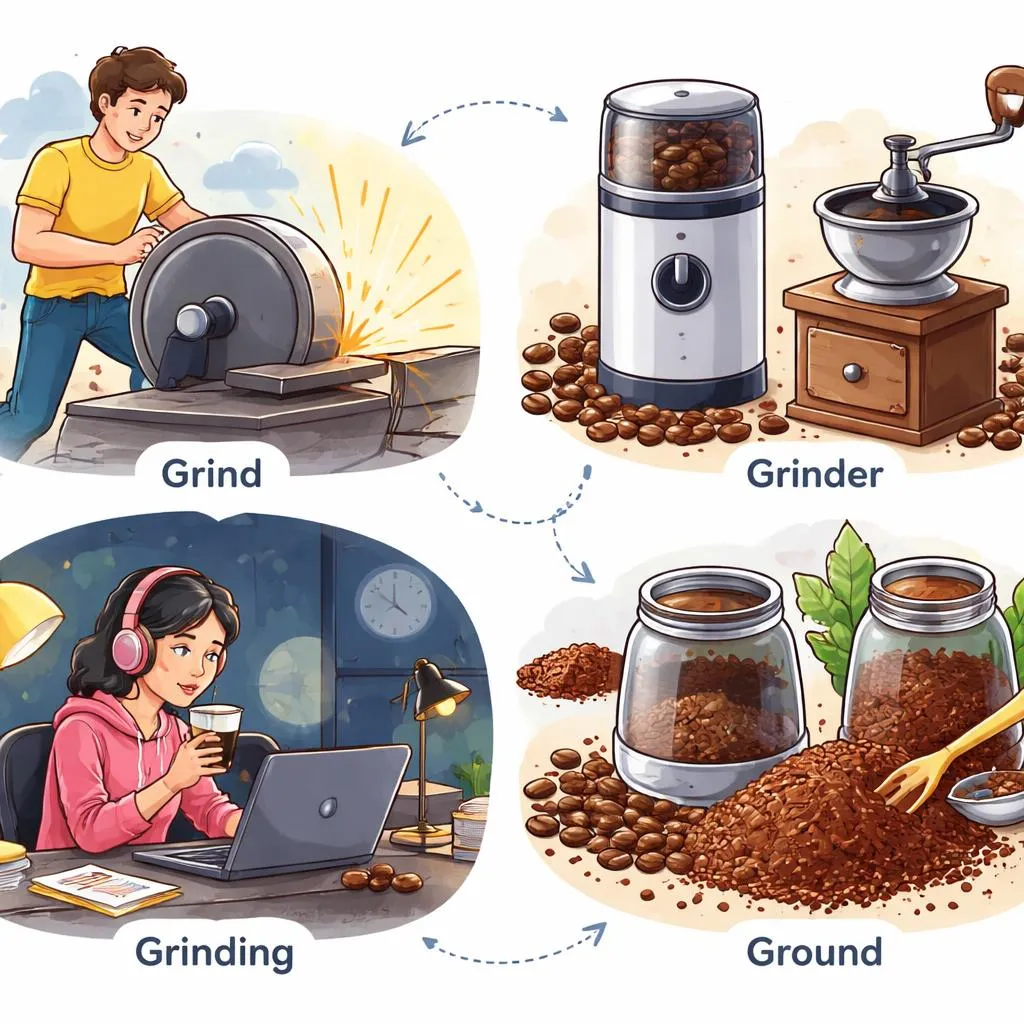
First, let us meet each tool. Grind is the action word. It means crushing things into small bits. We call it the Worker. Grinder is the tool or person who grinds. It can be a machine or a kid. We call it the Tool Master. Grinding is the process of grinding. It shows the action happening now. We call it the Job in Progress. Ground is the past action or the crushed result. It shows something already done. We call it the Finished Product. These nicknames help us remember. Watch Sam use them. At home, he grinds coffee. He uses a grinder. He hears grinding sounds. He sees ground beans. Each tool fits its spot. But Sam still mixes them. We will learn why.
Grind works hard every day. It never rests. Grinder waits to be used. Grinding happens while you watch. Ground stays as proof of work. Together, they make sense. Sam used to think they were the same. Now he knows better. Let’s see how they act in real life. We will follow Sam from morning to night. You will see each word in action. No more confusion. Ready? Let’s go!
Time Tells the Tale
Words change with clocks and calendars. Some show now. Some show yesterday. Others show always. At home, Sam says, “I grind nuts every morning.” That is habit. He says, “I am grinding wheat now.” That is present action. He says, “I ground oats yesterday.” That is past action. In the playground, Sam shouts, “Kids grind chalk on slides!” That is regular activity. He adds, “We are grinding leaves today!” That is current fun. He recalls, “We ground crayons last week.” That is past mess. At school, the teacher says, “We grind spices for science.” That is routine. She notes, “Students are grinding rocks now.” That is ongoing experiment. She adds, “They ground minerals before.” That is past learning. In nature, Sam watches a squirrel. He whispers, “It grinds acorns daily.” That is natural habit. He sees a bird. “It is grinding seeds!” That is current meal. He remembers, “The beaver ground wood yesterday.” That is past work. See the pattern? Grind is for now or habit. Grinding is for right now. Ground is for yesterday. Remember your clock. Pick the right word.
Time never lies. If you do something every day, use grind. If you are doing it this second, use grinding. If you did it before, use ground. Sam learned this the hard way. Now he checks the clock first. You should too. It saves a lot of trouble. Try it next time you speak. You will sound smart!
Jobs in the Sentence
Each word wears a uniform. Some do actions. Others name things. Grind is a verb. It shows the action of crushing. Example: “Dad grinds pepper for soup.” Grinder is a noun. It names the tool or person. Example: “The grinder sits on the counter.” Grinding is a gerund or participle. As a gerund, it names the process. As a participle, it describes something. Example: “Grinding takes time.” Or “The grinding noise is loud.” Ground is a verb past tense or past participle. As past tense, it shows finished action. As participle, it describes the crushed result. Example: “I ground the beans.” Or “The ground coffee smells good.” At home, Sam says, “I grind nuts.” Verb action. He points to the grinder. Noun tool. He hears grinding sounds. Gerund process. He sees ground beans. Participle result. In the playground, Sam acts as the grinder. Noun person. He grinds sticks. Verb action. He plays a grinding game. Gerund activity. He steps on ground chalk. Participle result. At school, the teacher uses a grinder. Noun tool. We grind samples. Verb action. Grinding requires patience. Gerund process. Ground powder is fine. Participle result. In nature, the beaver is a grinder. Noun animal. It grinds trees. Verb action. Grinding wood makes dust. Gerund process. Ground bark is soft. Participle result. Always check the uniform. Is it doing or naming? Choose right.
Jobs matter more than you think. A worker (grind) cannot be a tool (grinder). A process (grinding) cannot be a result (ground). Sam used to mix them up. Now he checks the job first. You can do it too. Just ask: “Is this word doing something or naming something?” Easy!
Who Likes Helpers
Some words stand alone. Others need buddies. Grind often goes solo. Example: “I grind coffee.” No helpers needed. Grinding needs “is/am/are” for present continuous. Example: “I am grinding nuts.” Ground as past tense stands alone. Example: “I ground oats.” As past participle, it needs “have/has/had” or “is/was/were.” Example: “I have ground the beans.” Or “The beans are ground.” At home, Sam says, “I grind nuts.” Alone. He says, “I am grinding wheat.” Needs “am.” He says, “I ground oats.” Alone. He says, “I have ground barley.” Needs “have.” In the playground, Sam says, “Kids grind chalk.” Alone. They say, “We are grinding leaves.” Needs “are.” They say, “We ground crayons.” Alone. They say, “We have ground markers.” Needs “have.” At school, the teacher says, “We grind spices.” Alone. She says, “We are grinding rocks.” Needs “are.” She says, “We ground minerals.” Alone. She says, “We have ground salt.” Needs “have.” In nature, Sam says, “The squirrel grinds acorns.” Alone. It says, “It is grinding seeds.” Needs “is.” It says, “It ground wood.” Alone. It says, “It has ground branches.” Needs “has.” Learn the buddy system. It makes sentences smooth.
Helpers are like friends. They make words work better. Grind does not need friends. Grinding needs “is/am/are” to play. Ground needs “have/has/had” or “is/was/were” to join the party. Sam forgot this once. He said, “I am grind.” His mom corrected him. Now he remembers the buddies. You will too!
Small Differences Matter
Words seem alike but have secrets. Grind is the action itself. Grinding is the process of doing it. Ground is the result or finished state. At home, Sam says, “Grind the coffee.” Action command. He says, “Grinding coffee takes effort.” Process description. He says, “The ground coffee is ready.” Result state. In the playground, Sam says, “Grind the chalk.” Action request. He says, “Grinding leaves is messy.” Process comment. He says, “The ground chalk is powder.” Result observation. At school, the teacher says, “Grind the rock.” Action instruction. She says, “Grinding minerals is hard.” Process note. She says, “Ground minerals are useful.” Result fact. In nature, Sam says, “Grind the acorn.” Action suggestion. He says, “Grinding seeds feeds birds.” Process benefit. He says, “Ground seeds are easy to eat.” Result advantage. Using the wrong twin changes meaning. Say “grind” for the action. Say “grinding” for the process. Say “ground” for the result. Be exact.
Small differences make big sense. Sam learned this when he said, “The ground is grinding.” His friend laughed. Now he knows: grind = do, grinding = doing, ground = done. Simple! Keep these differences in mind. You will never mix them up again.
Avoid the Common Traps
Kids often trip here. Let us fix mistakes. Mistake one: “I am grind the coffee.” Wrong. Grind is verbbase, cannot follow “am.” Correct: “I grind the coffee.” Or “I am grinding the coffee.” Mistake two: “The grinder is grind.” Wrong. Grinder is noun, cannot follow “is” with verbbase. Correct: “The grinder is grinding.” Or “The grinder grinds.” Mistake three: “The ground is grind.” Wrong. Ground is past tense/participle, cannot be verbbase. Correct: “The grinding is done.” Or “The ground beans are here.” Mistake four: “Grinding is a grinder.” Wrong. Grinding is gerund, cannot equal noun “grinder.” Correct: “Grinding uses a grinder.” Mistake five: “I ground the grinder.” Wrong. Ground is past tense of grind, but grinder is tool, cannot be ground. Correct: “I used the grinder to grind.” Why these happen? Kids swap verbs and nouns. They ignore time clues. Memory rhyme: Grind do, Grinder who, Grinding what, Ground done. Say it loud. It sticks. Practice spotting errors. You will dodge traps.
Traps are everywhere. But you can avoid them. Just remember the rhyme. Test yourself often. Ask: “Is this word doing, being, or naming?” Soon, traps will disappear. Sam used to fall for them. Now he laughs at his old mistakes. You will too!
Quick Review of the Word Tools
Let us wrap up the rules. Grind is a verb for crushing actions. Use it for habits or routines. Grinder is a noun for tools or people. Use it to name who/what grinds. Grinding is a gerund or participle. Use it for processes or descriptions. Ground is a past tense verb or participle. Use it for finished actions or results. Remember time: grind for now/habit, grinding for right now, ground for past. Jobs: grind and grinding (as verb/gerund) do actions; grinder and ground (as noun/participle) name things. Partners: grind stands alone; grinding needs “is/am/are”; ground as past tense stands alone, as participle needs “have/has/had.” Small differences keep meanings clear. Avoid traps by checking job and time. If you crush something now, use grind. If you are crushing, use grinding. If you crushed before, use ground. Keep these tools handy.
This review is your cheat sheet. Read it before bed. Say it out loud. You will remember everything. Sam keeps it on his fridge. You can too!
Practice Time
Task A: Best Choice. At dinner, Mom ____ the pepper. (grind/grinder) Answer: grind. Because it is the action of crushing. Task B: Spot the Errors. Read this paragraph: “Yesterday, I am grind the coffee. The grinder is grind. Grinding is a grinder. The ground is grind.” Fix it: “Yesterday, I ground the coffee. The grinder is grinding. Grinding uses a grinder. The ground beans are here.” Task C: Be a Director. Scene: Doing homework. Make one sentence with grind and one with ground. Sample: “I grind my pencil sharpener.” “I ground my pencil yesterday.”
Practice makes perfect. Do these tasks today. Show them to your mom. She will be proud. Sam did them and got an A+ in English. You can too!
What You Learned
You learned to tell grind, grinder, grinding, and ground apart. You know grind is an action verb for crushing. You know grinder is a tool or person who grinds. You know grinding shows the process of grinding. You know ground is the result of grinding. These skills make your English clear.
Your Action Step
Today, grind some nuts at home. Use grinding to describe the sound. Tell a friend about the grinder in your kitchen. Practice makes perfect.