
The Big Mix-Up in Squirrel Town
Meet Sam the squirrel. He loves family dinners. One night, he wanted to say the floor was clean. He shouted, "The grounding is spotless!" Everyone laughed. Grandma thought he meant electrical wires. Sam felt silly. He mixed up ground and grounding. Later, at school, he said, "I am grounded today!" His teacher smiled. She thought he meant his science project. Sam meant he couldn't play outside. Poor Sam! These words look alike but work differently. Think of them as a tool family. Ground is the floor painter. Grounding is the safety connector. Grounded is the rule keeper. Groundwork is the base builder. They live together but do different jobs. Today, we fix Sam's mistakes. Follow his day. You'll master these tools. No more silly mix-ups. Let's start!
Meet the Word Toolbox
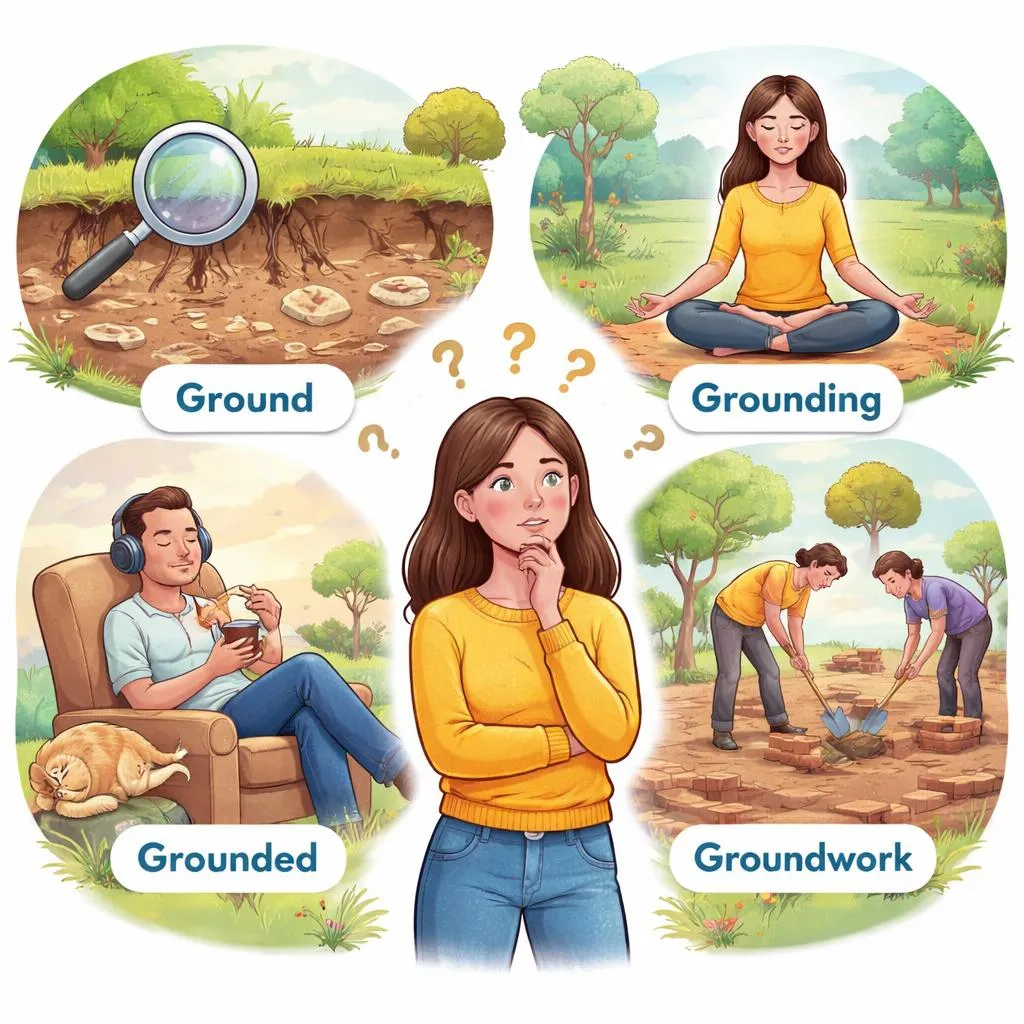
First, let us meet each tool. Ground is a noun. It means the earth under your feet. We call it the Floor Painter. Grounding is a noun. It means connecting to earth for safety. We call it the Safety Connector. Grounded is an adjective or verb past tense. It means being stuck at home or connected to earth. We call it the Rule Keeper. Groundwork is a noun. It means preparing for something big. We call it the Base Builder. These nicknames help us remember. Watch Sam use them. At home, he walks on the ground. He checks the grounding wire. He is grounded for messy room. He does groundwork for birthday party. Each tool fits its spot. But Sam still mixes them. We will learn why. Next, we dig deep into comparisons. We explore time, job, partners, small differences, and traps. Get ready to master these tools.
Time Tells the Tale
Words change with clocks and calendars. Some show now. Some show yesterday. Others show always. At home, Sam says, "I walk on the ground daily." That is habit. He says, "I grounded my toy plane yesterday." That is past action. He says, "The grounding wire is safe now." That is present state. He says, "We laid groundwork for the party last week." That is past preparation. In the playground, Sam shouts, "Kids run on the ground!" That is regular activity. He adds, "The swing was grounded last week." That is past event. He notes, "Grounding stops shocks." That is present safety. He says, "We did groundwork for the race." That is past planning. At school, the teacher says, "We study the ground in science." That is routine. She adds, "The student grounded the robot." That is past action. She explains, "Grounding is important for electronics." That is present fact. She says, "We finish groundwork for the project." That is ongoing work. In nature, Sam watches a bird. He whispers, "It hops on the ground." That is natural habit. He sees a tree. "It was grounded by lightning." That is past event. He notices, "Grounding helps plants grow." That is present benefit. He thinks, "Nature does groundwork for forests." That is ongoing process. See the pattern? Ground and grounding stay same. Grounded shows past. Groundwork stays same. Remember your clock. Pick the right word.
Jobs in the Sentence
Each word wears a uniform. Some name things. Others describe states. Ground is a noun. It names the earth. Example: "The ground is soft." Grounding is a noun. It names a safety process. Example: "Grounding keeps us safe." Grounded is an adjective. It describes being stuck. Example: "The drone is grounded." Groundwork is a noun. It names preparation. Example: "Groundwork makes parties great." At home, Sam says, "The ground is dirty." Noun naming earth. He says, "Grounding works well." Noun naming process. He says, "I am grounded today." Adjective describing state. He says, "Groundwork is done." Noun naming preparation. In the playground, Sam shouts, "Play on the ground!" Noun earth. He adds, "Grounding stops static." Noun process. He says, "The kite is grounded." Adjective state. He says, "Groundwork starts now." Noun preparation. At school, the teacher says, "Map the ground." Noun earth. She explains, "Grounding is science." Noun process. She says, "The student is grounded." Adjective state. She says, "Groundwork helps learning." Noun preparation. In nature, Sam whispers, "Forest ground is soft." Noun earth. He notices, "Grounding helps soil." Noun process. He says, "The log is grounded." Adjective state. He thinks, "Groundwork grows trees." Noun preparation. Always check the uniform. Is it naming or describing? Choose right.
Who Likes Helpers
Some words stand alone. Others need buddies. Ground stands alone. Example: "The ground is flat." Grounding stands alone. Example: "Grounding is safe." Grounded needs "is/was" helpers. Example: "The toy is grounded." Groundwork stands alone. Example: "Groundwork is done." At home, Sam says, "The ground is clean." Alone. He says, "Grounding works." Alone. He says, "I am grounded." Needs "am." He says, "Groundwork is ready." Alone. In the playground, Sam shouts, "Run on the ground!" Alone. He adds, "Grounding stops shocks." Alone. He says, "The bike was grounded." Needs "was." He says, "Groundwork starts." Alone. At school, the teacher says, "Study the ground." Alone. She explains, "Grounding is key." Alone. She says, "He is grounded." Needs "is." She says, "Groundwork helps." Alone. In nature, Sam whispers, "Walk on the ground." Alone. He notices, "Grounding helps trees." Alone. He says, "The branch is grounded." Needs "is." He thinks, "Groundwork grows forests." Alone. Learn the buddy system. It makes sentences smooth.
Small Differences Matter
Words seem alike but have secrets. Ground is the earth. Grounding is safety connection. Grounded is being stuck. Groundwork is preparation. At home, Sam says, "The ground is dirt." Earth. He says, "Grounding stops fires." Safety. He says, "I am grounded for mess." Stuck. He says, "Groundwork plans the party." Preparation. In the playground, Sam shouts, "Slide on the ground!" Earth. He adds, "Grounding keeps swings safe." Safety. He says, "The kite is grounded." Stuck. He says, "Groundwork sets up games." Preparation. At school, the teacher says, "Map the ground." Earth. She explains, "Grounding is science." Safety. She says, "The student is grounded." Stuck. She says, "Groundwork for tests." Preparation. In nature, Sam whispers, "Forest ground is soft." Earth. He notices, "Grounding helps soil." Safety. He says, "The log is grounded." Stuck. He thinks, "Groundwork grows trees." Preparation. Using the wrong twin changes meaning. Say "ground" for earth. Say "grounding" for safety. Say "grounded" for stuck. Say "groundwork" for prep. Be exact.
Avoid the Common Traps
Kids often trip here. Let us fix mistakes. Mistake one: "The ground is grounding." Wrong. Ground is noun, can't be verb. Correct: "The ground is flat." Or "Grounding is safe." Mistake two: "He grounded the ground." Wrong. Grounded is verb past, needs object. Correct: "He grounded the drone." Mistake three: "Groundwork is grounded." Wrong. Groundwork is noun, can't be adjective. Correct: "Groundwork is done." Mistake four: "The grounding ground is soft." Wrong. Grounding is noun, can't modify. Correct: "The ground is soft." Or "Grounding is important." Mistake five: "I am groundwork." Wrong. Groundwork is noun, can't be predicate. Correct: "I do groundwork." Why these happen? Kids swap nouns and verbs. They ignore meanings. Memory rhyme: Ground is floor, Grounding is safe, Grounded is stuck, Groundwork is base. Say it loud. It sticks. Practice spotting errors. You will dodge traps.
Traps are everywhere. But you can avoid them. Just remember the rhyme. Test yourself often. Ask: "Is this word naming or doing?" Soon, traps disappear. Sam used to fall for them. Now he laughs at old mistakes. You will too!
Quick Review of the Word Tools
Let us wrap up the rules. Ground is a noun for earth. Use it for the floor under feet. Grounding is a noun for safety connection. Use it for electrical safety. Grounded is an adjective for being stuck. Use it for no-play days. Groundwork is a noun for preparation. Use it for party or project plans. Remember time: ground and grounding stay same. Grounded shows past. Groundwork stays same. Jobs: ground, grounding, groundwork are nouns. Grounded is adjective. Partners: ground, grounding, groundwork stand alone. Grounded needs "is/was." Small differences keep meanings clear. Avoid traps by checking job and meaning. If you talk about earth, use ground. If about safety, use grounding. If stuck, use grounded. If prepping, use groundwork. Keep these tools handy.
This review is your cheat sheet. Read it before bed. Say it out loud. You will remember everything. Sam keeps it on his fridge. You can too!
Practice Time
Task A: Best Choice. At dinner, Mom says the ___ is clean. (ground/grounding) Answer: ground. Because it means the floor. Task B: Spot the Errors. Read this paragraph: "Yesterday, I grounded the ground. The grounding ground is soft. Groundwork is grounded. I am groundwork." Fix it: "Yesterday, I walked on the ground. The ground is soft. Groundwork is done. I do groundwork." Task C: Be a Director. Scene: Doing homework. Make one sentence with ground and one with grounded. Sample: "I put my book on the ground." "I am grounded if I don't finish."
Practice makes perfect. Do these tasks today. Show them to your mom. She will be proud. Sam did them and got an A+ in English. You can too!
What You Learned
You learned to tell ground, grounding, grounded, and groundwork apart. You know ground is the earth under feet. You know grounding is electrical safety. You know grounded means being restricted. You know groundwork is preparation for big things. These skills make your English clear.
Your Action Step
Today, look at the ground outside. Ask mom about grounding in your house. Do groundwork for your homework. Practice makes perfect.