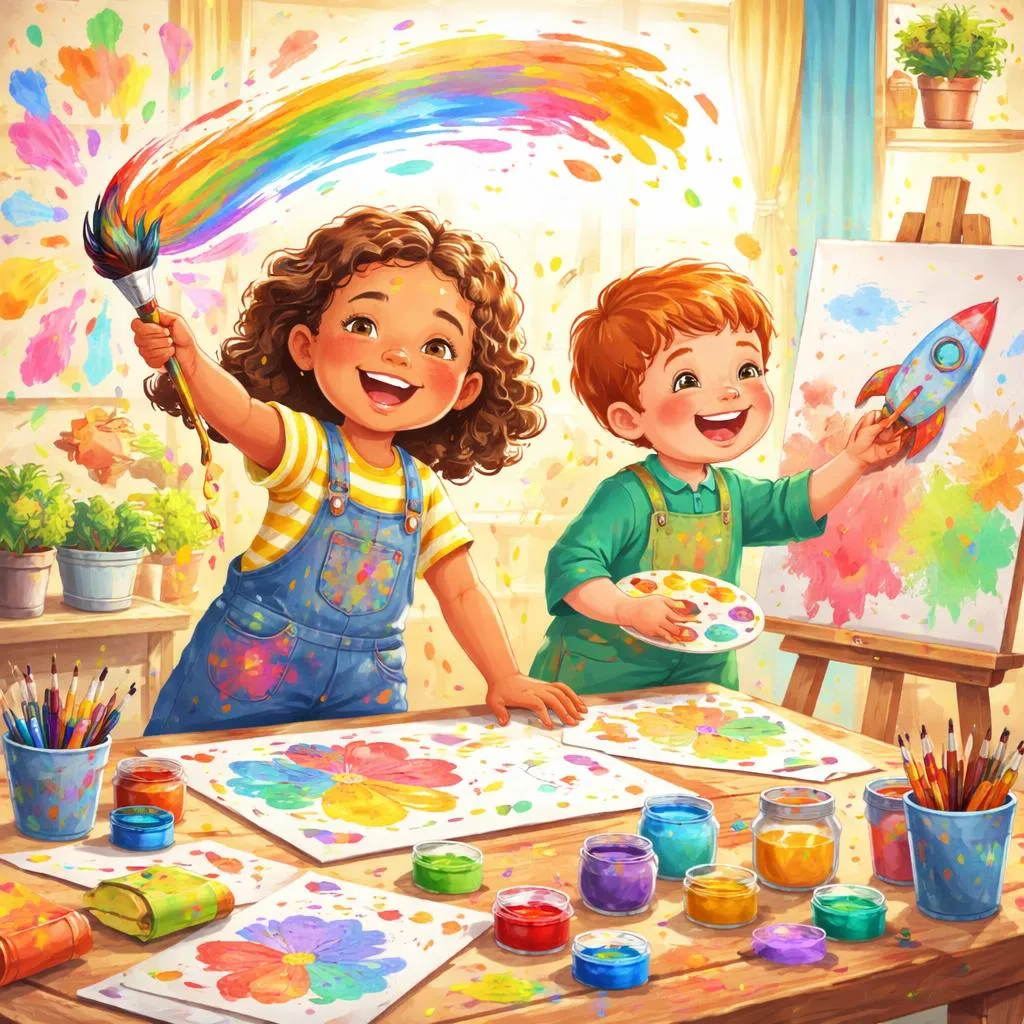

Every child loves to make marks. A stripe of blue. A splash of red. A rainbow across white paper. English gives us a colorful family of words for this joyful act. The root is “paint.” From this root come three more words. “Painter” names the person who creates with paint. “Painting” names the artwork or the activity. “Paintbrush” names the tool that holds the paint. These four words help children talk about art. They also help children explore their creative side. Let us explore this artistic family.
What Does “Same Word, Different Forms” Mean? One action takes different word shapes. “Paint” is the verb. You paint a sunflower on paper. “Paint” is also the noun. The red paint is in the jar. “Painter” is the person noun. A painter mixes colors on a palette. “Painting” is the artwork noun. The painting on the wall shows a forest. “Painting” is also the activity noun. Painting relaxes the mind. “Paintbrush” is the tool noun. A paintbrush holds water and pigment. Your child sees this pattern in other words. “Draw” becomes “drawer” and “drawing.” “Paint” gives us even more options.
Personal Pronouns Change Their Form Pronouns shift shape too. “I” becomes “me.” “She” becomes “her.” “We” becomes “us.” This shows that English changes words for grammar. Our word family “paint” changes for grammar as well. But it also changes for meaning. A verb shows action. A noun names a substance, person, artwork, activity, or tool. Learning these roles helps your child talk about art clearly.
From Verb to Noun – One Family, Many Words “Paint” is a verb. Paint a happy memory. “Paint” is a noun. The blue paint is dry. “Painter” is the person noun. The painter works in a studio. “Painting” is the artwork noun. This painting won an award. “Painting” is the activity noun. Painting teaches patience. “Paintbrush” is the tool noun. A flat paintbrush makes broad strokes. This family gives your child six meanings from one small root. One root. Six ways to create.
One Root, Many Roles – How Words Grow from Colors to Masterpieces Let us follow a painting story. A child wants to paint a butterfly. The child chooses purple paint. The child becomes a painter for the afternoon. The painting shows a butterfly on a flower. The child uses a small paintbrush for the delicate wings. See how “paint” runs through all five sentences. Each form adds a new layer. Your child can say “I will paint a butterfly.” “Purple paint is my favorite.” “I am a painter.” “My painting is finished.” “A paintbrush helps me be precise.” One root tells a whole story of creation.
Same Meaning, Different Jobs – Is It a Verb or a Noun? How does your child know the job? Look at the sentence position. After “will,” “want to,” or “can,” use the verb. Example: “She wants to paint a rainbow.” As a subject or object, use the noun “paint.” Example: “The paint smells strong.” For the person, use “a” or “the.” Example: “The painter signed the canvas.” For the artwork, use “a” or “the.” Example: “The painting is worth a thousand words.” For the activity, use as a subject. Example: “Painting is good for stress.” For the tool, use “a” or “the.” Example: “The paintbrush was too thick.” Endings give clues. “Paint” is verb or substance noun. “-er” signals a person. “-ing” signals an artwork or activity. “Brush” signals a tool.
Adjectives and Adverbs – When Do We Add -ly? From “painting” as an adjective, we can make “paintingly.” This word is rare. From “painterly” (an adjective meaning like a painter), we can make “painterlily.” That is also rare. Focus first on “paint,” “painter,” “painting,” and “paintbrush.” Teach the “-ly” rule briefly. Most adjectives become adverbs with “-ly.” “Quick” becomes “quickly.” “Painterly” is advanced. For now, celebrate the main four words.
Watch Out for Tricky Spelling Changes (Double Letters, y to i, and More) “Paint” has no double letters. No silent letters. Has a vowel pair “ai.” When we add “-er” to make “painter,” keep the “in.” No change. “Paint” + “er” = “painter.” When we add “-ing” to make “painting,” keep the “n.” No change. “Paint” + “ing” = “painting.” When we add “brush” to make “paintbrush,” keep the “t.” “Paint” + “brush” = “paintbrush.” No double letters. No “y” changes. This family is very stable. The only challenge is the spelling of “paintbrush.” It is one word, not two. Not “paint brush” with a space. “Paintbrush.” Also note that “paint” has the “ai” pair. Say “paint” with a long “a” sound, not a short “a” (not “pant”).
Let’s Practice – Can You Choose the Right Form? Try these simple sentences with your child.
Let’s (paint / painter) a picture of the ocean. (Answer: paint)
The red (paint / painting) spilled on the table. (Answer: paint)
A famous (paint / painter) created this masterpiece. (Answer: painter)
The (painting / paintbrush) of the dog looks so real. (Answer: painting)
Use a small (paint / paintbrush) for the tiny details. (Answer: paintbrush)
Make your own sentences from daily life. Say “We will paint tomorrow.” Say “The green paint is my favorite.” Say “You are a great painter.” Say “Your painting makes me smile.” Say “This paintbrush is soft.”
Tips for Parents – Help Your Child Learn Word Families in a Fun Way Paint together regularly. Set up paper, paints, brushes, and water. As you create, use the words. Say “Let’s paint a tree.” Say “Dip the paintbrush in the blue paint.” Say “You are a wonderful painter.” Say “This painting tells a story.” This hands-on learning builds vocabulary and creativity.
Play the painter game. Pretend to be famous painters. “Today I am a painter of cats.” “Today you are a painter of spaceships.” Use the words. “The painter needs more yellow paint.” “My painting shows a dragon.” “Your paintbrush is magic.” This game builds imagination and language.
Read books about artists and painting. Many children’s books introduce famous painters like Frida Kahlo or Henri Matisse. Pause during reading. Ask “What does the painter paint?” Ask “What colors of paint do they use?” Ask “What is the name of this painting?” Ask “What kind of paintbrush would you use?” These questions build art appreciation.
Create a home art gallery. Frame your child’s paintings. Hang them on a wall. Say “Welcome to our gallery.” “This painting is by a rising star painter.” “The paintbrush strokes show emotion.” “Let’s make a new painting next week.” This builds pride and vocabulary.
Visit a museum or look at art online. Point to paintings. Say “The painter used thick paint here.” Say “This painting is 500 years old.” Say “Imagine what paintbrush they used.” This builds cultural awareness.
Use “paint” for more than art. “Paint a picture with your words.” “The sunset painted the sky orange.” “Let’s paint the fence together.” This shows the verb’s wider use.
Distinguish “painting” as activity vs. artwork. “Painting is fun” (activity). “I love this painting” (artwork). This simple distinction builds grammatical understanding.
Now you have a complete guide. Paint with joy. Be a fearless painter. Fill the world with your paintings. Hold your paintbrush with pride. This word family does more than teach English. It teaches that art is for everyone. It teaches that colors speak. It teaches that every child is an artist. Keep painting. Keep growing together. One word family at a time.