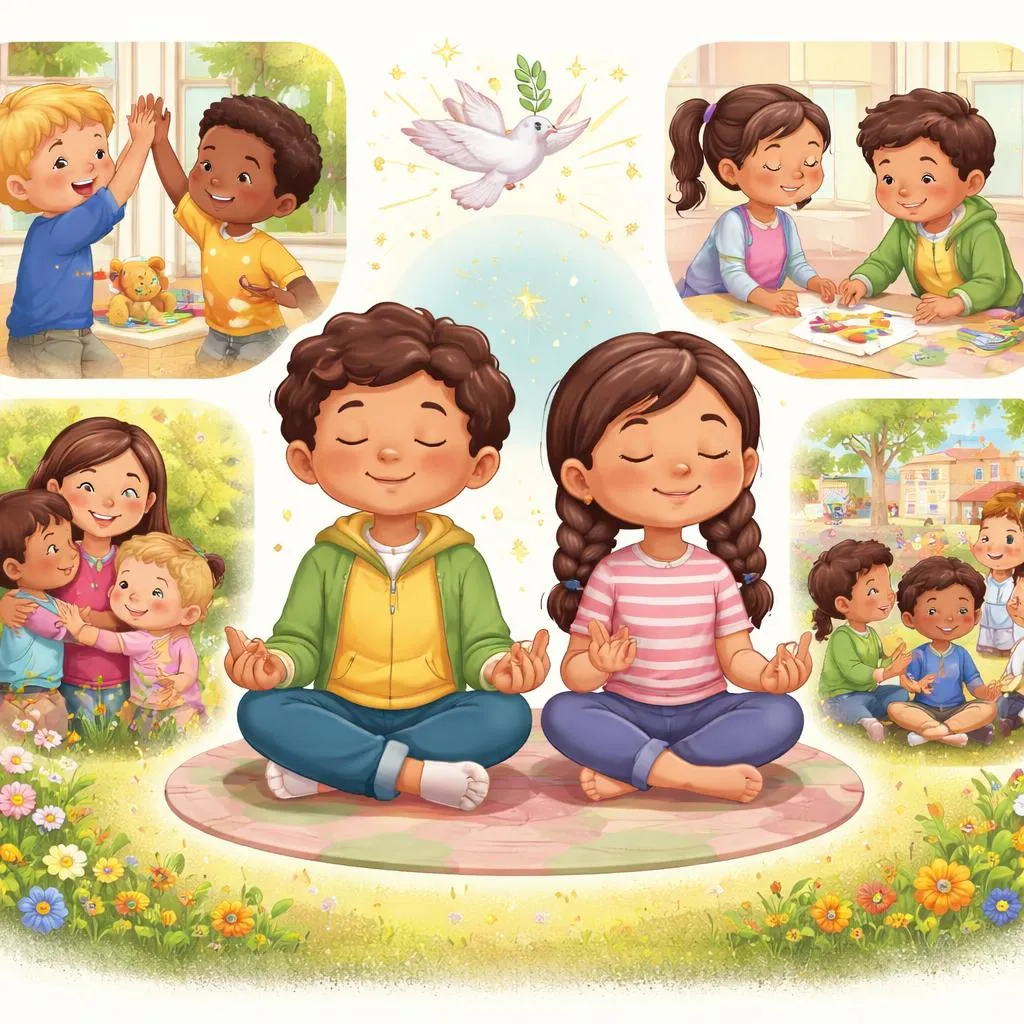

Every child wants peace. A quiet room to read. A calm lunch table. A friendship without fights. English gives us a gentle family of words for this deep human need. The root is “peace.” From this root come three more words. “Peaceful” describes a time or place without conflict. “Peacefully” describes how someone acts in a calm, non-fighting way. “Peacemaker” names a person who helps others stop fighting. These four words help children find inner calm and outer harmony. They also help children become helpers when conflicts arise. Let us explore this calming family.
What Does “Same Word, Different Forms” Mean? One state takes different word shapes. “Peace” is the noun. Peace means no fighting, yelling, or war. “Peaceful” is the adjective. A peaceful library lets everyone read. “Peacefully” is the adverb. The baby slept peacefully through the night. “Peacemaker” is the person noun. A peacemaker listens to both sides of an argument. Your child sees this pattern in other words. “Calm” becomes “calmly” and “calmness.” “Peace” gives us even more options.
Personal Pronouns Change Their Form Pronouns shift shape too. “I” becomes “me.” “She” becomes “her.” “We” becomes “us.” This shows that English changes words for grammar. Our word family “peace” changes for grammar as well. But it also changes for meaning. A noun names a state or person. An adjective describes. An adverb describes an action. Learning these roles helps your child talk about calm and conflict clearly.
From Noun to Adjective to Adverb to Person – One Family, Many Words “Peace” is the noun. Peace is better than winning an argument. “Peaceful” is the adjective. A peaceful voice calms angry feelings. “Peacefully” is the adverb. The two friends parted peacefully after talking. “Peacemaker” is the person noun. A peacemaker suggests a compromise. This family gives your child four tools for creating calm. One root. Four ways to build harmony.
One Root, Many Roles – How Words Grow from Quiet to Action Let us follow a peace story. Two children argue over a toy. There is no peace in the room. One child suggests a timer. That peaceful idea changes everything. The children play peacefully with their new turns. That child becomes a peacemaker for the group. See how “peace” runs through all four sentences. Each form adds a new layer. Your child can say “We need peace.” “That was a peaceful solution.” “They played peacefully together.” “You are a peacemaker.” One root tells a whole story of conflict resolution.
Same Meaning, Different Jobs – Is It a Noun or an Adjective? How does your child know the job? Look at the sentence position. As a subject or object, use the noun “peace.” Example: “Peace makes everyone happier.” Before a noun or after “be,” use “peaceful.” Example: “A peaceful home helps children grow.” Before a verb or at the end of a clause, use “peacefully.” Example: “The family ate dinner peacefully.” For the person, use “a” or “the.” Example: “The peacemaker raised her hand.” Endings give clues. “Peace” is the state noun. “-ful” signals an adjective. “-fully” signals an adverb. “-maker” signals a person who creates something.
Adjectives and Adverbs – When Do We Add -ly? This family shows the “-ly” rule clearly. Take the adjective “peaceful.” Add “-ly” to make “peacefully.” No spelling change. Many adjectives work this way. “Quick” becomes “quickly.” “Kind” becomes “kindly.” “Peaceful” becomes “peacefully.” Also from “peace” we cannot make an adverb. Only from “peaceful.” Most “-ful” adjectives become “-fully” adverbs. “Careful” becomes “carefully.” “Hopeful” becomes “hopefully.” “Peaceful” becomes “peacefully.”
Watch Out for Tricky Spelling Changes (Double Letters, y to i, and More) “Peace” has no double letters. Has a vowel pair “ea.” When we add “-ful” to make “peaceful,” keep the “eace.” No change. “Peace” + “ful” = “peaceful.” Not “peacefull” with double “l.” One “l” in “ful.” When we add “-ly” to make “peacefully,” keep the “ful.” “Peaceful” + “ly” = “peacefully.” Now we have double “l”? “Peaceful” ends with one “l.” Adding “ly” makes two “l”s together. That is correct. “Peacefully” has double “l” in the middle. When we add “maker” to make “peacemaker,” keep the “peace.” “Peace” + “maker” = “peacemaker.” No change. The main challenge is remembering that “peaceful” has one “l,” but “peacefully” has two “l”s (the last “l” of “peaceful” plus the “l” of “ly”).
Let’s Practice – Can You Choose the Right Form? Try these simple sentences with your child.
(Peace / Peaceful) is better than fighting. (Answer: Peace)
A (peace / peaceful) room helps you focus. (Answer: peaceful)
The cat slept (peacefully / peacemaker) on the sofa. (Answer: peacefully)
The (peace / peacemaker) asked both friends to share their feelings. (Answer: peacemaker)
We found (peace / peaceful) after talking through our problem. (Answer: peace)
Make your own sentences from daily life. Say “Let us find peace in this room.” Say “You have a peaceful voice.” Say “We ate dinner peacefully together.” Say “You were a peacemaker when you shared your toy.”
Tips for Parents – Help Your Child Learn Word Families in a Fun Way Model peace at home. When you feel angry, take a deep breath. Say “I need a moment of peace.” Say “Let us have a peaceful conversation.” Say “We can solve this peacefully.” Say “You can be a peacemaker by listening first.” This modeling teaches more than words.
Play the peacemaker game. When siblings argue, pause. Say “Who will be the peacemaker today?” The peacemaker suggests a solution. Use the words. “The peacemaker listens to everyone.” “That was a peaceful idea.” “Now you can play peacefully.” This game builds conflict resolution skills.
Read books about kindness, sharing, and solving arguments. Many children’s books show characters becoming peacemakers. Pause during reading. Ask “Where is the peace in this scene?” Ask “What is a peaceful solution here?” Ask “How did they act peacefully?” Ask “Who was the peacemaker?” These questions build emotional intelligence.
Create a family peace corner. A small space with pillows, crayons, and paper. Say “This is our peace corner. Go here when you need calm.” Say “A peaceful corner helps us find peace.” Say “You can sit peacefully here.” Say “Sometimes being a peacemaker means giving yourself a break.” This builds self-regulation.
Use “peacefully” for transitions. “Let us walk peacefully to the car.” “Let us eat peacefully without arguing.” “Let us clean up peacefully together.” This turns everyday moments into vocabulary practice.
Distinguish “peace” from “quiet.” Peace is more than silence. Peace is when people feel safe and respected. You can have noise and still have peace (a happy playground). This distinction builds deep understanding.
Celebrate your child when they act as a peacemaker. “You were a peacemaker today. I am proud of you.” “You chose a peaceful way to solve that.” “You spoke peacefully even when you were upset.” This positive reinforcement builds character and vocabulary.
Now you have a complete guide. Seek peace in every situation. Create peaceful spaces and habits. Act peacefully toward everyone. Become a peacemaker in your family and community. This word family does more than teach English. It teaches that calm is a choice. It teaches that one small peacemaker can change a whole room. It teaches that every child has the power to bring peace. Keep being peaceful. Keep growing together. One word family at a time.