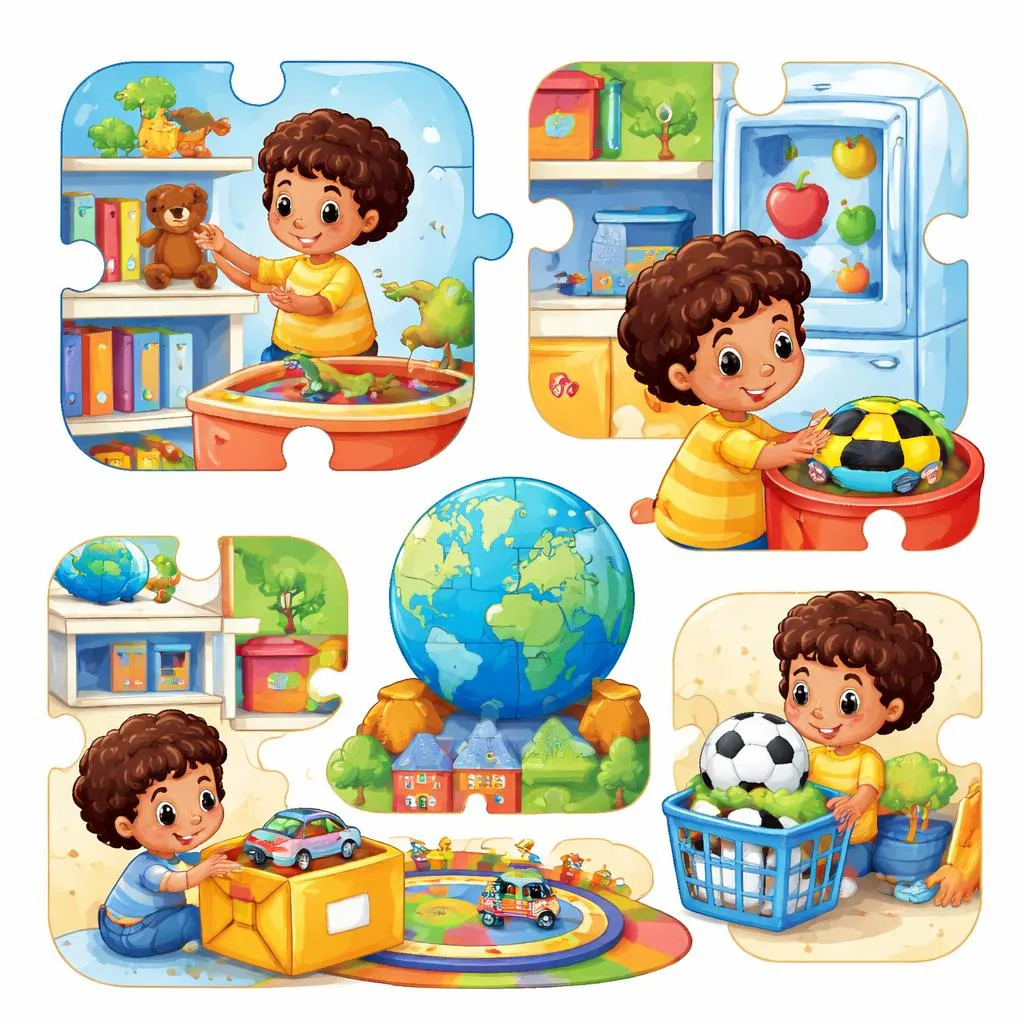

Every child puts things somewhere. Toys in a bin. Books on a shelf. Shoes by the door. English gives us a useful family of words for talking about location and movement. The root is “place.” From this root come three more words. “Placement” names the act of putting something in a spot. “Replace” means to put something back or to put a new thing in an old spot. “Displace” means to move something from its usual spot. These four words help children organize their spaces. They also help children understand change. Let us explore this positional family.
What Does “Same Word, Different Forms” Mean? One action takes different word shapes. “Place” is a noun. A place is a location. “Place” is a verb. Please place the cup on the table. “Placement” is the noun for the act or the location. The placement of the lamp was perfect. “Replace” is the verb. Replace the lid after using the marker. “Displace” is the verb. The flood displaced many animals. Your child sees this pattern in other words. “Put” becomes “input.” “Set” becomes “settle.” “Place” gives us even more precision.
Personal Pronouns Change Their Form Pronouns shift shape too. “I” becomes “me.” “She” becomes “her.” “We” becomes “us.” This shows that English changes words for grammar. Our word family “place” changes for grammar as well. But it also changes for meaning. A noun names a location. A verb shows action. Learning these roles helps your child talk about positioning clearly.
From Verb to Noun – One Family, Many Words “Place” is a verb. Place your hand on your heart. “Place” is a noun. This is my favorite place to read. “Placement” is the act noun. The placement of the chairs allowed everyone to see. “Replace” is the verb. Please replace the book on the shelf. “Displace” is the verb. The new couch displaced the old armchair. This family gives your child five tools for organizing spaces. One root. Five ways to put things in order.
One Root, Many Roles – How Words Grow from Spots to Switches Let us follow a placement story. A child wants to place a new toy on a shelf. The child thinks about the best placement for easy reach. The child must first replace an old toy that is in the way. That old toy gets displaced to a different bin. See how “place” runs through all four sentences. Each form adds a new layer. Your child can say “I will place this here.” “Good placement matters.” “I will replace the lid.” “The game displaced my book.” One root tells a whole story of organizing.
Same Meaning, Different Jobs – Is It a Verb or a Noun? How does your child know the job? Look at the sentence position. After “can,” “will,” or “please,” use the verb “place.” Example: “Please place the napkin here.” As a subject or object, use the noun “place” for location. Example: “This is a safe place.” For the act of arranging, use “placement.” Example: “The placement of the rug tied the room together.” After “please” or “will,” use “replace” for putting back or substituting. Example: “Replace the batteries when they die.” After “can” or “might,” use “displace” for moving from a spot. Example: “A strong wind can displace roof tiles.” Endings give clues. “Place” is verb or location noun. “-ment” signals an act noun. “Re-” signals again or back. “Dis-” signals away or removal.
Adjectives and Adverbs – When Do We Add -ly? From “placed” we can make “placedly.” That is rare. From “replaceable” we can make “replaceably.” That is advanced. Focus first on “place,” “placement,” “replace,” and “displace.” Teach the “-ly” rule briefly. Most adjectives become adverbs with “-ly.” “Quick” becomes “quickly.” “Placeable” (an adjective) would become “placeably.” Your child will meet this pattern later. For now, celebrate the main four words.
Watch Out for Tricky Spelling Changes (Double Letters, y to i, and More) “Place” has no double letters. Has a silent “c”? No, “c” sounds like “s.” When we add “-ment” to make “placement,” keep the “c.” No change. “Place” + “ment” = “placement.” When we add “re-” to make “replace,” keep the “c.” “Re” + “place” = “replace.” When we add “dis-” to make “displace,” keep the “c.” “Dis” + “place” = “displace.” No double letters. No silent letters except the “c” is soft. The only challenge is remembering that “place” has an “a” before the “c.” Not “plice.” Also note that “displace” has one “s” in “dis.” Not “dissplace.”
Let’s Practice – Can You Choose the Right Form? Try these simple sentences with your child.
Please (place / placement) your backpack on the hook. (Answer: place)
The (place / placement) of the flowers made the table look pretty. (Answer: placement)
(Replace / Displace) the cap on the toothpaste. (Answer: Replace)
The wind will not (replace / displace) this heavy rock. (Answer: displace)
This is a quiet (place / placement) to read. (Answer: place)
Make your own sentences from daily life. Say “Place your cup in the sink.” Say “The placement of the sofa blocks the window.” Say “Please replace the toilet paper roll.” Say “The kitten displaced the pillow from the couch.”
Tips for Parents – Help Your Child Learn Word Families in a Fun Way Practice placing things. As you clean up, use the words. Say “Please place the blocks in the bin.” Say “The placement of your shoes should be here.” Say “Replace the crayons in the box.” Say “Don’t displace your sister’s backpack.” This hands-on learning builds organization and vocabulary.
Play the placement game. Give your child small objects and ask them to place them in different spots. “Place the coin under the book.” “Place the spoon beside the plate.” “Place the toy between the pillow and the blanket.” Ask “What is the placement of the coin now?” This game builds spatial awareness.
Use “replace” for missing things. “We need to replace the burned-out light bulb.” “We should replace your worn-out sneakers.” “Let’s replace the batteries in the remote.” This teaches maintenance and vocabulary.
Use “displace” for movement. “When you sit on the bed, you displace the blanket.” “The big dog displaced the small dog from the bed.” “Floods can displace people from their homes.” This teaches cause and effect.
Read books about organizing, cleaning, or moving. Pause during reading. Ask “Where did they place the toy?” Ask “What was the placement of the furniture?” Ask “Did they replace anything?” Ask “Did anything get displaced?” These questions build comprehension.
Create a family “placement” map. Draw a simple map of your living room. Mark where items belong. Say “The placement of the remote is on this table.” “Please replace the remote in its place.” “Do not displace the magazines.” This builds responsibility and vocabulary.
Now you have a complete guide. Place things with care. Think about placement. Replace what is used. Avoid displacing what others need. This word family does more than teach English. It teaches that order is possible. It teaches that small actions keep spaces tidy. It teaches that every child can be the keeper of places. Keep placing. Keep growing together. One word family at a time.