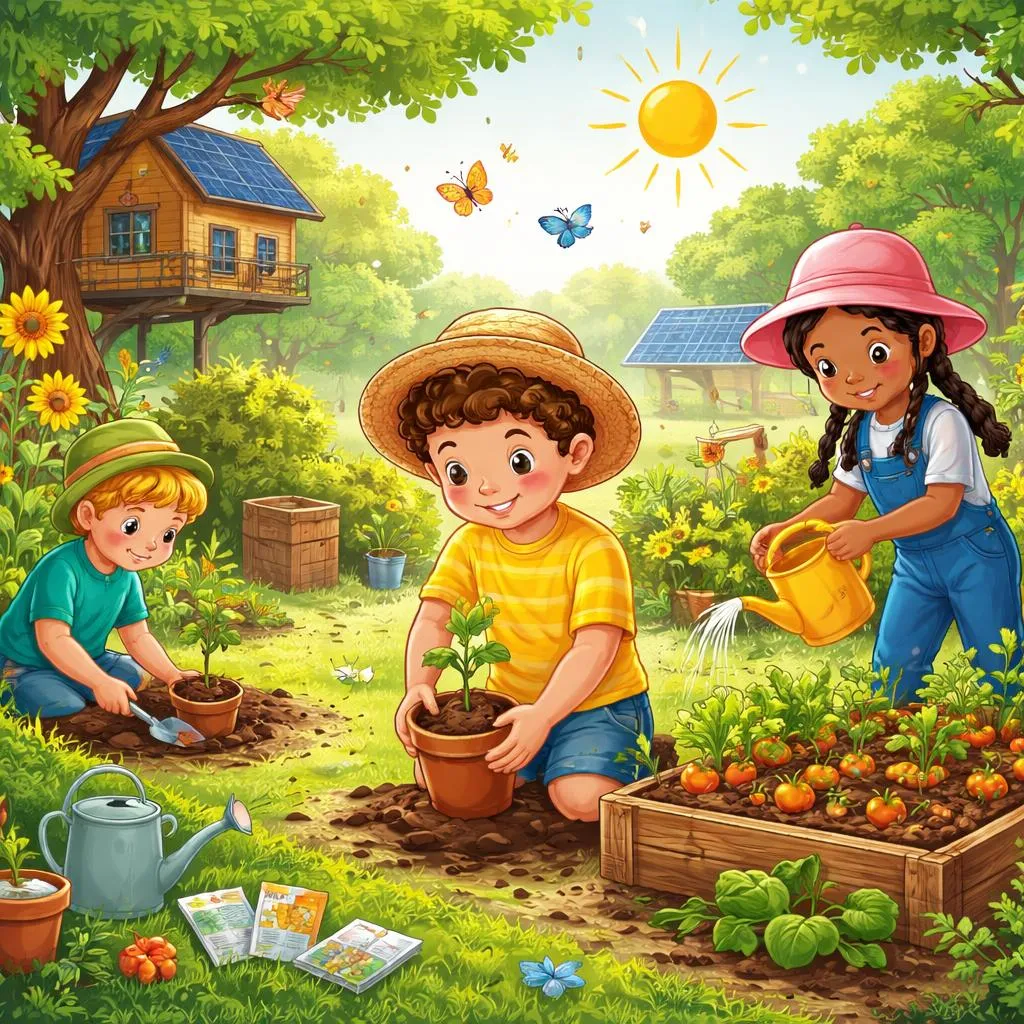

Every child can grow something. A seed in a cup. A flower in a pot. A vegetable in a garden. English gives us a growing family of words for this earthy act. The root is “plant.” From this root come three more words. “Plantation” names a large farm, often for tea, coffee, or cotton. “Planter” names the container or the person who plants. “Planting” names the act of putting seeds or plants into the ground. These four words help children understand where food comes from. They also teach patience and care. Let us explore this green family.
What Does “Same Word, Different Forms” Mean? One action takes different word shapes. “Plant” is a noun. A plant needs sun and water. “Plant” is a verb. Please plant the seed one inch deep. “Plantation” is the noun for a large farm. The tea plantation stretched across the hills. “Planter” is the person noun. The planter wore a wide hat. “Planter” is also the container noun. Use a clay planter for your flower. “Planting” is the activity noun. Planting in spring brings summer flowers. Your child sees this pattern in other words. “Grow” becomes “grower.” “Farm” becomes “farmer.” “Plant” gives us even more variety.
Personal Pronouns Change Their Form Pronouns shift shape too. “I” becomes “me.” “She” becomes “her.” “We” becomes “us.” This shows that English changes words for grammar. Our word family “plant” changes for grammar as well. But it also changes for meaning. A verb shows action. A noun names a living thing, a farm, a container, or a person. Learning these roles helps your child talk about growing things clearly.
From Verb to Noun – One Family, Many Words “Plant” is a noun. A plant breathes carbon dioxide. “Plant” is a verb. We will plant tomatoes this weekend. “Plantation” is the large farm noun. The banana plantation uses irrigation. “Planter” is the person noun. The planter checked each row. “Planter” is the container noun. Buy a ceramic planter for the balcony. “Planting” is the activity noun. Planting takes patience and hope. This family gives your child six meanings from one small root.
One Root, Many Roles – How Words Grow from Seeds to Harvests Let us follow a planting story. A child wants to plant a bean seed. The child puts the seed in a small planter. The child’s family drives past a corn plantation on vacation. The child is the planter of this bean. The planting process teaches the child about water and sunlight. See how “plant” runs through all four sentences. Each form adds a new layer. Your child can say “I will plant a seed.” “This plantation grows coffee.” “My planter has a hole for drainage.” “I am a careful planter.” “Planting is my new hobby.” One root tells a whole story of growth.
Same Meaning, Different Jobs – Is It a Verb or a Noun? How does your child know the job? Look at the sentence position. After “will,” “want to,” or “should,” use the verb. Example: “We should plant more trees.” As a subject or object, use the noun “plant.” Example: “This plant needs more light.” For the large farm, use “plantation.” Example: “The plantation hires many workers.” For the person, use “a” or “the.” Example: “The planter uses a hoe.” For the container, use “a” or “the.” Example: “The planter cracked in the cold.” For the activity, use “planting.” Example: “Planting is good for the soul.” Endings give clues. “Plant” is verb or living noun. “-ation” signals a large farm. “-er” signals a person or container. “-ing” signals an activity.
Adjectives and Adverbs – When Do We Add -ly? From “planted” we can make “plantedly.” That is rare. From “planting” as an adjective (“planting season”), we can make “plantingly.” That is also rare. Focus first on “plant,” “plantation,” “planter,” and “planting.” Teach the “-ly” rule briefly. Most adjectives become adverbs with “-ly.” “Quick” becomes “quickly.” Your child will meet this pattern later. For now, celebrate the main four words. Gardening vocabulary doesn’t need many adverbs.
Watch Out for Tricky Spelling Changes (Double Letters, y to i, and More) “Plant” has no double letters. Ends with “ant.” When we add “-ation” to make “plantation,” we keep the “t.” “Plant” + “ation” = “plantation.” No change. When we add “-er” to make “planter,” we keep the “t.” “Plant” + “er” = “planter.” When we add “-ing” to make “planting,” we keep the “t.” “Plant” + “ing” = “planting.” No double letters. No silent letters. The only challenge is remembering that “plantation” has one “n” in the middle? Actually “plantation” is p-l-a-n-t-a-t-i-o-n. One “n” after “pla.” No double “n.” Also, “planter” has one “n.” “Planting” has one “n.” This family is very stable. Practice the “ant” sound. “Plant” rhymes with “can’t.”
Let’s Practice – Can You Choose the Right Form? Try these simple sentences with your child.
A (plant / plantation) needs soil, sun, and water. (Answer: plant)
The tea (plant / plantation) covered the hillside. (Answer: plantation)
Use a (planter / planting) to hold your flowers. (Answer: planter)
(Planting / Plantation) vegetables in spring leads to a fall harvest. (Answer: Planting)
The (planter / planted) carefully placed each seed in the row. (Answer: planter)
Make your own sentences from daily life. Say “This plant is a succulent.” Say “We visited a pineapple plantation.” Say “Fill the planter with soil.” Say “Planting seeds is a hopeful act.”
Tips for Parents – Help Your Child Learn Word Families in a Fun Way Plant something together. A seed in a cup. A flower in the yard. A herb in a pot. Use the words. Say “Let’s plant a bean.” Say “This is our tiny plantation.” Say “Use this planter for your seed.” Say “Planting teaches patience.” This hands-on learning builds science and vocabulary.
Play the planter game. Take turns being the planter. “Today you are the bean planter.” “Now you are the flower planter.” “Now I am the vegetable planter.” Use the words. “The planter digs a small hole.” “The planter covers the seed gently.” “Planting is hard work!” This game builds empathy and language.
Read books about gardens, farms, and how food grows. Many children’s books show planting from seed to harvest. Pause during reading. Ask “What plant is this?” Ask “Is this a plantation or a small garden?” Ask “Who is the planter here?” Ask “What happens during planting?” These questions build agricultural literacy.
Create a family planting calendar. List what to plant in each season. Say “Our planting plan for spring includes lettuce.” Say “We will plant carrots in this planter.” Say “Grandpa’s tomato plantation is famous.” This builds planning skills and vocabulary.
Visit a farm or a botanical garden. Point to rows of crops. Say “This is a corn plantation.” Say “The planters work early in the morning.” Say “Planting on this scale is amazing.” This real-world learning makes vocabulary vivid.
Distinguish “plant” as noun vs. verb. “This plant is a rose” (noun). “We plant roses in spring” (verb). This simple distinction builds grammar skills.
Now you have a complete guide. Care for every plant. Visit a plantation if you can. Use a sturdy planter. Enjoy the act of planting. This word family does more than teach English. It teaches that growth takes time. It teaches that small seeds become big plants. It teaches that your child’s hands can help the earth. Keep planting. Keep growing together. One word family at a time.