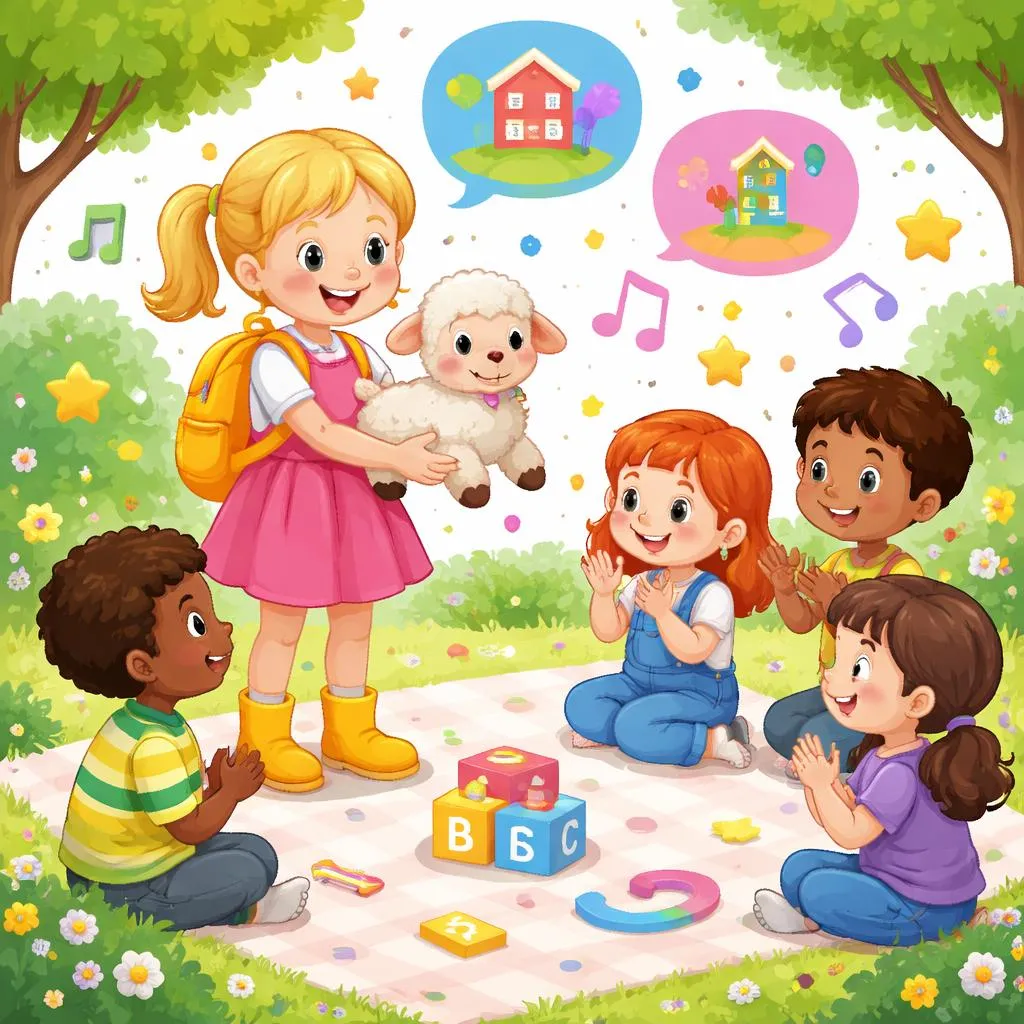

What Is The Rhyme? "Mary Had a Little Lamb" is one of the most iconic English nursery rhymes. It tells a simple, charming story in song form. The rhyme is based on a true 19th-century story from America. It describes a young girl named Mary and her loyal pet lamb. The lamb’s unusual behavior of following her to school forms the core of the tale. The "Mary had a little lamb" song lyrics are narrative and sequential. The gentle melody and clear storyline make it an ideal teaching tool. It captures a child’s imagination while providing excellent material for language learning.
The Lyrics of Nursery Rhymes The traditional lyrics of nursery rhymes for this song are straightforward and repetitive. The first verse is: "Mary had a little lamb, little lamb, little lamb. Mary had a little lamb, its fleece was white as snow." The second verse continues the story: "And everywhere that Mary went, Mary went, Mary went, everywhere that Mary went, the lamb was sure to go." The lyrics use repetition for emphasis ("little lamb, little lamb"). They also use simile ("white as snow") and cause-and-effect structure. This makes the story easy to follow and remember.
Vocabulary Learning The "Mary had a little lamb" song lyrics introduce key, concrete vocabulary. Core nouns include: Mary, lamb, fleece, school, children, teacher. We learn adjectives: little, white. We see the comparative "as snow." We can expand this list thematically. We talk about farm animals: sheep, wool, pasture. We discuss school words: classroom, rule, desk, book. Action verbs from the song: had, went, go, followed, turned out. We learn the concept of everywhere. This provides a perfect foundation for building simple sentences about pets, school, and daily life.
Phonics Points This rhyme is excellent for phonics practice. We focus on the /m/ sound in Mary, lamb, and snow. The /l/ sound is prominent in little, lamb, white, and school. We can highlight the long 'a' sound in Mary and lamb. The blend /fl/ appears in fleece. The rhyme also offers a great example of the silent 'b' in lamb. We can practice the soft 'c' sound in fleece and the hard 'c' sound in school. Finding rhyming words within the song (snow/go) strengthens phonemic awareness. Clapping the syllables helps with the rhythm of multi-syllable words like everywhere.
Grammar Patterns The "Mary had a little lamb" song lyrics beautifully model past tense narrative. The entire story is told in the simple past tense: had, went, was, followed, turned out. This provides clear examples of common irregular past tense verbs. It introduces possessive pronouns: its fleece. The structure "was sure to go" teaches a common English idiom for certainty. The phrase "white as snow" is a classic simile using "as." We can also practice transforming the past tense story into the present. "Mary has a little lamb. It follows her to school."
Learning Activities Engaging activities can extend the learning. Try "Story Sequencing." Provide picture cards for key events: Mary with her lamb, the lamb following, the children laughing, the lamb waiting. Children put them in order and retell the story. Another is "Change the Story." Keep the melody but change the character and pet. "Tom had a little dog, little dog, little dog..." This encourages creative use of vocabulary within a safe grammatical structure. Also, a "Why/Because" discussion about the story builds reasoning skills in English. "Why did the lamb follow Mary? Because it loved her."
Printable Materials Printable resources make the lesson interactive. Create a "Mary Had a Little Lamb" mini-book. Each page has a line from the song and a space for illustration. Design "Vocabulary Matching Cards." Match a picture (lamb, school, fleece) to its word. A "Past Tense Worksheet" can highlight the verbs: have/had, go/went, is/was. Children fill in the blanks in new sentences. Also, provide a black-and-white lamb outline. Children can glue cotton balls on it while describing it: "The lamb's fleece is white and fluffy."
Educational Games Games make the vocabulary and story memorable. Play "Follow the Leader" with a twist. The leader is "Mary." Others are "lambs" and must follow everywhere, practicing the phrase "I am sure to go!" "Farm Animal Sounds Bingo" can start with the lamb’s "baa" and include other animals. For a listening and acting game, play "Freeze Frame." Read a line from the song. Children create a still picture of that moment. For example, "the children laughed and played" – they freeze in laughing poses. This connects physical action to the lyrics.
Using the "Mary had a little lamb" song lyrics is about tapping into a timeless story that children love. Its simplicity is its strength. The song provides a complete, coherent context for learning past tense verbs, descriptive language, and narrative sequence. From singing the familiar tune to acting out the story and creating new versions, children engage with English in multiple ways. This builds not only vocabulary and grammar skills but also confidence in using English to tell a story. The rhyme reminds us that effective language learning often starts with a simple, joyful tale about a girl and her faithful lamb, making English feel friendly, familiar, and fun.