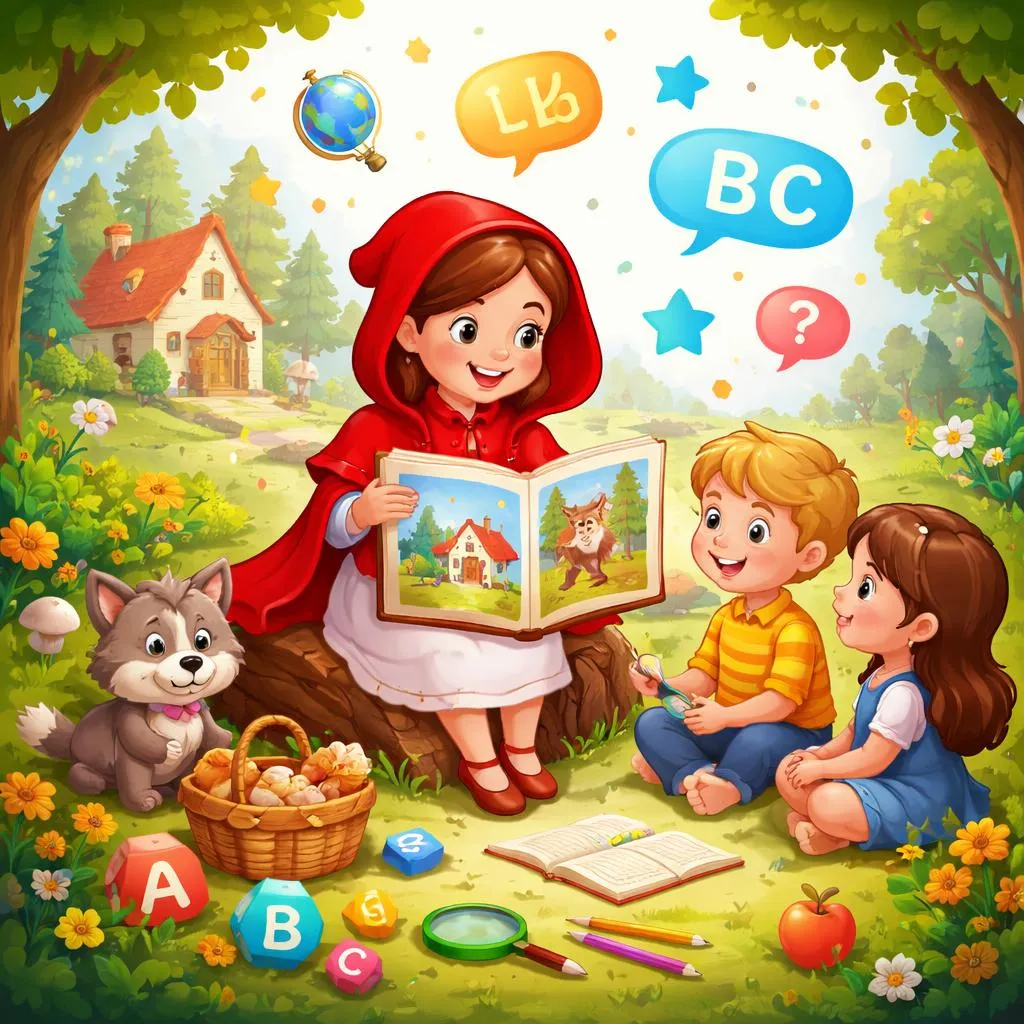

Teaching a second language often requires stepping away from textbooks and embracing the magic of storytelling. Classic tales provide a rich context for learning, offering more than just vocabulary. They present language in a natural, memorable framework. Today, we will explore how the Little Red Riding Hood children's story can serve as a powerful tool in the English learning classroom or at home. This narrative is not just a fairy tale; it is a structured language lesson waiting to be unfolded.
What is the Little Red Riding Hood Children's Story?
This is a classic European fairy tale about a young girl and a big bad wolf. The story follows a girl, named after her distinctive red hooded cloak, who journeys through the woods to visit her sick grandmother. Along the way, she meets a cunning wolf. The wolf tricks her, races to the grandmother’s house, and creates a chaotic situation that requires a heroic rescue. This narrative structure is simple and linear, making it ideal for young learners. The plot’s repetition and clear sequence of events help children anticipate what comes next, reinforcing comprehension without frustration. The story exists in many versions, but the core message about caution and listening to parents remains constant.
Meaning and Explanation of the Key Themes
Why does this story resonate so well for language acquisition? The themes are universal and easily explained. We can talk about the concept of "stranger danger" in simple terms. Explain that the wolf represents someone who is not kind. The woods represent a place full of unknown things. These big ideas become understandable through the characters’ actions. We can ask guiding questions: "What does the wolf do?" This helps children connect words to concepts. The story’s conflict is clear, so the language describing it becomes clear too. It provides a safe space to discuss emotions like fear, worry, and relief, which are all valuable vocabulary builders.
Vocabulary Learning from the Story
This tale is a treasure trove of thematic vocabulary. We can categorize the words to make them easier for students to absorb. Focusing on nouns, verbs, and adjectives separately helps build a balanced lexicon.
Characters and People: little girl, mother, grandmother, woodcutter, wolf.
Places: woods, house, path, bed.
Objects: cloak (hood), basket, cake, butter, flowers, door, teeth, ears, eyes.
Descriptive Words (Adjectives): little, big, bad, sick, soft, furry, scary, kind.
Action Words (Verbs): walk, meet, pick, run, knock, eat, hide, jump, rescue.
When teaching these words, use visuals. Point to a picture of the basket. Say the word clearly and have the students repeat it. We can then place the word into a simple sentence from the text, such as, "The girl carries a basket." This method grounds the vocabulary in the narrative.
Daily Life Examples Linked to the Story
Connecting the story to daily life makes the language relevant. We can draw parallels between the story and a child's own experiences. For instance, just like Little Red Riding Hood, a child might help their parents by carrying something to a family member. We can practice sentences like, "I help my mom," or "I visit my grandma."
Another connection is the idea of listening to instructions. The mother in the story tells the girl not to talk to strangers. This is a rule children know well. We can use this to practice phrases like, "I must not talk to strangers," or "I listen to my mother." Also, picking flowers or walking on a path are common activities. Using these connections, we transform abstract story words into practical, usable language for the child’s own world.
Grammar Patterns in the Story
The simple past tense dominates this narrative, making it an excellent introduction to how we tell stories in English. We do not need to explain complex grammar rules initially. Instead, we can highlight the pattern.
She walked through the woods.
The wolf ran to the house.
He jumped into the bed.
We can point out the "-ed" ending on regular verbs. For younger learners, just hearing the rhythm of the past tense is enough. For slightly older students, we can contrast it with the present. "Today, I walk. Yesterday, Red Riding Hood walked." The story also features direct speech, which is perfect for practicing question forms. "What big eyes you have!" becomes a fun, repeatable phrase that teaches the "What... you have" structure.
Phonics Points to Practice
Specific sounds repeat throughout the text, offering natural phonics practice. The story is full of words that help students focus on individual letter sounds and blends.
The /w/ sound: wolf, woods, walk, what.
The /b/ sound: big, bad, basket, bed.
The /g/ sound: girl, grandmother, good.
We can isolate these sounds. For example, while reading the part about the wolf, we can emphasize the "w" sound. Ask the students to listen for it. Then, practice saying the words together. We can also look at rhyming words, even if they are not directly in the story. "Look" and "book" don't rhyme perfectly, but we can find patterns like "cake" and "bake" from the cake in her basket.
Learning Activities for the Classroom
Active participation cements language learning. Instead of passive listening, we engage students with the material. Here are several activity ideas centered around this story.
Story Sequencing: Give students picture cards from the story. Ask them to put the cards in the correct order. As they place each card, they can say a simple sentence about what is happening. This reinforces both comprehension and narrative structure.
Role-Play: Assign roles: Little Red Riding Hood, the wolf, the grandmother, and the woodcutter. Acting out the scene is powerful. Students speak the lines with emotion, which helps memory. They do not just say the words; they feel them.
Character Description: Draw a simple picture of the wolf. Ask the class to describe him. Write their adjectives around the drawing. "Big," "scary," "bad," "furry." Do the same for Little Red Riding Hood. This creates a visual word bank.
Educational Games for Language Reinforcement
Games turn learning into a fun, low-stress experience. They encourage repetition and practice without feeling like work.
"What's in the Basket?" Game: Place a few items or pictures in a basket (a toy cake, a flower, a red cloth). Have children reach in, feel an item without looking, and try to name it. Then, they pull it out and say the full sentence: "It is a cake." This uses tactile learning and sentence building.
Yes/No Game: Make statements about the story, some true and some false. For example, "The wolf was kind." Students shout "Yes!" or "No!" If no, they can provide the correct information. This checks comprehension in an energetic way.
Character Hot Seat: One student sits at the front. They are a character from the story. The other students ask them questions. "Little Red, why are you walking in the woods?" The student answers in character. This encourages creative language use.
Printable Materials for Practice
Having tangible materials extends the learning beyond the story time. Simple, printable resources can be incredibly effective for review and practice.
Vocabulary Flashcards: Create cards with a picture on one side and the word on the other. Words like "wolf," "grandmother," and "basket" are perfect. These can be used for matching games, memory games, or simple drilling.
Coloring Pages: Print outline drawings of scenes from the story. As students color, they can describe what they are coloring. "I am coloring the red hood." This quiet activity reinforces vocabulary in a calm setting.
Simple Worksheets: A worksheet with two columns can help practice descriptive words. One column has a picture of the wolf, the other has a picture of Little Red. Students draw a line from adjectives like "kind" to the girl and "scary" to the wolf. Another worksheet could have simple sentences with blanks, like "She walked through the ______." with a word bank.
The Little Red Riding Hood children's story offers a complete language learning package. Its familiar plot reduces cognitive load, allowing students to focus on the words. The clear characters and repeated phrases build confidence. By using its elements for vocabulary, grammar, and phonics, and by reinforcing these with games and activities, educators can create a rich, immersive experience. The goal is not just to tell a story, but to use it as a gateway for children to express themselves in a new language with joy and understanding.