
What Does “Same Word, Different Forms” Mean?
Many English words grow from one root.
This is called a word family.
Word families help children see patterns instead of memorizing separate words.
The family relate, relation, relationship, relative, relatively is a rich example.
All five words connect to the idea of connection.
Things may connect in meaning, in family, in comparison, or in ideas.
But each word has a different role.
Relate is a verb. Relation is a noun. Relationship is a noun. Relative can be a noun or adjective. Relatively is an adverb.
One root.
Many forms.
Many meanings.
That makes this family useful and interesting.
Personal Pronouns Change Their Form
Children already know some words change shape.
They see:
I, me, my they, them, their
Different forms.
Connected meaning.
Word families work in much the same way.
Look at these:
I relate to the story. There is a relation between ideas. Friendship is a relationship. My aunt is a relative. The puzzle was relatively easy.
These words connect.
But each one has a different grammar job.
Seeing those patterns supports stronger reading.
From Verb to Noun to Adjective to Adverb – One Family, Many Words
This family grows in many directions.
That makes it a powerful learning tool.
Relate as a Verb
Relate shows action.
It often means connect or understand through connection.
Examples:
I relate to that character. Science can relate ideas. These facts relate to weather.
One word can carry slightly different uses.
Children can learn meaning from context.
Relation as a Noun
Relation names a connection.
Examples:
There is a relation between rain and clouds. Cause and effect have a relation.
This word often appears in school subjects.
It is useful in academic vocabulary.
Relationship as a Noun
Relationship also names connection.
But often a deeper or ongoing one.
Examples:
They have a strong friendship relationship. Plants and sunlight have a close relationship.
Children can compare relation and relationship.
They overlap.
But relationship often feels stronger or longer-lasting.
Relative as Noun and Adjective
Relative has two common jobs.
As a noun:
My cousin is a relative.
As an adjective:
Success is relative.
That means dependent on comparison.
This is an exciting discovery for learners.
One word.
Two roles.
Relatively as an Adverb
Relatively describes degree.
Examples:
The test was relatively easy. Winter here is relatively mild.
This word often means “somewhat” or “in comparison.”
That is advanced but useful vocabulary.
One Root, Many Roles – How Words Grow from Actions to Qualities
Look how the root expands.
relate → action relation → connection relationship → stronger connection relative → person or comparison idea relatively → degree or comparison
One root supports many meanings.
Children can think of it as a branching tree.
The root stays.
Endings add meaning.
This supports morphology awareness.
That is a big reading skill.
It helps children understand unfamiliar words.
Same Meaning, Different Jobs – Is It a Verb or a Noun?
Children often mix up relation and relationship.
Or relative and relatively.
That is normal.
Grammar helps.
Ask:
Is this word acting?
Naming?
Describing?
Or showing degree?
Look here:
Correct:
I relate to the story. The story has a relation to history.
Not correct:
I relation to the story.
Now compare:
My uncle is a relative. The question is relatively simple.
One is noun.
One is adverb.
Different jobs.
That matters.
Adjectives and Adverbs – When Do We Add -ly?
This family gives a clear pattern.
Relative can become relatively.
Add -ly.
Examples:
The result is relative. The result is relatively good.
Compare them.
Relative describes a noun.
Relatively describes degree.
That is a common pattern.
complete → completely active → actively relative → relatively
Children who notice this pattern improve writing.
It also helps with grammar choices.
Watch Out for Tricky Spelling Changes (Double Letters, y to i, and More)
This family has useful spelling patterns.
Relate to Relation
The final e drops.
relate → relation
This happens often.
create → creation relate → relation
Pattern awareness supports spelling.
Relation to Relationship
Add -ship.
This suffix often forms nouns.
Examples:
friend → friendship leader → leadership relation → relationship
That is worth noticing.
Relative to Relatively
Add -ly.
No tricky change.
Just add the ending.
Children often like predictable patterns.
This one is helpful.
Let’s Practice – Can You Choose the Right Form?
Try these.
- I can ______ to that story.
Answer: relate
Action word.
- There is a ______ between exercise and health.
Answer: relation
Names a connection.
- They have a close ______.
Answer: relationship
Names a lasting connection.
- My grandmother is a ______.
Answer: relative
Names a family member.
- The test was ______ easy.
Answer: relatively
Shows degree.
Practice helps children compare forms clearly.
That builds confidence.
Tips for Parents – Help Your Child Learn Word Families in a Fun Way
Word families can be playful.
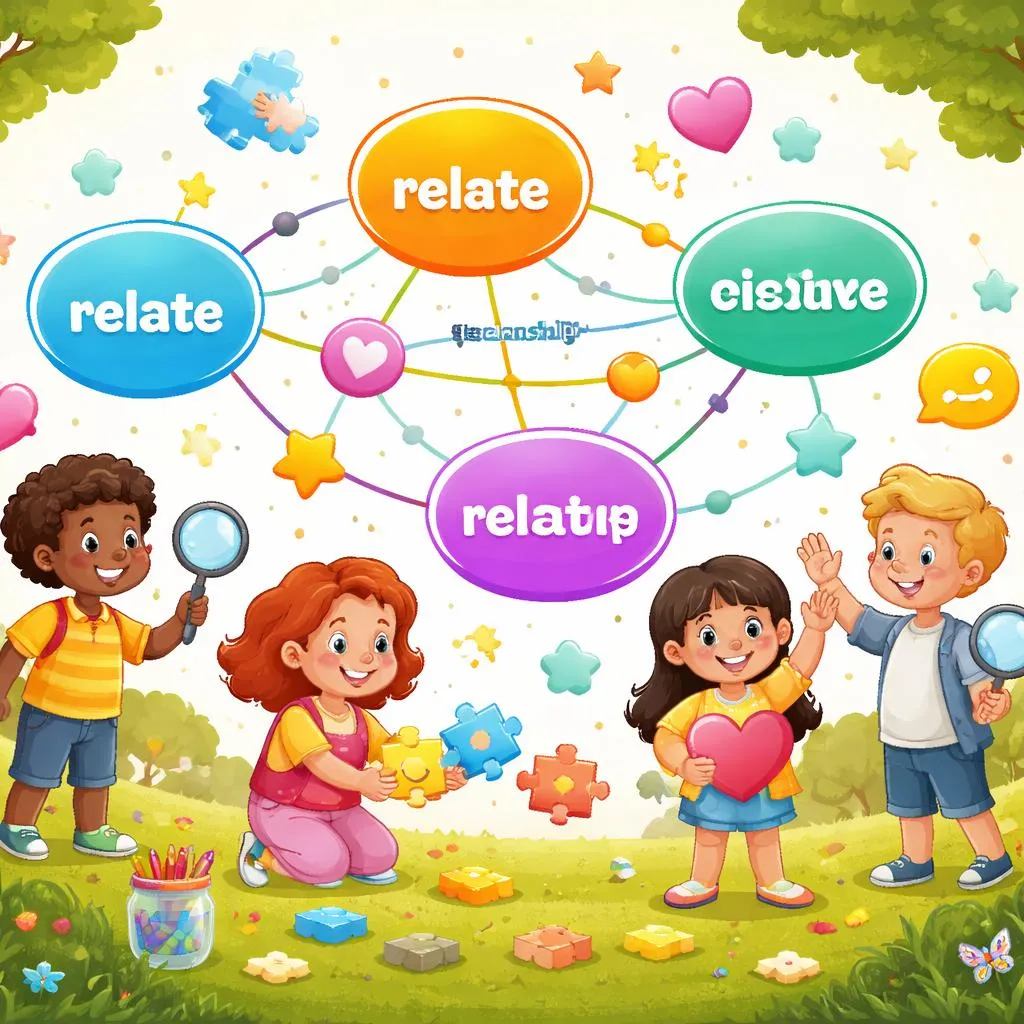
Make a Word Family Web
Write relate in the center.
Add:
relation relationship relative relatively
Draw links.
Visual patterns support memory.
Compare Similar Meanings
Ask:
How is relation different from relationship?
Children grow through comparison.
That deepens understanding.
Use Family Examples
Use relative in family conversations.
Use relationship when discussing friendships.
Real examples make vocabulary stick.
Hunt for Suffixes
Find:
-ion -ship -ive -ly
Children start spotting patterns in books.
That builds independence.
Turn It Into a Word Puzzle
Match roots and endings.
relate + ion
relation + ship
relative + ly
Word building can feel like a game.
Why This Word Family Helps Reading Growth
This family appears across subjects.
Reading:
relate to characters
Science:
relation between causes
Social studies:
human relationships
Math:
relative size
One family travels widely.
That makes it valuable.
Children who study roots and forms often read with stronger understanding.
They infer meanings more easily.
That supports long-term literacy.
Common Mix-Ups Children Make Relation and Relationship
Very common confusion.
Both involve connection.
But relationship often feels deeper.
Compare:
relation between facts relationship between friends
Context helps.
Relative and Relatively
These look close.
But grammar differs.
a relative person? no a relative measurement? yes relatively easy? yes
Usage matters.
Relate and Relationship
Children may assume same use.
But one is action.
One is a noun.
Different jobs.
Shared root.
That is a key lesson.
How One Word Family Builds Bigger Vocabulary
This family teaches more than five words.
It teaches roots.
Suffixes.
Grammar roles.
Meaning shifts.
That knowledge transfers.
Children may later understand:
related unrelated relativity
One root can keep growing.
That makes vocabulary learning powerful.
Learning relate, relation, relationship, relative, relatively as One Family
These words show how English builds meaning through patterns.
A verb can become a noun.
A noun can grow into a larger idea.
An adjective can become an adverb.
One root can support family words, comparison words, and abstract ideas.
That is rich learning.
When children understand relate, relation, relationship, relative, relatively as one connected family, they do more than expand vocabulary.
They begin seeing how English words connect.
And once those connections become clear, reading, spelling, and expression often grow much more naturally.