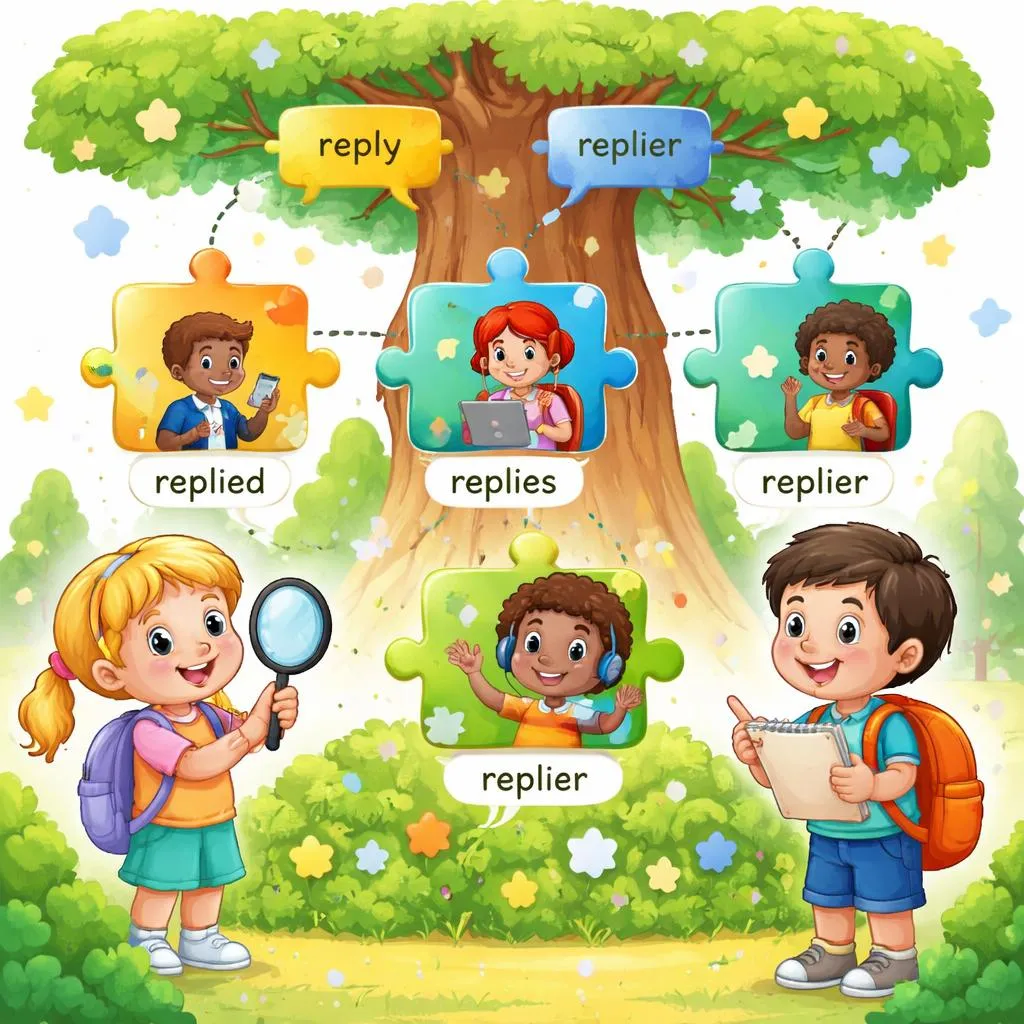

What Does “Same Word, Different Forms” Mean?
Many English words grow in families.
One root can create different forms.
The family reply, replier is a simple but useful example.
Both words connect to answering.
But they have different jobs.
Reply can be a verb and a noun. Replier is a noun.
One root.
Different roles.
That is how word families work.
Even small word families can teach big patterns.
Children do not need huge word groups to learn morphology.
A small family can still reveal how English grows.
Personal Pronouns Change Their Form
Children already know forms can change.
They see:
I, me, my they, them, their
Different forms.
Connected meaning.
Word families work in a similar way.
Look at these:
I reply quickly. Her reply was polite. He was the first replier.
The meaning connects.
The grammar shifts.
That is the heart of word families.
When children notice this, vocabulary feels more logical.
From Verb to Noun to Adjective to Adverb – One Family, Many Words
This family is smaller than some others.
But it still teaches rich ideas.
Reply as a Verb
Reply often acts as a verb.
It means answer.
Examples:
Please reply soon. I replied to the email. She replied politely.
This is a very common everyday word.
Children hear it often.
Reply as a Noun
Reply can also be a noun.
Examples:
His reply was thoughtful. I liked your reply.
This is exciting for learners.
One word can do two jobs.
Verb and noun.
That is worth noticing.
Replier as a Noun
Replier names a person who replies.
Examples:
She was the first replier online. The quick replier answered first.
This word is less common than reply.
But it is useful for studying word formation.
The ending -er often names a person connected to an action.
Examples:
teach → teacher write → writer reply → replier
That pattern matters.
One Root, Many Roles – How Words Grow from Actions to Qualities
Look how this root works.
reply → action reply → thing named replier → person who does the action
One root.
Many roles.
That is powerful.
Children can learn that a root can stay the same while endings change meaning.
And sometimes one word can have two roles.
That is important grammar awareness.
Same Meaning, Different Jobs – Is It a Verb or a Noun?
Children may not realize reply can be both verb and noun.
That is a great discovery.
Look here:
Verb:
Please reply tomorrow.
Noun:
Your reply was helpful.
Same spelling.
Different job.
Context tells us which one it is.
Now compare:
I reply often. I am the replier.
Action versus person.
Different jobs.
Shared root.
That is the key lesson.
Adjectives and Adverbs – When Do We Add -ly?
This word family does not include common adjective and adverb forms in the keyword set.
That is worth noticing.
Not every family has every grammar category.
Some families are smaller.
That is normal.
Still, children can connect this family to related patterns.
For example:
quick reply reply quickly
This helps show how nouns and adverbs work around the family.
Children learn that word families vary.
That is an important insight.
Watch Out for Tricky Spelling Changes (Double Letters, y to i, and More)
This family has an important spelling pattern.
Reply to Replier
Notice something interesting.
The y stays.
reply → replier
Some children expect:
“replier” to change differently.
But it keeps the y.
That is worth remembering.
Reply Has Two Grammar Jobs
This can be tricky.
Children may think one spelling means one role.
But reply can be noun or verb.
That matters.
Context shows the difference.
Watch the Reply To Pattern
Children often use:
reply someone
But common English often says:
reply to someone
That pattern matters.
Let’s Practice – Can You Choose the Right Form?
Try these.
- Please ______ to my message.
Answer: reply
Verb.
- Her ______ made me smile.
Answer: reply
Noun.
- He was the fastest ______.
Answer: replier
Person who does the action.
- I will ______ tomorrow morning.
Answer: reply
Action again.
Simple practice builds strong pattern awareness.
Tips for Parents – Help Your Child Learn Word Families in a Fun Way
Word families can be playful.
Explore One Word with Two Jobs
Use reply as noun and verb.
Make two sentence groups.
Children enjoy spotting the difference.
That builds grammar awareness.
Find More -er Words
Look for:
writer singer replier
This shows a useful pattern.
Patterns support vocabulary growth.
Practice Real Communication
Use email examples.
Use text messages.
Ask:
What would your reply be?
This makes vocabulary meaningful.
Play “Action or Person?”
Say a word.
Child decides:
Action?
Person?
This turns morphology into a game.
Build a Mini Word Family Tree
Write reply in the center.
Add replier.
Even small families can grow.
That helps children see connections.
Why This Word Family Helps Reading Growth
This family may be small.
But it teaches big literacy ideas.
One spelling can have multiple jobs.
Suffixes can add meaning.
Context helps identify grammar.
Those are advanced reading skills.
And reply is common in everyday texts.
That makes it practical.
Useful words often build strong foundations.
Common Mix-Ups Children Make Reply as Verb or Noun
Very common.
Compare:
I reply quickly. My reply was short.
Same word.
Different job.
That can confuse learners.
Practice helps.
Reply and Answer
Children may wonder if they are the same.
They overlap.
But usage can differ.
That is a good discussion point.
Vocabulary often has shades of meaning.
Forgetting Reply To
A frequent error:
I replied him.
Better:
I replied to him.
That pattern matters.
How Small Word Families Build Big Vocabulary
Even a two-word family teaches patterns.
And patterns transfer.
Children may later understand:
apply, applier supply, supplier
They may notice -er patterns.
They may notice noun-verb dual roles.
One small family can open bigger ideas.
That is how vocabulary grows.
Learning reply, replier as One Family
These words may seem simple.
But they teach important language patterns.
A word can be both action and noun.
A suffix can name the person doing the action.
One root can carry many roles.
That is how English grows.
When children learn reply, replier as one connected family, they begin seeing patterns inside words rather than memorizing words one by one.
And once those patterns become familiar, reading, spelling, and expression often become much easier and much more enjoyable.