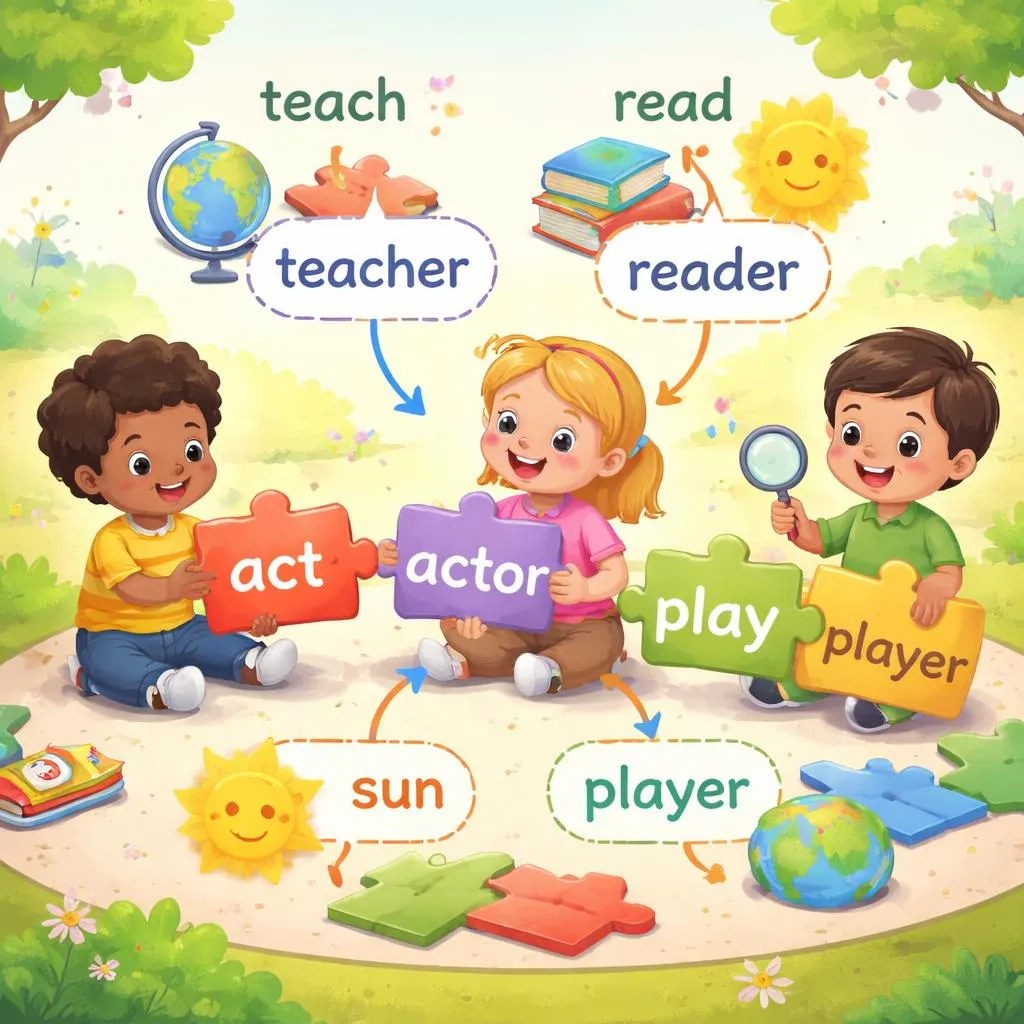

What Does “Same Word, Different Forms” Mean?
Many English words grow in families.
One root can lead to many forms.
The family represent, representation, representative is a strong example.
All three words connect to showing, standing for, or speaking for something.
But each word has a different job.
Represent is a verb. Representation is a noun. Representative can be a noun or an adjective.
One root.
Several forms.
Different roles.
That is how word families work.
Children who study these patterns often understand vocabulary more deeply.
Personal Pronouns Change Their Form
Children already know forms can change.
They see:
I, me, my we, us, our
Different forms.
Connected meaning.
Word families work in a similar way.
Look at these:
Colors can represent ideas. The drawing is a representation. She is our class representative.
Same root idea.
Different grammar jobs.
Seeing these connections helps children understand how English grows.
That supports literacy.
From Verb to Noun to Adjective to Adverb – One Family, Many Words
This family shows meaningful growth.
It is rich for learning.
Represent as a Verb
Represent shows action.
It often means stand for or show.
Examples:
A dove can represent peace. This map represents the town. She will represent our team.
Children may meet this in art, math, and social studies.
It is an important academic word.
Representation as a Noun
Representation names an image, symbol, or act of representing.
Examples:
The chart is a representation of data. The painting is a representation of nature.
The action becomes an idea or thing.
This follows a common pattern.
create → creation represent → representation
The ending -ation often forms nouns.
That is a helpful clue.
Representative as a Noun
Representative can name a person.
Examples:
Our class representative spoke first. The representative answered questions.
It names someone who acts for others.
Representative as an Adjective
It can also describe something typical.
Examples:
This sample is representative of the group.
That is exciting.
One word.
Two jobs.
Children can learn much from that.
One Root, Many Roles – How Words Grow from Actions to Qualities
Look how the root grows.
represent → action representation → idea or image representative → person or description
One root.
Many roles.
That is how English expands.
Children can use endings as clues.
-ation often forms nouns -ive often forms adjectives sometimes nouns too
Patterns support decoding.
That helps children read harder texts.
Same Meaning, Different Jobs – Is It a Verb or a Noun?
Children may mix forms.
That is normal.
Ask:
Is this word showing action?
Naming something?
Describing something?
Look here:
Correct:
Pictures represent ideas. The picture is a representation.
Not correct:
Pictures representation ideas.
Now compare:
She is our representative. This sample is representative.
Same spelling.
Different jobs.
Noun in one sentence.
Adjective in another.
That is an important discovery.
Adjectives and Adverbs – When Do We Add -ly?
This family does not include a common -ly form in this set.
That matters too.
Not every family has every form.
Some families stop at adjective.
That is normal.
Still, representative helps children study adjective endings.
The -ive ending often signals adjectives.
Examples:
active creative representative
That is a strong pattern.
Children can apply it elsewhere.
Watch Out for Tricky Spelling Changes (Double Letters, y to i, and More)
This family has useful spelling patterns.
Represent to Representation
Add -ation.
represent → representation
Long words can look difficult.
Break them apart.
represent + ation
Smaller parts help.
Represent to Representative
Add -ative.
represent → representative
Another useful suffix.
Worth noticing.
Representative Has Two Jobs
This can confuse children.
But context helps.
class representative representative sample
Person or description.
Context shows meaning.
Let’s Practice – Can You Choose the Right Form?
Try these.
- This flag can ______ a country.
Answer: represent
Action word.
- The chart is a ______ of rainfall.
Answer: representation
Names a thing.
- Our student ______ spoke today.
Answer: representative
Person.
- This example is ______ of the group.
Answer: representative
Adjective.
Practice helps children compare grammar roles.
That builds confidence.
Tips for Parents – Help Your Child Learn Word Families in a Fun Way
Word families can be engaging.
Build a Word Family Web
Write represent in the center.
Add:
representation representative
Show how the root grows.
Visual learning helps memory.
Explore Symbols Around You
Ask:
What does a heart represent?
What does a flag represent?
Vocabulary becomes meaningful.
Find -ation Words
Look for:
celebration creation representation
Patterns repeat.
Children enjoy noticing them.
Practice Noun or Adjective Sorting
Use representative.
Is it naming a person?
Or describing something?
This turns grammar into discovery.
Connect to School Life
Talk about class representatives.
Use real examples.
Words stick when connected to life.
Why This Word Family Helps Reading Growth
This family appears in many school subjects.
Math uses representation.
Social studies uses representatives.
Art discusses what pictures represent.
These are academic words.
Children who know them often understand nonfiction better.
That supports comprehension growth.
Common Mix-Ups Children Make Represent and Representation
Very common.
One acts.
One names.
represent ideas a representation of ideas
Different jobs.
Representative as Noun or Adjective
This often surprises learners.
But context helps.
our representative representative sample
Two jobs.
One word.
Great learning opportunity.
Thinking Long Words Are Unrelated
Some children may not see the family connection.
Breaking words into parts helps.
Roots reveal relationships.
That is morphology.
How One Word Family Builds Bigger Vocabulary
This family teaches transferable patterns.
Children may later understand:
present, presentation create, creation active, representative
Suffix patterns repeat.
One family can unlock many others.
That is how vocabulary grows.
Through connections.
Learning represent, representation, representative as One Family
These words teach much more than definitions.
They show how one root can become action, idea, person, and description.
That is how English builds meaning.
When children understand represent, representation, representative as one connected family, they begin seeing words as patterns rather than isolated pieces.
And once those patterns become familiar, reading, spelling, and expression often become much easier and much more enjoyable.