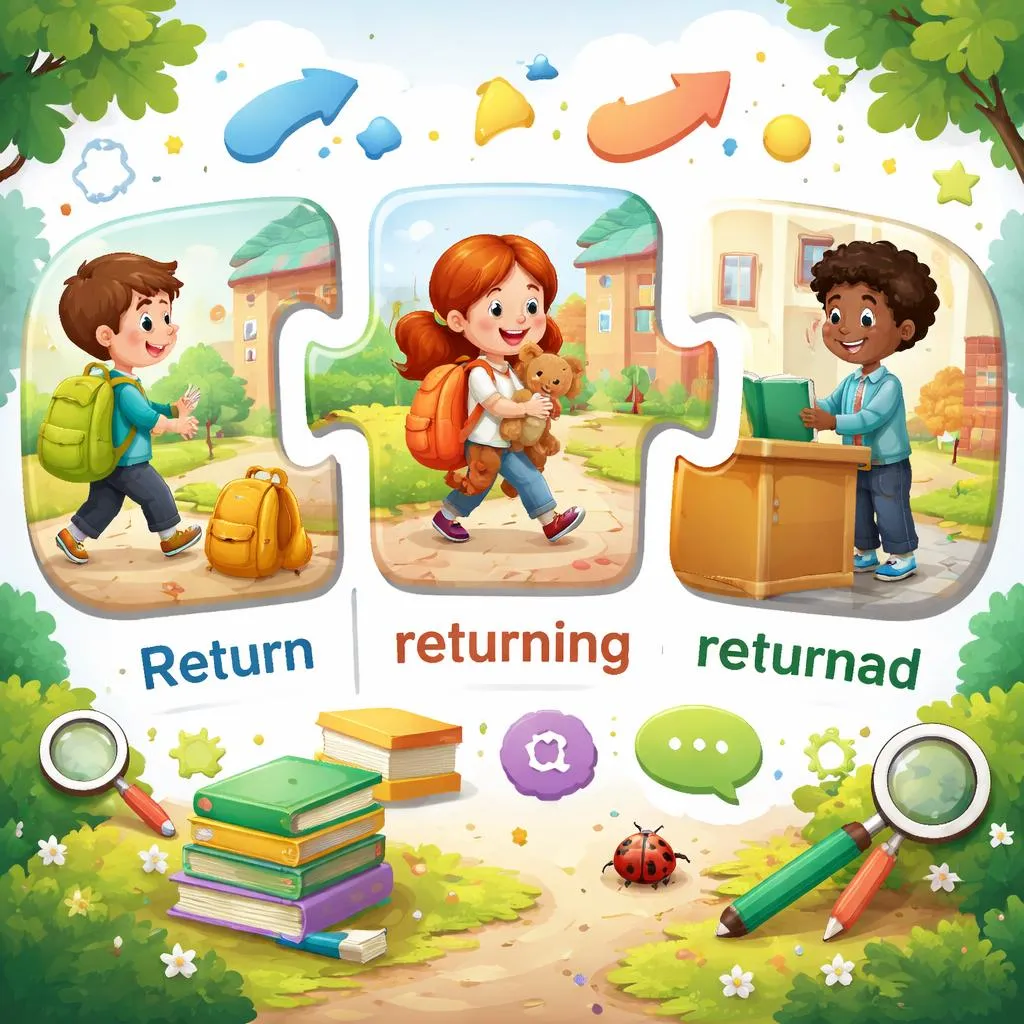

What Does “Same Word, Different Forms” Mean?
Many English words belong to families.
One root can grow into several forms.
The family return, returning, returned shows this clearly.
All three words connect to coming back.
But each form has a different role.
Return can be a verb or noun. Returning can be a verb form or adjective. Returned can be a verb form or adjective.
One root.
Different forms.
Different jobs.
That is how word families work.
Children who notice these patterns often become stronger readers and writers.
They begin seeing structure inside words.
Personal Pronouns Change Their Form
Children already know forms can change.
They see:
I, me, my he, him, his
Different forms.
Connected meaning.
Word families work similarly.
Look at these:
I return home early. The returning birds are back. The returned book is on the desk.
Connected root.
Different grammar jobs.
That is the key idea.
Patterns help children understand English.
From Verb to Noun to Adjective to Adverb – One Family, Many Words
This family shows useful growth.
It also shows how -ing and -ed forms work.
Very important in English.
Return as a Verb
Return often acts as a verb.
Examples:
Please return the library book. Birds return in spring.
It means come back or give back.
Useful everyday word.
Return as a Noun
It can also be a noun.
Examples:
We celebrated her return. His return made everyone happy.
Same spelling.
Two grammar jobs.
That matters.
Returning as a Verb Form
Returning can be part of a verb.
Examples:
She is returning tomorrow. They were returning home.
It shows ongoing action.
Important pattern.
Returning as an Adjective
It can also describe.
Examples:
The returning students smiled. Returning visitors know the rules.
Now it acts like an adjective.
Interesting shift.
Returned as a Verb Form
Returned can show past action.
Examples:
He returned yesterday. I returned the toy.
Past tense.
Clear pattern.
Returned as an Adjective
It can also describe something.
Examples:
The returned package arrived damaged. The returned homework was corrected.
That is adjective use.
Children often enjoy noticing this.
One Root, Many Roles – How Words Grow from Actions to Qualities
Look at the growth.
return → action return → event returning → ongoing action or description returned → completed action or description
One root.
Many roles.
That is how English works.
Endings matter.
-ing often shows ongoing action -ed often shows completed action
Sometimes they also describe.
That is a powerful lesson.
Same Meaning, Different Jobs – Is It a Verb or a Noun?
Children may confuse these forms.
That is natural.
Ask:
Is it acting?
Naming?
Describing?
Look here:
I return every summer. My return was joyful.
Verb.
Noun.
Different jobs.
Now compare:
returning guests returned books
Both describe.
But they show different ideas.
One suggests coming back.
One suggests already brought back.
Important difference.
Adjectives and Adverbs – When Do We Add -ly?
This family has no -ly adverb.
That matters too.
Not every family has every form.
Children should know that.
But this family teaches -ing and -ed adjectives.
Very useful pattern.
Compare:
exciting game excited child
Now:
returning traveler returned traveler
Patterns connect.
That helps learning.
Watch Out for Tricky Spelling Changes (Double Letters, y to i, and More)
This family has important spelling patterns.
Return to Returning
Drop nothing.
Add -ing.
return + ing
Simple pattern.
Return to Returned
Add -ed.
return + ed
Clear pattern.
Returning and Returned Mean Different Things
Very important.
Children may mix them.
returning birds are coming back returned books have already come back
Big difference.
Context matters.
Let’s Practice – Can You Choose the Right Form?
Try these.
- Please ______ the pencil tomorrow.
Answer: return
Verb.
- Her ______ made us smile.
Answer: return
Noun.
- The ______ students looked happy.
Answer: returning
Adjective.
- He is ______ next week.
Answer: returning
Verb form.
- The ______ package was opened.
Answer: returned
Adjective.
Practice builds confidence.
It also builds grammar awareness.
Tips for Parents – Help Your Child Learn Word Families in a Fun Way
Word families can be playful.
Build a Word Family Chart
Write return in the center.
Add:
returning returned
Show how endings change roles.
Visual learning helps.
Practice -ing and -ed Pairs
Use more examples.
falling / fallen exciting / excited returning / returned
Patterns become familiar.
Act Out the Meanings
Pretend to return a book.
Pretend to be returning home.
Movement supports memory.
Find These Words in Books
Notice returning birds.
Notice returned letters.
Reading reinforces vocabulary.
Ask “Action or Description?”
Great grammar game.
Is it doing?
Or describing?
Children enjoy solving it.
Why This Word Family Helps Reading Growth
This family appears everywhere.
Stories use return.
School texts use returned.
Informational books use returning animals.
Very common vocabulary.
Children who understand these forms often read more smoothly.
That supports comprehension.
And it builds grammar awareness.
Common Mix-Ups Children Make Return as Verb or Noun
Very common.
return home make a return
Different jobs.
Returning and Returned
Another big one.
Children mix ongoing and completed action.
Practice helps.
Thinking -ing Is Always a Verb
Not true.
Returning can describe.
Important discovery.
How One Word Family Builds Bigger Vocabulary
This family teaches transferable patterns.
Children may later understand:
walk, walking, walked paint, painting, painted
Patterns repeat.
One family unlocks many others.
That is how vocabulary grows.
Through connections.
Learning return, returning, returned as One Family
These words teach much more than definitions.
They show how one root can become action, event, ongoing action, completed action, and description.
That is rich language learning.
They also help children understand how -ing and -ed forms can do more than show tense.
They can describe too.
When children understand return, returning, returned as one connected family, they begin seeing patterns inside words rather than memorizing vocabulary one by one.
And once those patterns become familiar, reading, spelling, and expression often become much easier and much more enjoyable.