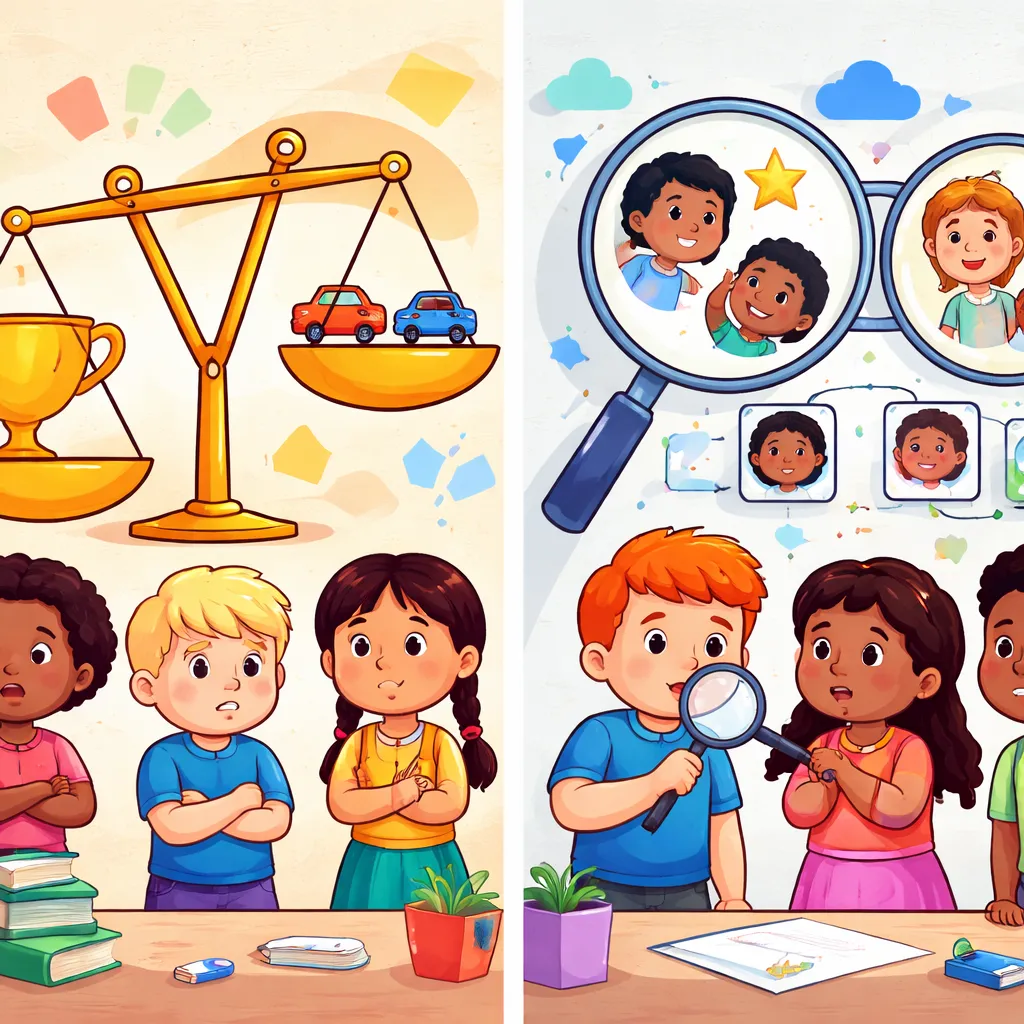

Unfair and Biased: What’s the Difference?
In the journey of learning English, children often encounter words that seem to have similar meanings. Unfair and biased are two such words. Both describe situations where something is not right, or when people are treated in an unequal way. But while they sound similar, they are used in different contexts and have distinct meanings. Understanding these differences can help children use these words correctly.
This article explores the meanings of unfair and biased, their subtle differences, and when to use each word in various situations. By the end of this article, children and parents will better understand these terms and be able to use them appropriately in conversations and writing.
Are Similar Words Really Interchangeable?
Although unfair and biased both describe situations that involve inequality, they are not exactly the same. A situation can be unfair without being biased, and vice versa.
Unfair generally refers to any situation where there is a lack of equality or justice. It can apply to a wide range of situations, from everyday interactions to larger societal issues. For example, if two children are not given the same opportunities to participate in a game, it’s an unfair situation.
Biased, on the other hand, specifically refers to an unfair preference or prejudice towards one group, person, or thing. A biased decision or opinion is one that is influenced by personal preferences, often in a way that is unjust or not based on facts. Bias is often hidden, and it can occur without people realizing it.
So, while both unfair and biased involve unequal treatment, biased refers more to an intentional or subconscious preference, while unfair is a broader term for any situation where there is unequal treatment or injustice.
Set 1: Unfair vs Biased — Which One Is More Common?
Unfair is used more commonly in everyday language. Children often talk about things being unfair when they feel they haven’t been treated equally. For example, a child might complain about a friend getting more candy or a classmate being picked first for a team in a game. In these cases, the situation is unfair, and the term is used to describe the unequal treatment in a straightforward manner.
Examples of unfair:
“It’s unfair that I have to do all the work.” “She got the bigger piece, and that’s unfair.”
Biased, on the other hand, is less commonly used, especially by younger children. It is a more specific term that is often used in discussions about personal opinions, discrimination, or situations where a person or group is treated unfairly due to prejudice. Biased is often used in more formal settings or discussions about social justice, politics, or media.
Examples of biased:
“The news article was biased because it only showed one side of the story.” “The teacher was biased when she gave more attention to the boys.”
So, in terms of frequency, unfair is more common in everyday speech, while biased is more specific and formal.
Set 2: Unfair vs Biased — Same Meaning, Different Contexts
While both unfair and biased refer to situations where one party is treated unjustly, they are used in different contexts.
Unfair is typically used to describe situations where equality or justice is not upheld. It can refer to situations where everyone should be treated equally but isn't. For example, when two children are playing a game, and one is allowed to cheat while the other follows the rules, that situation is unfair.
Examples of unfair:
“It’s unfair that only some people were allowed to speak in the meeting.” “It’s unfair that she always gets the best seat in the classroom.”
Biased, however, is used to describe situations where personal opinions, preferences, or prejudices influence a decision or treatment. It often refers to a more specific, often hidden, influence on how decisions are made or how people are treated. Biased can be seen in areas like politics, hiring practices, or media coverage.
Examples of biased:
“The hiring manager was biased against the candidate because of their accent.” “The teacher’s grading was biased, favoring students she liked more.”
So, unfair is used for more general instances of inequality, while biased points to an unequal treatment that stems from personal preference, judgment, or prejudice.
Set 3: Unfair vs Biased — Which Word Is “Bigger” or More Emphatic?
When comparing unfair and biased, biased is often seen as more specific and more impactful, particularly because it suggests that someone’s actions or decisions are influenced by prejudice or an inherent preference. Bias can be harder to detect because it is often subtle or unconscious.
Unfair can refer to any unequal treatment, but it doesn’t always imply that someone is consciously making a biased decision. For example, a situation might be unfair simply because of poor planning or oversight, rather than because of someone’s personal biases.
For example:
If a teacher grades students without considering their effort, but only based on their final scores, this could be considered unfair. If a teacher grades students differently based on their personal likes or dislikes, this would be biased.
In this sense, biased carries a stronger connotation because it implies a deeper moral or ethical issue, while unfair is more of a general observation of inequality.
Set 4: Unfair vs Biased — Concrete vs Abstract
Unfair is often a more concrete term. It refers to situations where unequal treatment is easily observable. For example, a child can see that they are being treated unfairly when someone cuts in line or gets more cookies. The idea of unfairness is often more visible and can be directly experienced.
Examples of unfair:
“It’s unfair that I didn’t get a turn.” “She took all the toys, and that’s unfair.”
Biased, however, is more abstract. It involves an internal or hidden preference that influences decisions. A biased person may not always show their preferences openly, and the bias may be subtle or unintentional. Because of this, biased often deals with more abstract ideas about judgment, prejudice, or stereotyping.
Examples of biased:
“The judge was biased in his decision because of his personal opinions.” “The media can be biased in how they report the news.”
So, while unfair is more straightforward and easy to understand, biased involves deeper, often less obvious, factors that influence decisions or treatment.
Set 5: Unfair vs Biased — Verb or Noun? First Understand the Role
Both unfair and biased are used primarily as adjectives, but they can also be used in different forms.
Unfair can also be used as an adverb (unfairly) or a noun (unfairness). “He was treated unfairly.” “The unfairness of the decision was clear.” Biased is also primarily used as an adjective, but it can be used as a verb when describing the action of influencing something with prejudice. The noun form is bias. “Her opinion was biased.” “He was biased against certain candidates.” “The bias in his decision-making was evident.”
In terms of frequency, unfair is often used in its adjective form, but biased is more likely to appear as a noun (bias) or in the verb form (to bias).
Set 6: Unfair vs Biased — American English vs British English
In both American and British English, unfair and biased have the same meanings, but their usage can vary slightly.
In American English, unfair is often used in casual, everyday situations. Biased, however, is more commonly used in discussions about politics, media, or social issues. It’s a term that can appear frequently in debates about social justice or equality.
In British English, the terms are used similarly, but there may be a stronger emphasis on fairness in social settings and a slightly broader usage of biased in formal discussions.
Set 7: Unfair vs Biased — Which Fits Formal Situations?
Biased is generally used in more formal settings, especially when discussing ethics, law, or moral issues. It is often used when talking about discrimination, prejudice, or media representation.
For example:
“The company was accused of biased hiring practices.” “The journalist’s biased reporting led to public outcry.”
Unfair is more commonly used in informal contexts, such as when discussing daily situations at home, school, or in a game. It can be used in both formal and informal settings, but it doesn’t carry the same weight as biased in formal discussions about inequality or justice.
For example:
“The teacher made an unfair decision when choosing the group leaders.” “It’s unfair to blame one person for the entire project.” Set 8: Unfair vs Biased — Which One Is Easier for Kids to Remember?
For children, unfair is easier to understand and remember. It’s a term that children use often when discussing situations in which they feel they haven’t been treated equally. The concept of fairness is a core value in childhood development, and children learn to recognize unfairness in many everyday situations.
Biased, however, can be more difficult for children to fully grasp because it involves more complex ideas about personal preferences, prejudice, and societal structures. As children grow older, they will encounter more opportunities to understand the idea of bias, especially in discussions about social justice and equality.
Mini Exercise: Can You Spot the Differences Between These Similar Words?
Test your understanding of unfair and biased with these short questions:
Which word would you use to describe a situation where someone is treated equally? a) Unfair b) Biased “The teacher was ____ when she gave extra time to her favorite students.” a) Unfair b) Biased “It’s ____ to let only one child play while others wait.” a) Unfair b) Biased “The media report seemed ____ because it only showed one perspective.” a) Unfair b) Biased Parent Tips: How to Help Kids Learn and Remember Similar Words
To help children understand and remember the differences between unfair and biased, encourage them to think about real-life situations where they have observed or experienced these terms. Talk about times when they felt treated unfairly and use examples from books, movies, or news stories to discuss bias.
This will help children build a clearer understanding of how these words differ and how to use them correctly in conversation.