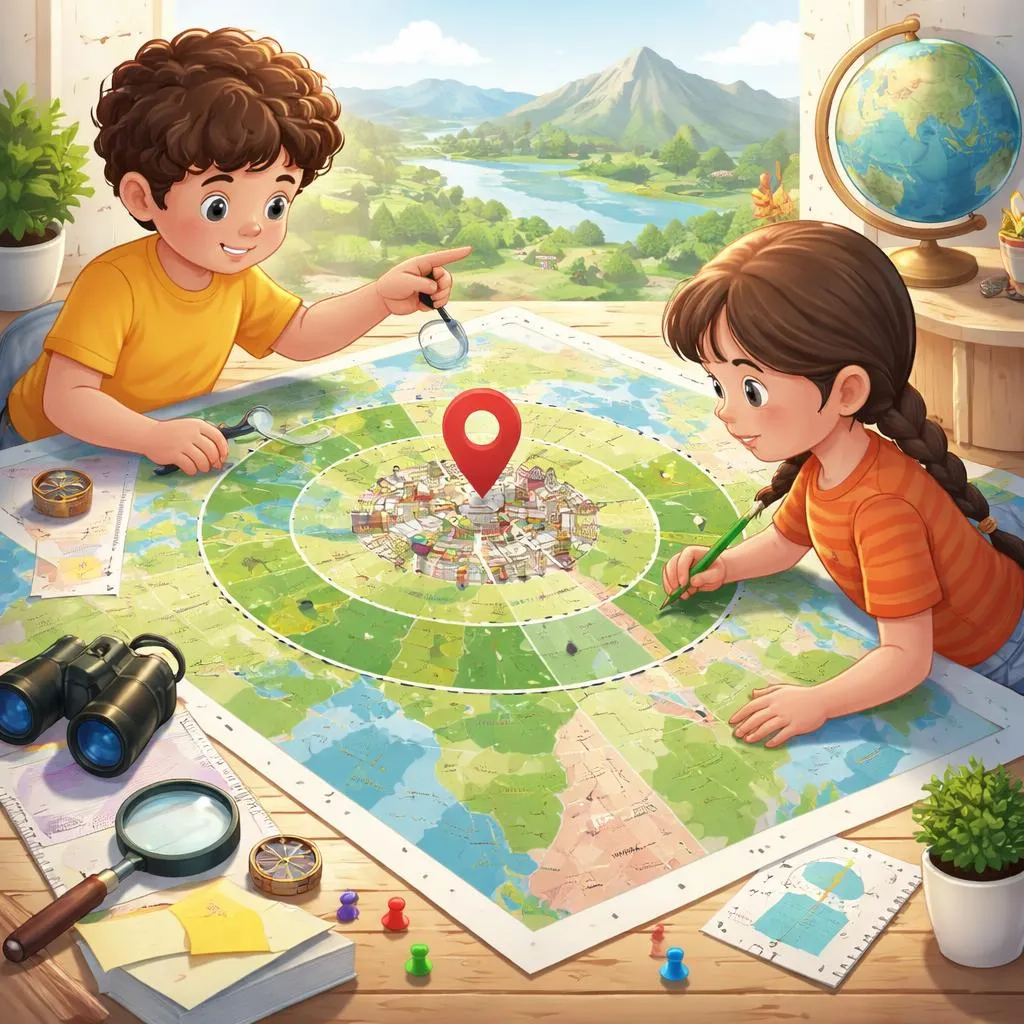

What is the Concept? Let's explore a useful phrase we often see on maps and in descriptions: "and surrounding areas." This phrase is not a single word. It is a prepositional phrase that gives us more information about a location. It helps us understand the relationship between a main place and the space around it.
When we use "and surrounding areas," we expand our view. We move from thinking about one specific point, like a city, to including the towns, neighborhoods, or countryside nearby. This concept is important for building a clear picture of places when we read, talk, or learn about the world.
Meaning and Explanation The meaning of "and surrounding areas" is about inclusion and proximity. The word "surrounding" comes from the verb "to surround," which means to be all around something. "Areas" means places or regions. So, "and surrounding areas" literally means "and the places all around it."
We use this phrase to give a more complete description without listing every single nearby town. For example, "We will explore London and surrounding areas." This tells us the trip might include visits to places like Greenwich or Kew, which are close to central London. It makes our language more efficient and our mental maps more detailed.
Categories or Lists We can think of "and surrounding areas" as part of a category of location phrases. Other phrases in this category include "downtown and the suburbs," "the city and its outskirts," or "the village and the nearby countryside." All these phrases share the same function: linking a central location to its broader geographical context.
The phrase itself is a fixed list. It always includes the conjunction "and," the adjective "surrounding," and the plural noun "areas." We do not change the words within this common phrase. It acts as a single unit of meaning to describe a cluster of locations.
Daily Life Examples We encounter "and surrounding areas" frequently in daily life. Listen for it in weather reports: "Rain is forecast for Seattle and surrounding areas." Check local business websites: "We deliver to Denver and surrounding areas." See it on tourism brochures: "Discover Paris and surrounding areas."
We can also use it in our own descriptions. "Our school serves children from Springfield and surrounding areas." Or, "The park attracts visitors from the city and surrounding areas." Pointing out these real-world uses helps connect the grammar phrase to practical understanding.
Printable Flashcards Effective flashcards for "and surrounding areas" should illustrate the core concept. One side of the card can show a simple map. A star marks a central city. A shaded circle around it represents the "surrounding areas." The phrase itself is written clearly below.
The other side can have a fill-in-the-blank sentence for practice. For example: "The museum is popular with people from Boston ______." The answer, "and surrounding areas," reinforces its use. These cards turn an abstract phrase into a visual and interactive learning tool.
Learning Activities and Games A great activity is "Map Maker." Provide a blank map outline. Have learners draw a central point (a town square, a major lake) and label it. Then, ask them to draw and label three or four "surrounding areas" (a forest to the north, a village to the east, etc.). They can then write a sentence using the phrase to describe their map.
Play "News Anchor." Give learners a simple weather map or event poster. They must pretend to be a TV presenter and create a one-sentence report using "and surrounding areas." For example, "The concert will be heard throughout the stadium and surrounding areas." This builds confidence in using the phrase in a realistic context.
Understanding how to use "and surrounding areas" enriches descriptive language and geographical literacy. It moves communication from vague to specific, from a point to a region. By linking this phrase to maps, weather reports, and local information, we show its practical value. Learners gain a tool for clearer expression and a better understanding of the spatial relationships in the world around them, preparing them to be more informed readers and communicators.