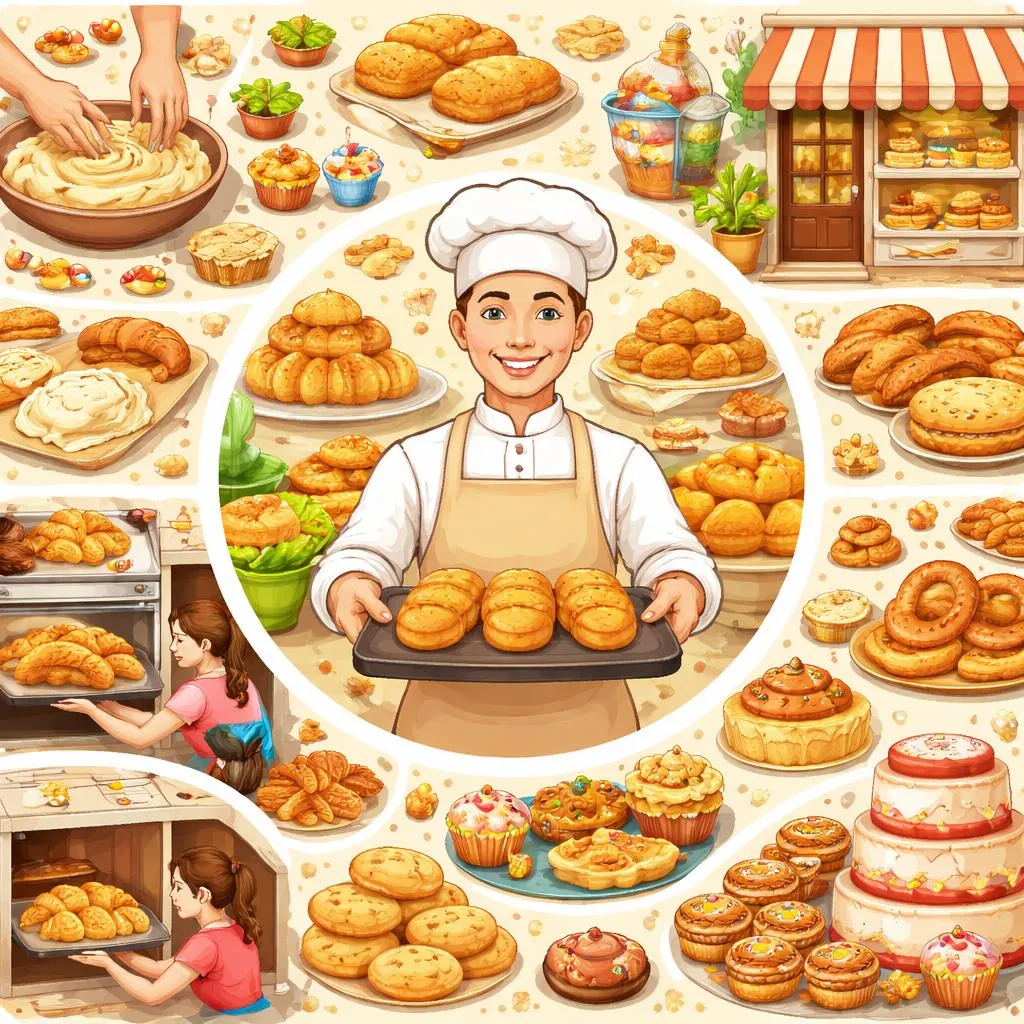

You bake cookies in a warm oven. A baker wakes up early to make bread. The words “bake, baker, bakery, baking, baked” all come from one family. Each word talks about cooking with dry heat. But each one has a different job in a sentence. Learning this family helps children enjoy cooking and understand food. Let us explore these five words together.
What Does “Same Word, Different Forms” Mean? One core idea can grow into many word shapes. The meaning stays the same at the heart. But the word changes its ending or combines for a new role. For example, “bake” is a verb or a noun. “Baker” is a noun. “Bakery” is a noun. “Baking” is a noun or a verb form. “Baked” is an adjective or a verb form. Knowing these five forms helps a child talk about cooking and treats.
Personal Pronouns Change Their Form Pronouns change from “he” to “him” or “his”. Our word family changes by adding suffixes, not by changing person. Think of “bake” as the core action of cooking in an oven. “Baker” turns that action into a person. “Bakery” turns the action into a place. “Baking” turns the action into an activity. “Baked” turns the action into the past or a description. Each form answers a simple question. What action? Bake. Who cooks? Baker. What place sells baked goods? Bakery. What activity? Baking. What is already cooked? Baked.
From Verb to Noun to Adjective to Adverb – One Family, Many Words This family has a verb, nouns, an adjective, and verb forms. Let us start with the verb “bake”. Verb: We will bake a cake for the party. “Bake” means to cook with dry heat in an oven.
“Bake” can also be a noun. Noun: The bake sale raised money for the school. “Bake” means an event where baked goods are sold.
Next is the noun “baker”. Noun: The baker kneaded the dough for an hour. “Baker” means a person who bakes.
Then the noun “bakery”. Noun: The bakery on the corner sells fresh croissants. “Bakery” means a store that sells bread, cakes, and pastries.
Then “baking” as a noun. Noun: Baking requires precise measurements. “Baking” can also be a verb form. Verb (ongoing): She is baking a pie.
Finally “baked” as an adjective. Adjective: The baked potatoes were hot and fluffy. “Baked” can also be a verb form (past tense). Verb (past): I baked brownies yesterday.
One Root, Many Roles – How Words Grow from Actions to Qualities The Old English word “bacan” meant to bake. From this root, we built a family about oven cooking. “Bake” kept the main verb and noun meanings. Adding -er made “baker” (the person). Adding -ery made “bakery” (the place). Adding -ing made “baking” (the activity). Adding -ed made “baked” (the past or adjective). Children can see the same pattern in other families. For example, “roast, roaster, roastery, roasting, roasted”. Learning the -ery suffix helps kids talk about shops.
Same Meaning, Different Jobs – Is It a Verb or a Noun? Look at each word’s job carefully. “Bake” can be a verb or a noun. Verb example: Bake the bread for 30 minutes. Noun example: We are having a bake sale.
“Baker” is a noun. Example: A baker must wake up very early.
“Bakery” is a noun. Example: The bakery donates leftover bread to shelters.
“Baking” is a noun or a verb form. Noun example: Baking is a relaxing hobby. Verb example: The cookies are baking in the oven.
“Baked” is an adjective or a verb form. Adjective example: Baked chicken is healthy. Verb example: Mom baked cupcakes for my class. Each form has a clear job.
Adjectives and Adverbs – When Do We Add -ly? We can make an adverb from “baked”. Add -ly to get “bakedly” (very rare). For young learners, focus on the verb “bake” and the noun “bakery.” A simple reminder: “Bake is the action. Baker is the person. Bakery is the shop. Baking is the activity. Baked means already cooked.”
Watch Out for Tricky Spelling Changes (Double Letters, y to i, and More) “Bake” has no double letters. It ends with a silent e. Add -er to make “baker”. Bake → baker (drop the e, add er). Add -ery to make “bakery”. Bake → bakery (drop the e, add ery). Add -ing to make “baking”. Bake → baking (drop the e, add ing). Add -ed to make “baked”. Bake → baked (drop the e, add ed). A common mistake is writing “bake” as “bak” (missing e). Say “Bake has a silent e at the end.” Another mistake is “baker” spelled “baker” (correct) but some write “bakker” (double k). Say “Baker has one k.” Another mistake is “bakery” spelled “bakery” (correct) but some write “bakary” (with a). Say “Bakery has e after k: B-A-K-E-R-Y.” Another mistake is “baking” spelled “baking” (correct) but some write “baking” (same). Good. Another mistake is “baked” spelled “baked” (correct) but some write “bakked” (double k). Say “Baked has one k.”
Let’s Practice – Can You Choose the Right Form? Try these sentences with your child. Read each one aloud. Pick the correct word from the family.
Let us ______ a pizza for dinner. Answer: bake (verb)
The ______ wore a tall white hat. Answer: baker (noun)
We bought a loaf of bread at the ______. Answer: bakery (noun)
______ a cake is a fun Saturday activity. Answer: baking (noun)
The ______ potatoes were delicious. Answer: baked (adjective)
The school had a ______ sale to earn money for books. Answer: bake (noun)
The ______ is known for her famous apple pie. Answer: baker (noun)
The smell of ______ bread filled the house. Answer: baking (adjective? actually “baking bread” uses baking as a verb form)
I ______ a cake for your birthday. Answer: baked (verb past tense)
The cookies are ______ in the oven right now. Answer: baking (verb form)
After the practice, ask your child one question. Is this word an oven cooking action, a person who does it, a shop, an activity, or a cooked description? That simple question teaches grammar through food.
Tips for Parents – Help Your Child Learn Word Families in a Fun Way Use an oven to teach “bake”. Say “We bake muffins at 350 degrees.”
Use a chef to teach “baker”. Say “A baker uses flour, yeast, and salt.”
Use a store to teach “bakery”. Say “Let us go to the bakery for fresh croissants.”
Use a timer to teach “baking”. Say “Baking cookies takes about 12 minutes.”
Use a finished pie to teach “baked”. Say “The baked pie needs to cool before eating.”
Play “fill in the blank” during car rides. Say “______ a potato in the microwave is fast.” (bake) Say “The ______ woke up at 4 a.m.” (baker) Say “The ______ had a line out the door.” (bakery) Say “______ requires patience and practice.” (baking) Say “We ate ______ beans for dinner.” (baked)
Read a story about a baker or a bakery. Ask “What does the baker bake?” Ask “What is the best selling item at the bakery?”
Turn a drawing activity into a word lesson. Draw an oven with a pan inside. Label “bake”. Draw a person with an apron. Label “baker”. Draw a storefront with bread in the window. Label “bakery”. Draw a mixing bowl and a rolling pin. Label “baking”. Draw a cookie sheet with cookies. Label “baked treats”.
When your child makes a mistake, stay calm. If they say “I went to the bake,” for a shop, say “Almost. I went to the bakery. Bake is the verb.” If they say “The baker bakes baked baking,” that is funny. “The baker bakes baked goods during baking.”
Write the five words on sticky notes. Put them on the refrigerator or the kitchen wall. Each time you bake together, point to “bake”.
Remember that baking is delicious and fun. Use these words to build kitchen confidence. “Every baker started as a beginner.” “The bakery is a happy place.” Soon your child will bake with joy. They will dream of being a baker. They will visit the bakery proudly. They will love the smell of baking. And they will enjoy the baked results. That is the tasty power of learning one small word family together.