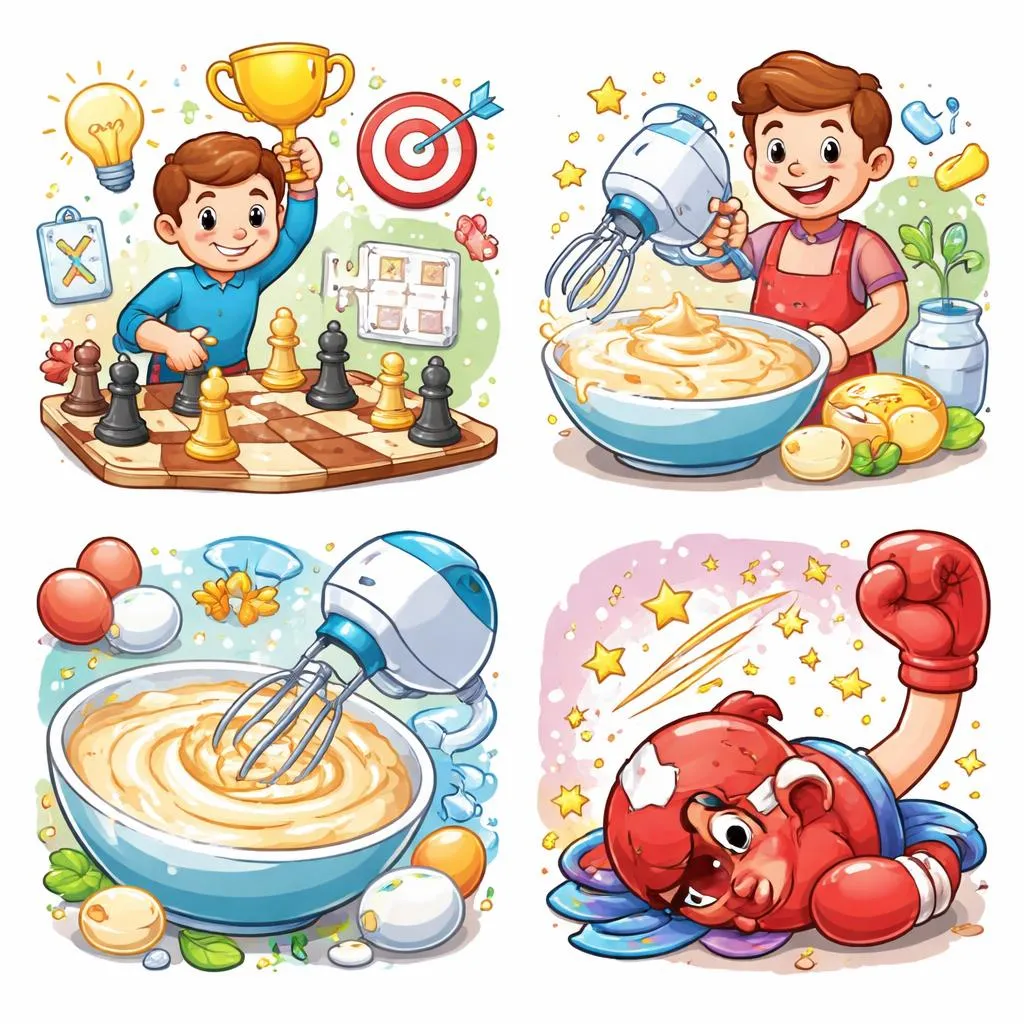

You beat an egg with a whisk. An egg beater mixes ingredients quickly. The words “beat, beater, beating, beaten” all come from one family. Each word talks about hitting or mixing. But each one has a different job in a sentence. Learning this family helps children understand cooking, sports, and overcoming. Let us explore these four words together.
What Does “Same Word, Different Forms” Mean? One core idea can grow into many word shapes. The meaning stays the same at the heart. But the word changes its ending for a new role. For example, “beat” is a verb or a noun. “Beater” is a noun. “Beating” is a noun or a verb form. “Beaten” is an adjective or a verb form. Knowing these four forms helps a child talk about mixing, rhythms, and winning.
Personal Pronouns Change Their Form Pronouns change from “he” to “him” or “his”. Our word family changes by adding suffixes, not by changing person. Think of “beat” as the core action of striking or defeating. “Beater” turns that action into a tool or person. “Beating” turns the action into an activity. “Beaten” turns the action into the past or a description. Each form answers a simple question. What action? Beat. What tool or person hits? Beater. What activity? Beating. What is already hit or defeated? Beaten.
From Verb to Noun to Adjective to Adverb – One Family, Many Words This family has a verb, nouns, an adjective, and verb forms. Let us start with the verb “beat”. Verb: Beat the eggs until they are fluffy. “Beat” means to hit repeatedly or to defeat.
“Beat” can also be a noun. Noun: The music had a strong beat. “Beat” means a rhythm or a hit.
Next is the noun “beater”. Noun: An egg beater saves time in the kitchen. “Beater” means a tool for beating or a person who beats.
Then “beating” as a noun. Noun: The beating of the drums could be heard down the street. “Beating” can also be a verb form. Verb (ongoing): She is beating the carpet to remove dust.
Finally “beaten” as an adjective. Adjective: The beaten team walked off the field sadly. “Beaten” can also be a verb form (past participle). Verb (past participle): The eggs have been beaten well.
One Root, Many Roles – How Words Grow from Actions to Qualities The Old English word “beatan” meant to strike. From this root, we built a family about hitting and defeating. “Beat” kept the main verb and noun meanings. Adding -er made “beater” (the tool or person). Adding -ing made “beating” (the activity). Adding -en made “beaten” (the past participle). Children can see the same pattern in other families. For example, “hit, hitter, hitting, hit (irregular)”. Learning the -er suffix helps kids name kitchen tools.
Same Meaning, Different Jobs – Is It a Verb or a Noun? Look at each word’s job carefully. “Beat” can be a verb or a noun. Verb example: Our team will beat the rivals. Noun example: The drum’s beat was steady.
“Beater” is a noun. Example: Use a whisk or an egg beater.
“Beating” is a noun or a verb form. Noun example: The beating of the storm scared the puppy. Verb example: He is beating a rug.
“Beaten” is an adjective or a verb form. Adjective example: The beaten path was easy to follow. Verb example: The cake batter has been beaten well. Each form has a clear job.
Adjectives and Adverbs – When Do We Add -ly? We can make an adverb from “beaten”. Add -ly to get “beatenly” (very rare). For young learners, focus on the verb “beat” and the noun “beat” (rhythm). A simple reminder: “Beat is the action. Beater is the tool. Beating is the activity. Beaten means defeated or mixed.”
Watch Out for Tricky Spelling Changes (Double Letters, y to i, and More) “Beat” has no double letters. Add -er to make “beater”. Beat + er = beater (no changes). Add -ing to make “beating”. Beat + ing = beating (no changes). Add -en to make “beaten”. Beat + en = beaten (no changes). A common mistake is writing “beat” as “beet” (the vegetable). Say “Beat is hitting or rhythm. Beet is a root vegetable.” Another mistake is “beater” spelled “beater” (correct) but some write “beater” (same). Good. Another mistake is “beating” spelled “beeting” (with e). Say “Beating has beat + ing.” Another mistake is “beaten” spelled “beeten” (with e). Say “Beaten has beat + en.”
Let’s Practice – Can You Choose the Right Form? Try these sentences with your child. Read each one aloud. Pick the correct word from the family.
______ the cream until it forms soft peaks. Answer: beat (verb)
Use an egg ______ to mix the batter. Answer: beater (noun)
The ______ of the rain on the roof was loud. Answer: beating (noun)
The ______ team practiced harder for the next game. Answer: beaten (adjective)
The song had a fast ______. Answer: beat (noun)
A wire whisk is a good egg ______. Answer: beater (noun)
The waves are ______ against the shore. Answer: beating (verb form)
After the long race, the runner felt ______. Answer: beaten (adjective)
We need to ______ the defending champions. Answer: beat (verb)
The ______ of the wind shook the windows. Answer: beating (noun)
After the practice, ask your child one question. Is this word an action of hitting/defeating, a tool/person, an ongoing action, or a defeated description? That simple question teaches grammar through cooking and sports.
Tips for Parents – Help Your Child Learn Word Families in a Fun Way Use a mixer to teach “beat”. Say “Let us beat the eggs for the omelet.”
Use a kitchen tool to teach “beater”. Say “The egg beater is in the drawer.”
Use a drum to teach “beating”. Say “The beating of the drum kept the rowers in sync.”
Use a race to teach “beaten”. Say “The beaten player congratulated the winner.”
Play “fill in the blank” during car rides. Say “______ the eggs with a fork.” (beat) Say “An egg ______ makes the job quicker.” (beater) Say “The ______ of the bird’s wings was fast.” (beating) Say “The ______ runner limped to the finish.” (beaten)
Read a story about a sports match or a cooking adventure. Ask “How does the character beat the opponent?” Ask “What is the beating rhythm in the story?”
Turn a drawing activity into a word lesson. Draw a whisk in a bowl. Label “beat”. Draw a hand whisk. Label “beater”. Draw a drum with sound waves. Label “beating”. Draw a runner with a sad face. Label “beaten”.
When your child makes a mistake, stay calm. If they say “I beat the game,” that’s correct. “I beated” is wrong; say “I beat” for past. If they say “He is a beater,” for a whisk, yes. For a person, it is fine.
Write the four words on sticky notes. Put them on the kitchen counter or a music corner. Each time you cook or play music, point to “beat”.
Remember that beating can be gentle. Use these words to build life skills. “Beat the dough gently.” “A beaten path is a worn path.” Soon your child will beat eggs for pancakes. They will use a beater safely. They will feel the beating of their own heart. And they will know that being beaten in a game is not the end. That is the rhythmic power of learning one small word family together.