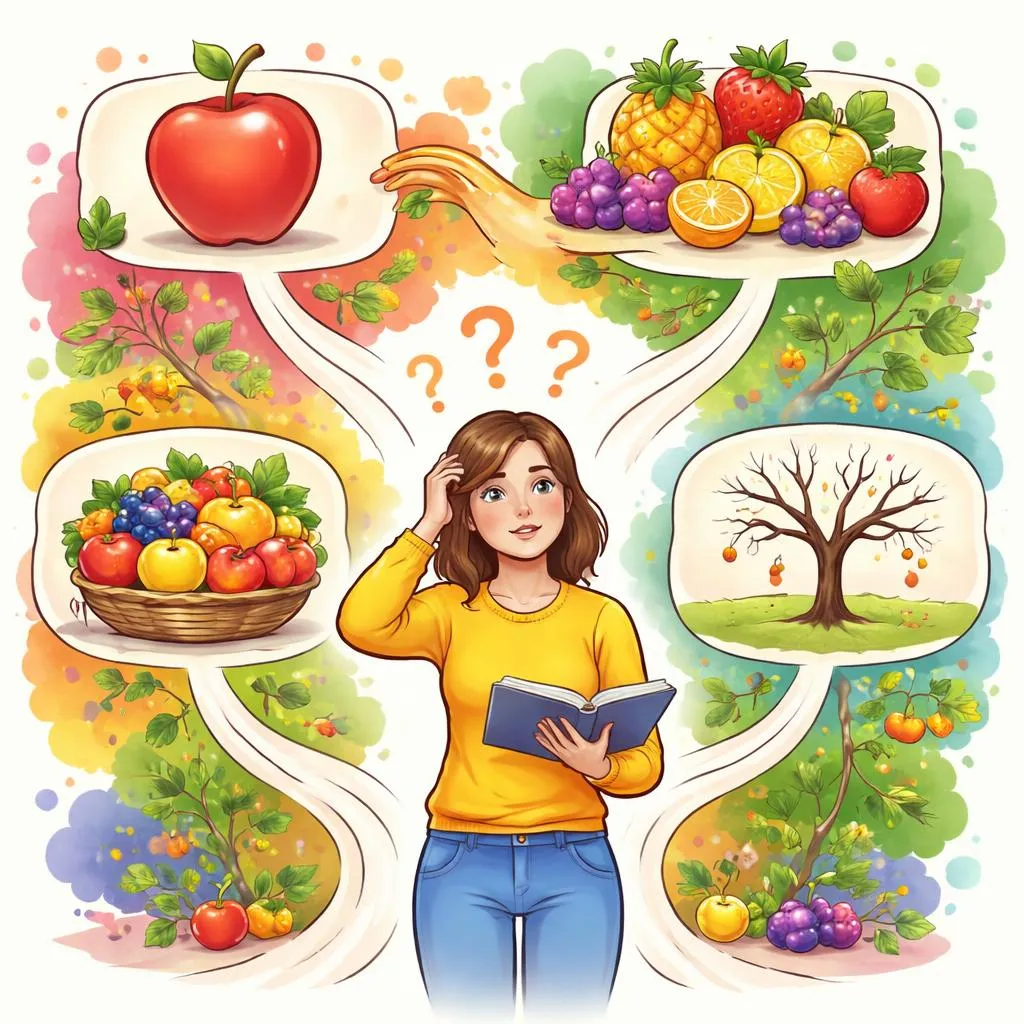

Hey there, word gardener! Have you ever visited an orchard? You pick a fruit from a tree. A juicy drink has a fruity taste. A successful project is a fruitful effort. A failed search is a fruitless trip. They all have "fruit" in them. But they are not the same! The words fruit, fruity, fruitful, and fruitless are a "Word Harvest Team". They all connect to results and flavors. Each team member is a different part of the harvest. Your mission is to learn their parts. Let's see a quick example at home.
At home, you might say: "I ate a piece of fruit." That names the food. But you could also say: "The meeting was very fruitful." That describes the result. Which one is right? They both are! You need the right gardener for your sentence. Let's start our harvest!
Adventure! Decoding the Harvest Team
Welcome to the word orchard! Our four harvest words are here. They share a root idea. But they are different. Meet Fruit. It is a noun for the food. Meet Fruity. It is an adjective for the flavor. Meet Fruitful. It is an adjective for success. Meet Fruitless. It is an adjective for no result. Let's learn their tastes.
Dimension One: The Role Reveal – Thing, Flavor, or Result?
Every word has a role. Is it a thing you eat? Is it a describing word for taste? Or is it a describing word for an outcome?
Fruit: The Food Noun. This word is a noun. It names the part of a plant that contains seeds and is often sweet and edible. It is the thing you can eat.
Nature example: "Apples and oranges are types of fruit." The word "fruit" is the thing we eat.
School example: "We drew a picture of our favorite fruit." The word "fruit" is the subject of the drawing.
Fruity: The Flavor Adjective. This word is an adjective. It describes a noun. It tells us the noun tastes or smells like fruit.
Home example: "This gum has a fruity flavor." The word "fruity" describes the flavor.
Playground example: "The new soda is very fruity and sweet." The word "fruity" describes the soda.
Fruitful: The Successful Adjective. This word is an adjective. It describes an activity, effort, or period. It means producing good results, successful, or productive.
School example: "Our study session was very fruitful." The word "fruitful" describes the session.
Nature example: "The farmer had a fruitful harvest this year." The word "fruitful" describes the harvest.
Fruitless: The Unsuccessful Adjective. This word is an adjective. It describes an activity or effort. It means producing no useful results, unsuccessful, or wasted.
Playground example: "Our search for the lost ball was fruitless." The word "fruitless" describes the search.
Home example: "The detectives made a fruitless attempt to find the clue." The word "fruitless" describes the attempt.
Dimension Two: The Meaning Focus – What is the Core Idea?
These words point to different core ideas. One is the literal edible object. One is a sensory quality. One is a positive outcome. One is a negative outcome.
Fruit: The Literal Object. This word focuses on the physical, edible product of a plant.
Fruity: The Sensory Quality. This word focuses on the characteristic of having the taste, aroma, or quality of fruit. It can be literal (tastes like fruit) or metaphorical (smells fruity).
Fruitful: The Positive Outcome. This word focuses on the concept of bearing fruit in a metaphorical sense—yielding success, profit, or good results.
Fruitless: The Negative Outcome. This word focuses on the concept of not bearing fruit—being unproductive, useless, or without success.
Dimension Three: The Team-Up – What Words Do They Work With?
Knowing their common "garden friends" helps us use them correctly.
Fruit (Noun): It can be countable or uncountable. It likes adjectives. "Fresh fruit", "tropical fruit", "a piece of fruit".
Fruity (Adjective): It usually comes before a noun or after a linking verb. "Fruity smell", "fruity yogurt", "It tastes fruity."
Fruitful (Adjective): It often describes discussions, work, or periods. "Fruitful collaboration", "fruitful meeting", "very fruitful".
Fruitless (Adjective): It often describes efforts, searches, or attempts. "Fruitless endeavor", "fruitless argument", "completely fruitless".
Our Discovery Map: The Harvest Team Guide
Our orchard guide is clear. Do you need to name the sweet, edible part of a plant? Use the noun fruit. Do you want to describe a taste or smell that is like fruit? Use the adjective fruity. Do you want to describe an effort that produced good results? Use the adjective fruitful. Do you want to describe an effort that produced no results? Use the adjective fruitless. Remember, fruit is the thing. Fruity is the flavor. Fruitful is the positive result. Fruitless is the lack of result.
Challenge! Become a Word Harvest Master
-
Best Word Choice: Read the scene. Pick the best word. (Nature/Animal Scene) A squirrel spent all morning digging in the wrong place, looking for nuts it had buried. It found nothing. a) The squirrel's digging was fruitful. b) The squirrel's digging was fruitless. Which one describes the effort as producing no results? (Answer: b)
-
Two-Word Sentence Showdown: (School/Group Project) Imagine your team worked very well together and finished a great project. First, use the adjective to describe your teamwork. Example: "Our teamwork was very fruitful." Now, use the noun to talk about a healthy snack you had while working. Example: "We ate some fruit for energy."
-
Eagle Eye! Find the Glitch: Look at this sentence. One word is not quite right for the meaning. Can you fix it? (Home/Tasting Scene) "The new candy is supposed to taste like fruit, but I think it's too fruit." What's wrong? "Fruit" is a noun. Here, we are trying to describe the taste. We need the adjective. Fixed sentence: "The new candy is supposed to taste like fruit, but I think it's too fruity."
Your Takeaway and Mission! Make Your Sentences Ripe
Great gardening, word harvester! You learned the special roles of each word. You can now choose the right word for any situation. Your English will be precise and flavorful.
What you can learn from this article:
You now see that fruit, fruity, fruitful, and fruitless are a team. But they have different functions. You learned to use "fruit" to name the edible part of a plant. You use "fruity" to describe a taste or smell like fruit. You use "fruitful" to describe a successful effort that produces good results. You use "fruitless" to describe an unsuccessful effort that produces no results. You know that "fruit" is a noun. The other three are adjectives.
Live Practice Application:
Try this today! Eat a snack: "This is a delicious fruit." Describe a drink: "This juice is very fruity." Talk about your work: "My practice was fruitful." Describe a failure: "The search was fruitless." When you write or speak, think: Is it the food? Use fruit. Is it the flavor? Use fruity. Was it successful? Use fruitful. Was it a waste? Use fruitless. Choosing the right word makes your language rich and accurate. You are now a master of the harvest team. Well done!