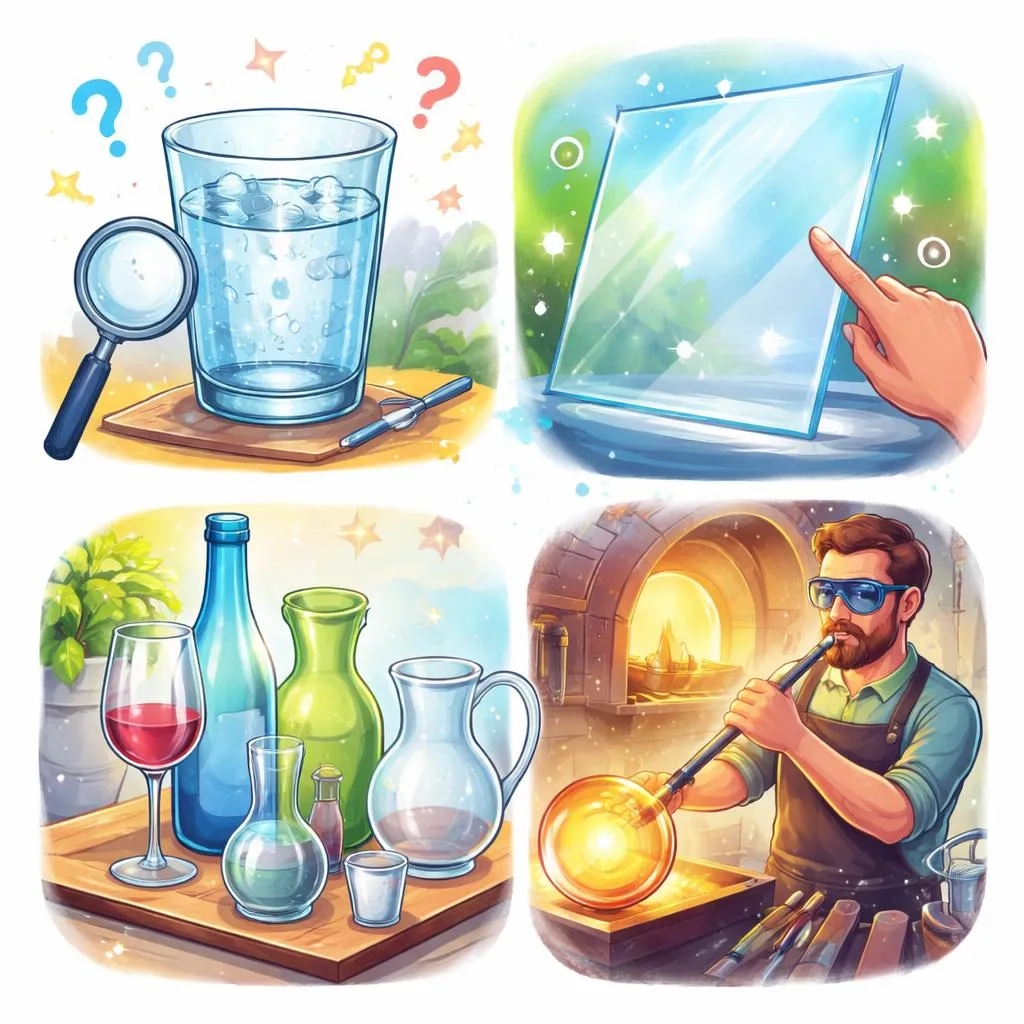

Hey there, word explorer! Have you ever looked through a window? The clear pane is glass. A calm lake has a glassy surface. Cups and bowls are glassware. An artist who shapes hot glass is a glassblower. They all talk about a clear, hard material. But they are not the same! The words glass, glassy, glassware, and glassblower are a "Word Material Team". They all connect to that transparent stuff. Each team member has a different form. Your mission is to learn their forms. Let's see a quick example at home.
At home, you might say: "Please pass the glass of water." That names a drinking container. But you could also say: "The table has a glassy finish." That describes the table's surface. Which one is right? They both are! You need the right form for your sentence. Let's start our clear adventure!
Adventure! Decoding the Material Team
Welcome to the word workshop! Our four material words are here. They share a root idea. But they are different. Meet Glass. It is a noun for the material or an object. Meet Glassy. It is an adjective for a quality. Meet Glassware. It is a noun for a collection. Meet Glassblower. It is a noun for a person. Let's learn their shapes.
Dimension One: The Role Reveal – What's Your Form?
Every word has a role. Is it a thing? Is it a describing word? Is it a group of things? Or is it a person?
Glass: The Material or Object Noun. This word is a noun. It names the hard, transparent material. It can also name a single object made from that material, like a drinking cup.
School example: "The beaker in science class is made of heatproof glass." Here, "glass" names the material.
Playground example: "Do not leave broken glass on the ground." The word "glass" names the material pieces.
Glassy: The Quality Adjective. This word is an adjective. It describes a noun. It tells us the noun is smooth, shiny, and clear like glass. It can also mean a blank, expressionless look.
Playground example: "The slide was glassy and slippery after the rain." The word "glassy" describes the slide's surface.
School example: "He had a glassy stare during the boring lecture." The word "glassy" describes his stare.
Glassware: The Collection Noun. This word is a noun. It names objects made of glass, like cups, vases, or bowls. It is the whole group of such items.
School example: "The chemistry lab has delicate glassware for experiments." It names the group of lab tools.
Home example: "We put the fancy glassware on the table for the party." It names the set of cups and dishes.
Glassblower: The Person Noun. This word is a noun. It names a person who shapes molten glass into objects. This artist uses a long tube to blow air into the hot glass.
School example: "Our class watched a video of a glassblower making a vase." It names the type of artist.
Playground example: "At the craft fair in the park, a glassblower made animal figures." It names the person.
Dimension Two: The Meaning Focus – What Idea Do They Point To?
These words point to different ideas. One is the substance itself or a single item. One is the characteristic of being like glass. One is a category of household or scientific items. One is the skilled craftsperson.
Glass: The Substance or Single Item. This word focuses on the material itself or one object made from it, like a window or a drinking vessel.
Nature example: "The greenhouse is built with sheets of glass." (Material) Home example: "I drank a whole glass of milk." (Single object)
Glassy: The Resemblance. This word focuses on the quality of having the appearance or texture of glass.
Nature example: "The lake was glassy in the morning light." (Smooth and reflective)
Glassware: The Category. This word focuses on the class of objects that are made from glass, especially for practical use.
Glassblower: The Creator. This word focuses on the human who practices the art of shaping glass.
Dimension Three: The Team-Up – What Words Do They Work With?
Knowing their common "workshop partners" helps us use them correctly.
Glass (Noun): It can be countable or uncountable. It likes articles and adjectives. "A glass window", "the broken glass", "stained glass".
Glassy (Adjective): It usually comes before a noun or after a linking verb. "Glassy eyes", "glassy finish", "The pond looked glassy."
Glassware (Noun): It is an uncountable noun. We say "some glassware" or "a piece of glassware". It likes adjectives. "Fine glassware", "scientific glassware", "wash the glassware".
Glassblower (Noun): It is a countable noun. It likes articles. "A skilled glassblower", "the glassblower's tools", "an expert glassblower".
Our Discovery Map: The Material Team Guide
Our workshop guide is clear. Do you need to name the hard, transparent material or a single object like a cup? Use the noun glass. Do you want to describe something that is smooth, shiny, or expressionless like glass? Use the adjective glassy. Do you want to name a group of objects like cups, vases, or lab equipment made of glass? Use the noun glassware. Do you want to name the artist who shapes hot glass into objects? Use the noun glassblower. Remember, glass is the material or item. Glassy is the quality. Glassware is the collection. Glassblower is the maker.
Challenge! Become a Word Material Master
-
Best Word Choice: Read the scene. Pick the best word. (Nature/Animal Scene) A snake is sliding over a flat, smooth rock after the rain. The rock's surface is very shiny and reflective, like a mirror. a) The snake moved over the glass rock. b) The snake moved over the glassy rock. Which one describes the rock as having a smooth, shiny surface like glass? (Answer: b)
-
Two-Word Sentence Showdown: (Home/Kitchen Scene) Imagine you are helping to set the table for a special dinner. First, use the noun to name the material of the drinking cups. Example: "These cups are made of delicate glass." Now, use the noun to name the whole set of these delicate items. Example: "Please be careful with the fine glassware."
-
Eagle Eye! Find the Glitch: Look at this sentence. One word is not quite right for the meaning. Can you fix it? (School/Field Trip) "At the museum, we saw a glass who was making a sculpture from melted sand." What's wrong? "Glass" is a material. Here, we are trying to name the person who works with the material. We need the noun for the person. Fixed sentence: "At the museum, we saw a glassblower who was making a sculpture from melted sand."
Your Takeaway and Mission! Make Your Sentences Clear
Great work, word material expert! You learned the special roles of each word. You can now choose the right word for any situation. Your English will be precise and clear.
What you can learn from this article:
You now see that glass, glassy, glassware, and glassblower are a team. But they have different functions. You learned to use "glass" to name the material or a single object like a cup. You use "glassy" to describe something that is smooth, shiny, or blank like glass. You use "glassware" to talk about a collection of glass objects. You use "glassblower" to name the artist who shapes hot glass. You know that "glass", "glassware", and "glassblower" are nouns, and "glassy" is an adjective.
Live Practice Application:
Try this today! Look at a window: "The glass is clean." Describe a puddle: "The water looks glassy." Help in the kitchen: "We store the glassware in that cabinet." Learn about art: "A glassblower uses a long tube." When you write or speak, think: Is it the material or a single item? Use glass. Is it a quality? Use glassy. Is it a collection of items? Use glassware. Is it the artist? Use glassblower. Choosing the right word makes your language clear and accurate. You are now a master of the material team. Well done!