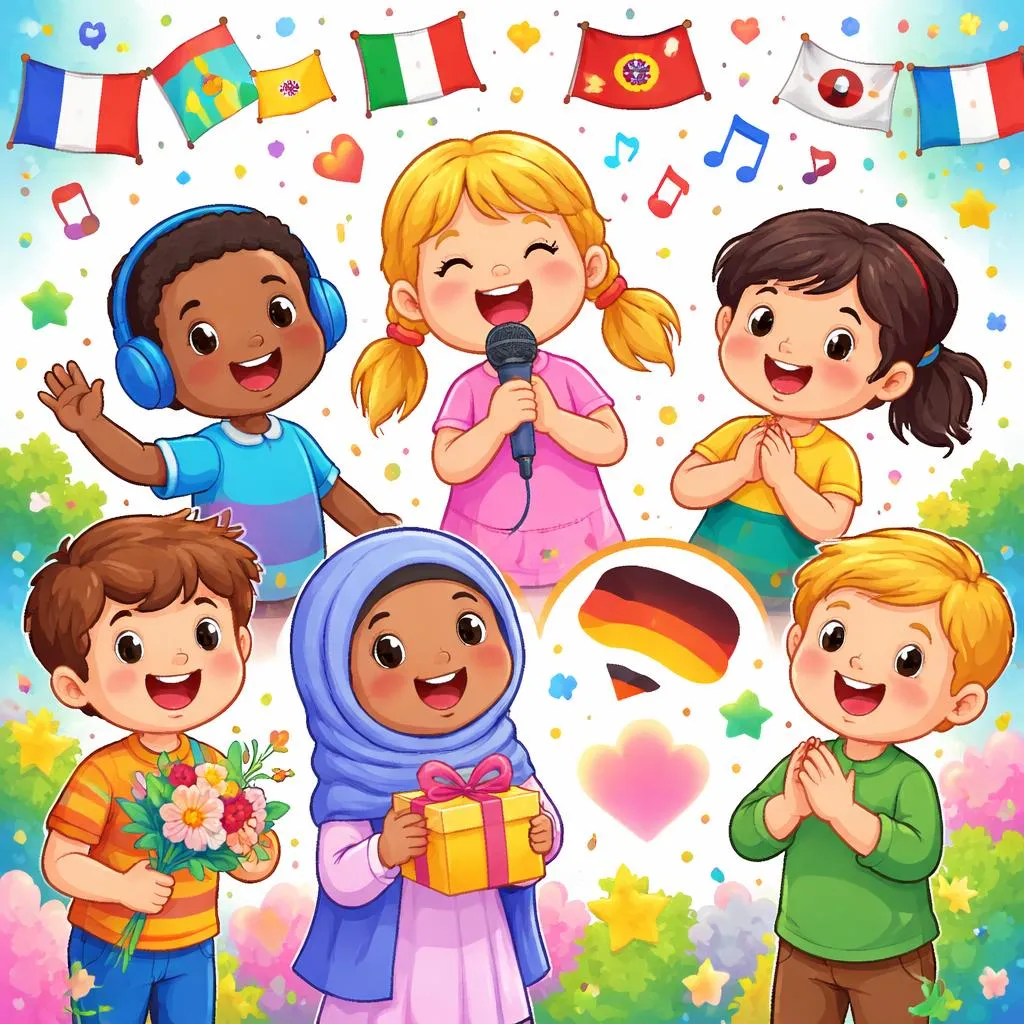

Hello, polite explorers and world citizens. Today we are going on a wonderful trip around the world. But we are not traveling in a plane. We are traveling with our words. We are going to learn how to say thank you in other languages. Saying thank you is a magic phrase. It makes people smile. Learning to say it in different languages is even more magical. It shows respect for people from all over. Let us start our journey of gratitude.
What is the rhyme/story?
We have a special rhyme today. It is not a long story. It is a short, cheerful song. The song is about saying thank you in many ways. It is set to a simple, happy tune. The rhyme lists "thank you" in different languages. It is easy to sing and remember. The "story" is that a child travels the world in their imagination. In each place, they learn how to say thank you. This song helps us remember the words. Music makes learning fun. Let us learn this song of thanks together.
The lyrics of nursery rhymes
Here are the lyrics to our "Thank You Around the World" song. You can sing it to the tune of "If You're Happy and You Know It."
In English, we say Thank You, Thank You! In Spanish, we say Gracias, Gracias! In French, we say Merci, Merci! For all the world to see!
In Japanese, we say Arigatou, Arigatou! In German, we say Danke, Danke! In Mandarin, we say Xièxie, Xièxie! For you and you and me!
We say thank you every day. In a very special way. It’s a word that’s good to know. It helps our gratitude to grow!
You can clap your hands or stamp your feet while singing. The song is short, repetitive, and full of joy.
Vocabulary learning
The song teaches us the word for "thank you" in six languages. Let us learn them well. We will split them by age group.
For 3-6 year olds (simple, short words): • English: Thank you
• Spanish: Gracias (GRAH-see-ahs)
• French: Merci (mehr-SEE)
For 7-12 year olds (adds more languages and details): • Japanese: Arigatou (ah-ree-gah-toh) - This is a casual "thanks." A more formal version is "Arigatou gozaimasu."
• German: Danke (DAHN-kuh)
• Mandarin Chinese: Xièxie (shyeh-shyeh) - The tones are important. Both syllables use a falling tone.
Learning these words opens a window. You learn that people everywhere appreciate kindness. It is vocabulary that connects hearts.
Phonics points
Saying these words correctly is part of the fun. Let us look at the sounds.
The 'th' sound in "Thank you": This is an English sound. Put your tongue between your teeth and blow. /th/.
The 'c' in "Gracias": In Spanish, the 'c' before 'i' or 'e' sounds like 's'. So "Gracias" sounds like GRAH-see-ahs.
The 'r' in "Merci": The French 'r' is a soft, throaty sound. It is not the strong English 'r'. Practice the soft "mehr-SEE."
The 'r' in "Arigatou": The Japanese 'r' is a mix between an 'r' and a 'l'. Try saying "ah-ree-gah-toh" with a light tap of your tongue on the roof of your mouth.
The 'a' in "Danke": The German 'a' is a pure /ah/ sound, like in "father." DAHN-kuh.
The 'x' and tones in "Xièxie": The 'x' in Pinyin (Chinese spelling) makes a "sh" sound. The falling tone ( ) means your voice goes down, like you are giving a command. Say "shyeh" with a falling pitch.
Practicing these sounds is like a game. It trains your mouth and ears for the wonderful sounds of our world.
Grammar patterns
The phrase "thank you" is an interjection. It is a word or phrase that expresses strong feeling. It often stands alone. In the song, we see a simple pattern: In [Language], we say [Word]. "In Spanish, we say Gracias." This is a great sentence pattern to learn. You can change the parts. "In Italian, we say Grazie." "In Korean, we say Gomawo."
Another pattern is the list. The song lists languages and words. This teaches us about grouping information. We can also talk about the action. "I say thank you." "You say gracias." "We say merci." These are simple present tense sentences. They describe what we do. Learning these patterns helps you talk about languages clearly.
Learning activities
Let us do some fun activities with our thank you song.
First, "Sing with Actions." Assign an action for each language. For "Gracias," do a little dance. For "Merci," give a small bow. For "Arigatou," put your hands together. Sing the song and do the actions. This helps memory through movement.
Second, "Thank You Card Craft." Make a simple card. On the front, write "THANK YOU" in big letters. Inside, write "Gracias, Merci, Danke, Xièxie, Arigatou" around the edge. Draw flags or simple symbols for each country. Give the card to someone special.
Third, "Language Detective." Listen to the song. Pause after each line. Can you repeat the word? Can you guess which language it is? Use a globe or map to point to the country. This connects the word to a place.
Fourth, "Voice Record." Use a phone or tablet to record yourself saying "thank you" in all six languages. Listen back. Do you sound clear? Try again. This builds pronunciation confidence.
Printable materials
Printable materials make this learning last. You can print a "Thank You Around the World" poster. It has the lyrics and flags. Hang it in your room. Print "Vocabulary Flash Cards." One side has a flag. The other side has the word and a pronunciation guide. "Gracias (GRAH-see-ahs)."
Print a "My Thank You Passport." Make a small booklet. Each page is for a language. Write the word. Draw a picture. Get a "stamp" (use a sticker or ink stamp) when you can say the word correctly five times. Fill your passport with gratitude.
Print "Coloring Pages." A page with the word "Gracias" and a sombrero to color. A page with "Merci" and the Eiffel Tower. Coloring helps you focus on the word's shape. Printable materials are tools you can see, touch, and play with.
Educational games
Games make learning "thank you" in other languages a celebration.
Play "Thank You Relay." Form two teams. The first person on each team runs to a poster with the six words. They read one word out loud, run back, and tag the next person. The next person runs and reads a different word. First team to correctly say all six words wins. This is active and fast.
Play "Phonetic Thank You Bingo." Make bingo cards with phonetic spellings: "GRAH-see-ahs", "mehr-SEE", "DAHN-kuh". The caller holds up a picture of a flag (Spain, France, Germany). Players find the matching phonetic spelling on their card and mark it. This links sound, spelling, and country.
Try the "International Cafe" role-play. Set up a small cafe with play food. One child is the customer from a different country. The other is the server. The customer must order and then say thank you in the server's language. The server must say "you're welcome" in that language or in English. This practices conversation.
For a quiet group game, play "Pass the Thank You." Sit in a circle. Start with a ball. The first person says "Thank you" in English and passes the ball. The next person says "Gracias" and passes it. Go through all six languages, then start again. See how fast you can go without mistakes. This builds quick recall.
All these games and activities make the simple question "how do you say thank you in other languages" into an adventure. You are learning words, sounds, and cultures. Most importantly, you are learning to share gratitude, which is a beautiful thing to share in any language.