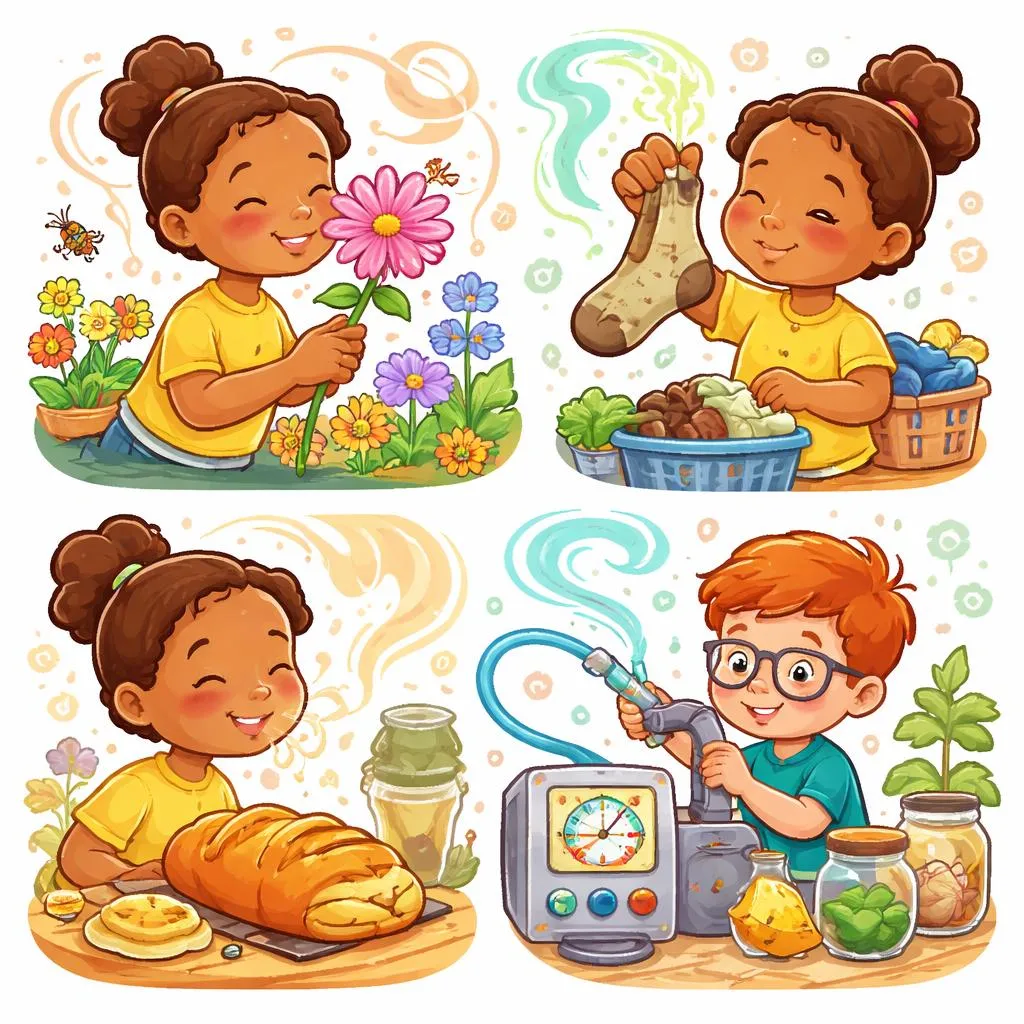

A rose gives off a sweet smell. A trash can is smelly. The words “smell, smelly, smelling, smelliness” all come from one family. Each word talks about odors or the sense of scent. But each one has a different job in a sentence. Learning this family helps children describe good and bad smells around them. Let us explore these four words together.
What Does “Same Word, Different Forms” Mean? One core idea can grow into many word shapes. The meaning stays the same at the heart. But the word changes its ending for a new role. For example, “smell” is a verb or a noun. “Smelly” is an adjective. “Smelling” is a verb form or a noun. “Smelliness” is a noun. Knowing these four forms helps a child talk about their nose’s job.
Personal Pronouns Change Their Form Pronouns change from “he” to “him” or “his”. Our word family changes by adding suffixes, not by changing person. Think of “smell” as the core action or odor. “Smelly” turns that idea into a description. “Smelling” turns the action into an ongoing activity. “Smelliness” turns the quality into a thing we can name. Each form answers a simple question. What action or odor? Smell. How does it smell? Smelly. What is happening? Smelling. What is the quality of being smelly? Smelliness.
From Verb to Noun to Adjective to Adverb – One Family, Many Words This family has verbs, nouns, and an adjective. Let us start with the verb “smell”. Verb: Please smell this cookie. “Smell” means to use your nose to sense something.
“Smell” can also be a noun. Noun: The smell of rain filled the air. “Smell” names an odor.
Next is the adjective “smelly”. Adjective: Take off those smelly socks. “Smelly” means having a bad odor.
Then we have “smelling” as a verb form. Verb (ongoing): The dog is smelling the fire hydrant. “Smelling” can also be a noun. Noun example: Smelling flowers is a pleasure.
Finally the noun “smelliness”. Noun: The smelliness of the fridge told us something had spoiled. “Smelliness” names the quality of being smelly. This family has no common adverb form. We can say “smellily” from “smelly”, but that is rare.
One Root, Many Roles – How Words Grow from Actions to Qualities The Old English word “smeall” meant a odor or scent. From this root, we built a sensory family. “Smell” kept the main verb and noun meanings. Adding -y made “smelly” (full of odor, usually bad). Adding -ing made “smelling” (the ongoing action). Adding -ness made “smelliness” (the state of being smelly). Children can see the same pattern in other sensory families. For example, “taste, tasty, tasting, tastiness”. Learning patterns helps kids describe what their senses detect.
Same Meaning, Different Jobs – Is It a Verb or a Noun? Look at each word’s job carefully. “Smell” can be a verb or a noun. Verb example: Smell the milk to see if it is fresh. Noun example: A funny smell came from the kitchen.
“Smelly” is an adjective. Example: The smelly gym bag stayed in the car.
“Smelling” is a verb form or a noun. Verb example: She is smelling the soup. Noun example: Smelling the ocean air relaxed him.
“Smelliness” is a noun. Example: The smelliness of the cheese was too strong. Each form has a clear job. Only “smell” and “smelling” have two roles.
Adjectives and Adverbs – When Do We Add -ly? We can make an adverb from “smelly”. Change “smelly” to “smellily” by replacing y with i and adding -ly. Smelly → smell + ily = smellily. Example: The socks smelled smellily. But “smellily” is very rare. We usually say “had a bad smell” instead. For young learners, focus on “smelly” as an adjective. A simple reminder: “Smelly describes a noun. Smelling describes an action.”
Watch Out for Tricky Spelling Changes (Double Letters, y to i, and More) “Smell” has a double l. That is the main tricky part. Add -y to make “smelly”. Smell + y = smelly (keep the double l). Add -ing to make “smelling”. Smell + ing = smelling (keep the double l). Add -ness to make “smelliness”. Smelly → smell + iness (change y to i, add -ness). Smelly → smell + i + ness = smelliness. Keep the double l throughout. A common mistake is writing “smel” with one l. Say “Smell has two l’s, like bell and tell.” Another mistake is “smelly” spelled “smely”. Say “Smelly keeps the double l from smell.” Another mistake is “smelling” spelled “smeling”. Say “Smelling has double l, like spelling.” Another mistake is “smelliness” spelled “smellyness”. Say “Change the y to i before adding -ness. Smell + i + ness.”
Let’s Practice – Can You Choose the Right Form? Try these sentences with your child. Read each one aloud. Pick the correct word from the family.
Can you ______ the fresh bread from the bakery? Answer: smell (verb)
The garbage can is ______ in the summer heat. Answer: smelly (adjective)
The cat is ______ the fish on the plate. Answer: smelling (verb form)
The ______ of the wet dog filled the room. Answer: smelliness (noun)
A sweet ______ came from the flowers. Answer: smell (noun)
Please put these ______ socks in the laundry. Answer: smelly (adjective)
______ freshly cut grass makes me happy. Answer: smelling (noun)
The ______ of the onions made everyone cry. Answer: smell (noun)
The skunk’s ______ kept us far away. Answer: smelliness (noun)
I love ______ dinner cooking when I come home. Answer: smelling (verb form)
After the practice, ask your child one question. Is this word an action, a description, an ongoing action, or a quality name? That simple question teaches grammar through the sense of smell.
Tips for Parents – Help Your Child Learn Word Families in a Fun Way Use a flower to teach “smell”. Hold a rose to your nose. Say “Let us smell this flower.”
Use a dirty sock to teach “smelly”. Hold it at a distance. Say “This sock is smelly.” Then say “We need to wash it.”
Use a cooking meal to teach “smelling”. Say “I am smelling the sauce to see if it is ready.”
Use a trash can to teach “smelliness”. Say “The smelliness of the trash tells us to take it out.”
Play “fill in the blank” during car rides. Say “Please ______ the milk before you pour it.” (smell) Say “A ______ diaper needs changing right away.” (smelly) Say “The dog is ______ the ground for clues.” (smelling) Say “The ______ of the fish market was too strong for me.” (smelliness)
Read a story about a skunk or a bakery. Ask “What smells do the characters notice?” Ask “Is that smell good or smelly?”
Turn a drawing activity into a word lesson. Draw a nose pointing at a flower. Label “smell”. Draw a trash can with stink lines. Label “smelly”. Draw a dog sniffing a tree. Label “smelling”. Draw a person holding their nose. Label “smelliness”.
When your child makes a mistake, stay calm. If they say “This flower smells good. It is smelling,” say “Yes. The flower smells good. The flower is smelling nice. Both are correct.” If they say “I love the smelly of cookies,” say “Almost. I love the smell of cookies. Smelly is an adjective. Smell is the noun.”
Write the four words on sticky notes. Put them in the kitchen near the stove. Each time you cook, point to “smell” and “smelling”. Each time you take out trash, point to “smelly” and “smelliness”.
Remember that the sense of smell is powerful. Use these words to talk about your child’s favorite and least favorite smells. Soon your child will smell a flower with joy. They will name a smelly sock before washing. They will talk about smelling dinner from the other room. And they will describe the smelliness of a gym bag. That is the sensory power of learning one small word family together.