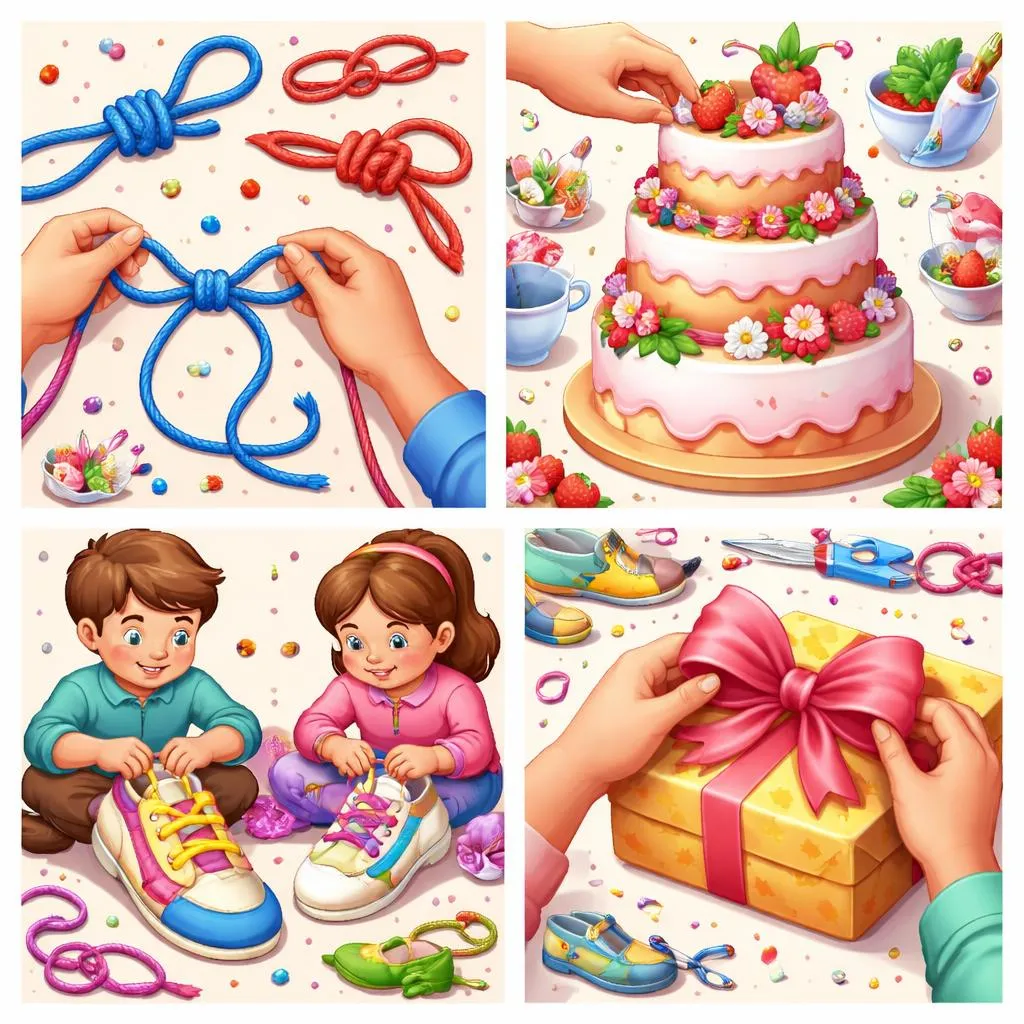

You tie your shoelaces every morning. A tier of a wedding cake holds candles. The words “tie, tier, tying, untie” all come from one family. Each word talks about fastening or levels. But each one has a different job in a sentence. Learning this family helps children master knots and understand layers. Let us explore these four words together.
What Does “Same Word, Different Forms” Mean? One core idea can grow into many word shapes. The meaning stays the same at the heart. But the word changes its ending for a new role. For example, “tie” is a verb or a noun. “Tier” is a noun. “Tying” is a noun or a verb form. “Untie” is a verb. Knowing these four forms helps a child talk about fastening and layers.
Personal Pronouns Change Their Form Pronouns change from “he” to “him” or “his”. Our word family changes by adding suffixes and prefixes. Think of “tie” as the core action of fastening. “Tier” sounds like “tie” but means a level or layer. “Tying” turns the action into an activity. “Untie” adds “un-” to mean do the opposite. Each form answers a simple question. What action? Tie. What is a layer? Tier. What activity? Tying. What opposite action? Untie.
From Verb to Noun to Adjective to Adverb – One Family, Many Words This family has verbs and nouns. Let us start with the verb “tie”. Verb: Please tie the ribbon around the gift. “Tie” means to fasten with a knot.
“Tie” can also be a noun. Noun: He wore a red tie with his suit. “Tie” means a necktie or an equal score in a game.
Next is the noun “tier”. Noun: The cake had three tiers. “Tier” means a level or row, like in a stadium or a cake.
Then “tying” as a noun. Noun: Tying a square knot takes practice. “Tying” can also be a verb form. Verb (ongoing): She is tying her shoes.
Finally the verb “untie”. Verb: Please untie the rope from the post. “Untie” means to loosen or undo a knot. This family has no common adjective or adverb form.
One Root, Many Roles – How Words Grow from Actions to Qualities The Old English word “teag” meant a cord or rope. From this root, we built a family about fastening. “Tie” kept the main verb and noun meanings. “Tier” came from Old French “tire” meaning order or row. It sounds the same but has a different origin. We group it here because it sounds like “tie” and works as a word family for learning. Adding -ing made “tying” (the activity). Adding the prefix “un-” made “untie” (to undo). Children can see the same pattern in other families. For example, “do, doer, doing, undo”. Learning the prefix “un-” helps kids reverse actions.
Same Meaning, Different Jobs – Is It a Verb or a Noun? Look at each word’s job carefully. “Tie” can be a verb or a noun. Verb example: Tie the bag closed. Noun example: My dad’s tie is blue.
“Tier” is a noun. Example: The wedding cake had four tiers.
“Tying” is a noun or a verb form. Noun example: Tying knots is fun. Verb example: He is tying his shoes.
“Untie” is a verb. Example: Untie the apron after cooking. Each form has a clear job. Only “tie” and “tying” have two roles.
Adjectives and Adverbs – When Do We Add -ly? This family has no common adverb form. We do not say “tily” or “tyingly.” Use other words to describe tying. Example: She tied it tightly. For young learners, focus on the difference between “tie” and “tier.” A simple reminder: “Tie is for knots and neckwear. Tier is for layers.”
Watch Out for Tricky Spelling Changes (Double Letters, y to i, and More) “Tie” has no double letters. Add -ing to make “tying”. Tie → ty + ing (drop the e, change i to y? Actually “tie” drops the e and the i changes to y? No: “tie” becomes “tying.” The “e” is dropped, and the “i” stays? Actually tie has three letters T-I-E. Drop the E, add ING: T-I-ING = TYING? Wait, T + I + ING = TIING? That would be “tiing.” But the correct spelling is “tying.” So the “i” changes to “y” before adding -ing. Yes! Rule: verbs ending in “ie” change the “ie” to “y” and add -ing. Tie → tying. Die → dying. Lie → lying. Add the prefix “un-” to make “untie”. Un + tie = untie (no change, keep the e). “Tier” is a separate word. A common mistake is writing “tieing” with an e. Say “Tie becomes tying. Drop the e, change i to y.” Another mistake is confusing “tie” and “tier” in speech. Say “Tie rhymes with my. Tier rhymes with clear.” Another mistake is “untie” spelled “untie” (correct) but some write “untye.” Say “Untie has a ie at the end. Un + tie.”
Let’s Practice – Can You Choose the Right Form? Try these sentences with your child. Read each one aloud. Pick the correct word from the family.
Can you ______ your shoes by yourself? Answer: tie (verb)
The birthday cake had three ______. Answer: tiers (noun)
______ a balloon string takes small fingers. Answer: tying (noun)
Please ______ the dog from the fence so he can run. Answer: untie (verb)
He wore a red ______ with his white shirt. Answer: tie (noun)
The stadium has many ______ of seats. Answer: tiers (noun)
She is ______ a bow on the present. Answer: tying (verb form)
Can you ______ this knot? It is too tight. Answer: untie (verb)
______ a necktie is a grown-up skill. Answer: tying (noun)
The game ended in a ______. Both teams had the same score. Answer: tie (noun)
After the practice, ask your child one question. Is this word a fastening action, a layer, a fastening activity, or an undoing action? That simple question teaches grammar through knots and levels.
Tips for Parents – Help Your Child Learn Word Families in a Fun Way Use a shoelace to teach “tie”. Say “Let me show you how to tie a bow.”
Use a cake to teach “tier”. Say “Look at the two tiers of this cake. Top and bottom.”
Use a practice board to teach “tying”. Say “Tying knots is a useful skill for camping.”
Use a gift to teach “untie”. Say “Please untie the ribbon so we can open the present.”
Play “fill in the blank” during car rides. Say “______ your shoelaces before you run.” (tie) Say “The stadium has three ______ of seats.” (tiers) Say “______ a fishing hook takes patience.” (tying) Say “Can you ______ this knot for me?” (untie)
Read a story about a sailor, a baker, or someone getting dressed. Ask “What does the character tie?” Ask “Are there tiers in the wedding cake?”
Turn a drawing activity into a word lesson. Draw two lace ends crossing. Label “tie”. Draw a cake with two layers. Label “two tiers”. Draw hands holding string. Label “tying a knot”. Draw hands pulling a bow apart. Label “untie”.
When your child makes a mistake, stay calm. If they say “The rope has three ties,” but mean layers, say “Almost. The rope has three tiers. Tier means layer or row. Tie means fasten.” If they say “I am tieing my shoe,” say “Almost. I am tying my shoe. Tie changes to tying.”
Write the four words on sticky notes. Put them near a shoe rack or a playground. Each time you tie or untie something, point to the words.
Remember that tying and untying are life skills. Use these words to build independence. “You tied your shoes! Great job.” Soon your child will tie a bow easily. They will know what a tier of a cake means. They will practice tying knots for fun. And they will untie a stubborn knot patiently. That is the skillful power of learning one small word family together.