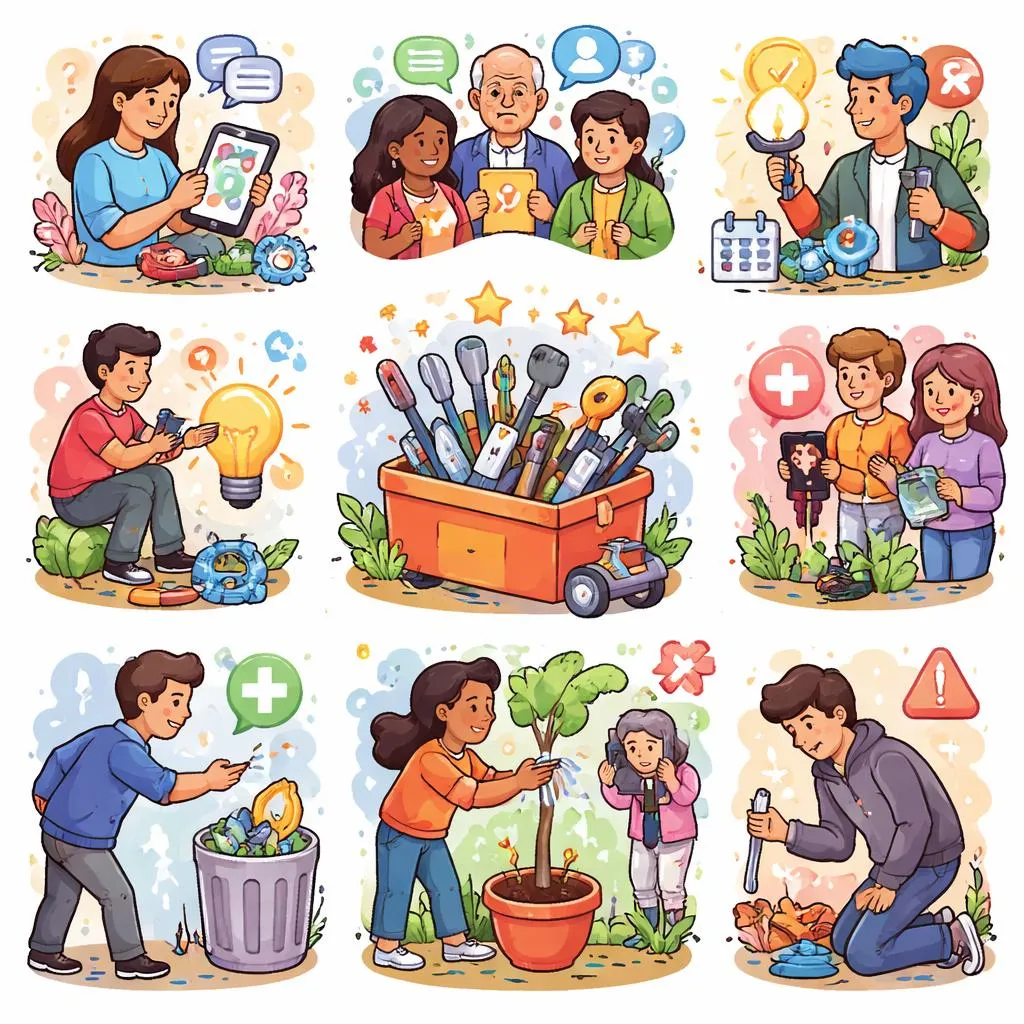

You use a fork to eat pasta. A user of a computer clicks the mouse. The words “use, user, useful, usefully, useless, misuse” all come from one family. Each word talks about employing something for a purpose. But each one has a different job in a sentence. Learning this family helps children talk about tools, value, and mistakes. Let us explore these six words together.
What Does “Same Word, Different Forms” Mean? One core idea can grow into many word shapes. The meaning stays the same at the heart. But the word changes its ending or adds a prefix for a new role. For example, “use” is a verb or a noun. “User” is a noun. “Useful” is an adjective. “Usefully” is an adverb. “Useless” is an adjective. “Misuse” is a verb or a noun. Knowing these six forms helps a child talk about helpfulness and waste.
Personal Pronouns Change Their Form Pronouns change from “he” to “him” or “his”. Our word family changes by adding suffixes and a prefix. Think of “use” as the core action of employing. “User” turns that action into a person. “Useful” turns the quality into a description (full of use). “Usefully” turns that quality into a way of doing. “Useless” turns the quality into a description (without use). “Misuse” adds “mis-” to mean to use wrongly. Each form answers a simple question. What action? Use. Who employs? User. What is helpful? Useful. How? Usefully. What is not helpful? Useless. What is wrong use? Misuse.
From Verb to Noun to Adjective to Adverb – One Family, Many Words This family has a verb, nouns, adjectives, and an adverb. Let us start with the verb “use”. Verb: Use your words to express your feelings. “Use” means to put something into action.
“Use” can also be a noun. Noun: The use of a map helped us find the way.
Next is the noun “user”. Noun: The user of the phone turned it off at night. “User” means a person who uses something.
Then the adjective “useful”. Adjective: A flashlight is useful during a power outage. “Useful” means helpful or having a good purpose.
Then the adverb “usefully”. Adverb: She spent her time usefully by reading. “Usefully” means in a helpful way.
Then the adjective “useless”. Adjective: A broken pencil is useless for writing. “Useless” means not helpful or without purpose.
Finally the word “misuse”. Verb: Do not misuse the library books by drawing in them. “Misuse” can also be a noun. Noun: The misuse of scissors caused an injury.
One Root, Many Roles – How Words Grow from Actions to Qualities The Latin word “uti” meant to use. From this root, we built a family about employing. “Use” kept the main verb and noun meanings. Adding -er made “user” (the person). Adding -ful made “useful” (full of use). Adding -ly made “usefully” (in a useful way). Adding -less made “useless” (without use). Adding the prefix “mis-” made “misuse” (bad use). Children can see the same pattern in other families. For example, “help, helper, helpful, helpfully, helpless, mishelp (rare)”. Learning the -ful and -less suffixes helps kids describe value.
Same Meaning, Different Jobs – Is It a Verb or a Noun? Look at each word’s job carefully. “Use” can be a verb or a noun. Verb example: Use a calculator for big numbers. Noun example: The use of technology is everywhere.
“User” is a noun. Example: Every user must create a password.
“Useful” is an adjective. Example: A useful tool saves time.
“Usefully” is an adverb. Example: She spent her allowance usefully on school supplies.
“Useless” is an adjective. Example: A useless argument helps no one.
“Misuse” can be a verb or a noun. Verb example: Do not misuse the equipment. Noun example: The misuse of medicine is dangerous. Each form has a clear job.
Adjectives and Adverbs – When Do We Add -ly? We add -ly to “useful” to make “usefully”. Useful + ly = usefully. No letter changes. No letters lost. A simple reminder: “Useful describes a thing. Usefully describes an action. Useless describes something worthless. Misuse is wrong use.”
Watch Out for Tricky Spelling Changes (Double Letters, y to i, and More) “Use” has no double letters. It ends with a silent e. Add -er to make “user”. Use → user (drop the e, add er). Add -ful to make “useful”. Use + ful = useful (keep the e? No, drop the e. Use + ful = useful. Drop the e.) Add -ly to make “usefully”. Useful + ly = usefully (no changes). Add -less to make “useless”. Use + less = useless (drop the e? Use + less = useless. Drop the e.) Add the prefix “mis-” to make “misuse”. Mis + use = misuse (keep the e? Yes, keep the e. Misuse has the e of use.) A common mistake is writing “use” as “uce” (wrong). Say “Use has U-S-E.” Another mistake is “user” spelled “useer” (double e). Say “User has one e.” Another mistake is “useful” spelled “use full” as two words. “Useful” as one word is correct. Another mistake is “useless” spelled “use less” as two words. “Useless” as one word is correct. Another mistake is “misuse” spelled “missuse” (double s). Say “Misuse has one s. Mis + use.”
Let’s Practice – Can You Choose the Right Form? Try these sentences with your child. Read each one aloud. Pick the correct word from the family.
Please ______ a napkin to clean your hands. Answer: use (verb)
The ______ of the tablet was a small child. Answer: user (noun)
A hammer is ______ for hanging pictures. Answer: useful (adjective)
She ______ spent her energy on the project. Answer: usefully (adverb)
A cracked smartphone screen is ______ for watching videos. Answer: useless (adjective)
Do not ______ the stapler as a toy. Answer: misuse (verb)
The ______ of glue as a snack is dangerous. Answer: misuse (noun)
What is the ______ of this button? Answer: use (noun)
A ______ tool can save hours of work. Answer: useful (adjective)
The broken remote is ______. We need a new one. Answer: useless (adjective)
After the practice, ask your child one question. Is this word an action, a person, a helpful description, a helpful action way, a worthless description, or a wrong action? That simple question teaches grammar through value and ethics.
Tips for Parents – Help Your Child Learn Word Families in a Fun Way Use a cup to teach “use”. Say “Use a cup to drink water.”
Use a computer to teach “user”. Say “The user of the computer is you.”
Use a tool to teach “useful”. Say “This flashlight is useful when the power goes out.”
Use a study habit to teach “usefully”. Say “You spent your time usefully by practicing piano.”
Use a broken toy to teach “useless”. Say “A toy with no batteries is useless.”
Use a warning to teach “misuse”. Say “If you misuse scissors, you could get hurt.”
Play “fill in the blank” during car rides. Say “______ a spoon to eat soup.” (use) Say “A ______ of a library should return books.” (user) Say “A map is ______ for finding your way.” (useful) Say “Please spend your screen time .” (usefully) Say “A wet match is ______ for starting a fire.” (useless) Say “ of electricity can cause a fire.” (misuse)
Read a story about an inventor or a wasteful character. Ask “What useful thing did they make?” Ask “How did someone misuse an object?”
Turn a drawing activity into a word lesson. Draw a hand holding a spoon. Label “use”. Draw a person at a computer. Label “user”. Draw a multi-tool. Label “useful”. Draw a clock with checkmarks. Label “usefully spent time”. Draw a broken umbrella. Label “useless”. Draw a person cutting paper the wrong way. Label “misuse”.
When your child makes a mistake, stay calm. If they say “This is use,” for helpful, say “Almost. This is useful. Use is the verb. Useful is the adjective.” If they say “I misused my time,” for wasted time, say “Yes, that is correct. Misuse means to use wrongly.”
Write the six words on sticky notes. Put them on a wall near a toolbox or a desk. Each time you use a tool, point to “use”.
Remember that everything has a purpose. Use these words to teach respect for objects. “A useful item should be cared for.” Soon your child will use things wisely. They will become a thoughtful user. They will find useful tools in a crisis. They will use their time usefully. They will recognize a useless item and recycle it. And they will never misuse a good thing. That is the resourceful power of learning one small word family together.