
Opening Introduction
Leo was in the garden. He saw a tiny, striped caterpillar on a leaf. It was munching slowly. "Hello, little guy," Leo said. His sister, Mia, came over. "I saw a beautiful monarch butterfly here yesterday," she said. "Do you think they are friends?" Their mom heard them. "They are more than friends," she smiled. "They are the same animal at different times! That caterpillar will one day be a butterfly. It goes through an amazing change called a life cycle. Let's learn the special life cycle of a butterfly vocabulary. Knowing the words helps us tell the story of this incredible transformation." Leo looked at the caterpillar with wonder. It could turn into a butterfly? He needed to know these words. Let's follow the journey together.
Core Knowledge Explanation
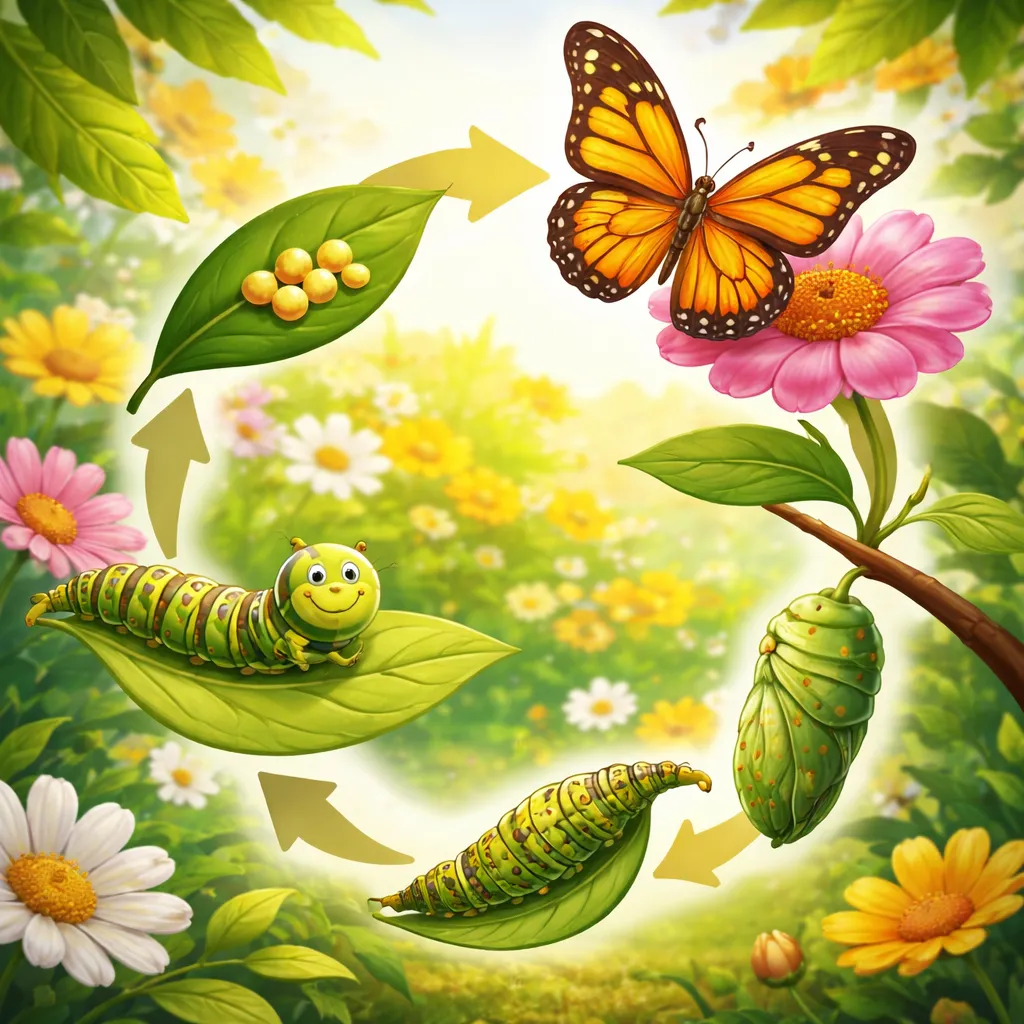
A life cycle is the stages a living thing goes through from the beginning of its life to the end. The butterfly has one of the most famous life cycles. It has four main stages. Learning the life cycle of a butterfly vocabulary is like learning the chapters of a magical story. The first stage is the egg. A butterfly starts its life as a very small egg. The mother butterfly lays the egg on a leaf. The leaf will be food for the next stage. The egg is tiny, round, or oval. After a few days, something amazing happens.
The second stage is the larva. This is the scientific name for a caterpillar! The caterpillar hatches from the egg. Its main job is to eat and grow. It eats leaves all day long. It grows so fast that its skin becomes too tight. It sheds its old skin. This is called molting. It does this several times. The caterpillar is the eating and growing stage. This is a key part of the life cycle of a butterfly vocabulary.
The third stage is the pupa. When the caterpillar is big enough, it stops eating. It finds a safe place. It hangs upside down from a leaf or a twig. Then, it does something incredible. It forms a protective case around its body. In a butterfly, this case is called a chrysalis. The chrysalis is often green or brown. It looks like it is not doing anything. But inside, a huge change is happening. The caterpillar's body is changing into a butterfly. This change is called metamorphosis. This is the most important word in the life cycle of a butterfly vocabulary.
The fourth and final stage is the adult. After days or weeks, the chrysalis opens. A beautiful, wet butterfly comes out. It waits for its wings to dry and get strong. Then, it can fly! The adult butterfly's job is to find a mate and lay eggs. Then the life cycle starts all over again. Egg, larva (caterpillar), pupa (chrysalis), adult. These are the four stages. This is the complete life cycle of a butterfly vocabulary. It is a story of transformation, patience, and new beginnings.
Fun Interactive Learning
Let's act out the life cycle! This is a fun game. First, curl up in a tiny ball. You are an egg. Then, hatch! Crawl on the floor like a hungry caterpillar. Munch on imaginary leaves. Grow bigger. Now, stop eating. Stand very still. Wrap your arms around yourself like a chrysalis. Stay very, very still. This is the pupa stage. Then, burst out! Stretch your arms out wide like beautiful wings. You are a butterfly! Fly around the room. This game uses your whole body to remember the life cycle of a butterfly vocabulary.
Another activity is to make a "Life Cycle Wheel." Draw a big circle on paper. Divide it into four parts. In the first part, draw an egg on a leaf. Write "Egg." In the second part, draw a caterpillar. Write "Larva (Caterpillar)." In the third part, draw a chrysalis. Write "Pupa (Chrysalis)." In the fourth part, draw a butterfly. Write "Adult." Cut out the circle. Attach it to another paper with a brass fastener in the center. Now you can spin the wheel and tell the story. Say the words as you spin. This is a great way to practice the life cycle of a butterfly vocabulary.
You can also play "Vocabulary Match." Write the four stage names on cards: Egg, Larva, Pupa, Adult. On other cards, write the actions: "Hatches and eats," "Lays eggs and flies," "Changes inside a chrysalis," "Is laid on a leaf." Mix them up. Match the stage to the correct action. This helps you remember what happens in each part of the cycle.
Expanded Learning
Butterflies are found all over the world. The life cycle of a butterfly vocabulary is the same for all of them, but the time and colors can be different. Some caterpillars make a cocoon, like moths do. But butterflies make a chrysalis. The word "metamorphosis" comes from ancient Greek words meaning "change shape." It is a perfect word for what happens. In many cultures, butterflies are symbols of change, hope, and new life.
The life cycle is not just for butterflies. Frogs, ladybugs, and many other insects go through metamorphosis too. But the butterfly's change is one of the most beautiful. When you learn the life cycle of a butterfly vocabulary, you are learning a pattern that is common in nature. It teaches us about patience and the wonder of nature's designs. Let's make a butterfly life cycle song. Sing to the tune of "The Wheels on the Bus."
The life of a butterfly has four stages, four stages, four stages! The life of a butterfly has four stages, let us sing! First comes a tiny little egg, little egg, little egg! Then a caterpillar hatches out, to eat and grow! Next it forms a chrysalis, chrysalis, chrysalis! Metamorphosis happens inside, what a change! Then out comes a butterfly, butterfly, butterfly! It spreads its wings and flies away, to start the cycle again!
What You Will Learn
You are learning about biology, change, and natural processes. You are learning the complete life cycle of a butterfly vocabulary: life cycle, egg, larva, caterpillar, pupa, chrysalis, metamorphosis, adult. You are also learning related words like hatch, molt, and transform.
You are learning sequential and descriptive sentences. You can say, "The first stage is the egg." You can explain, "Inside the chrysalis, the caterpillar undergoes metamorphosis." You can narrate, "The adult butterfly lays eggs on a leaf." You are using English to tell a scientific story with a clear beginning, middle, and end. This builds narrative and explanatory skills.
You are building important knowledge and abilities. You are building science vocabulary. You learn precise terms for natural phenomena. You are building sequencing skills. You understand the order of stages in a process. You are building observation skills. You can look for these stages in nature. You are building patience. You understand that beautiful things take time. You are building awe for nature. You appreciate a common miracle.
You are forming a patient and curious habit. The habit of observing slow changes in the natural world. You learn that not all changes are fast. Some, like metamorphosis, are slow and hidden, but lead to something wonderful. Learning the life cycle of a butterfly vocabulary gives you the language to appreciate and share one of nature's most beautiful stories.
Using What You Learned in Life
Use your new words when you are outside. If you see a caterpillar, say, "Look, a larva! It will become a pupa soon." If you find a chrysalis, observe it but do not touch. Check it every day. You might see the butterfly emerge! Plant flowers that attract butterflies. Watch the adult butterflies come. Tell the life cycle story to a younger sibling or a friend. Use your new vocabulary. You can also raise butterflies from a kit at home or school. It is the best way to see the life cycle of a butterfly vocabulary in real life.
At school, you can draw the life cycle for an art project. Label each stage with the correct word. You can write a short story from the perspective of the caterpillar. "My name is Chewy. I am a larva. Soon I will build my chrysalis..." The more you use the life cycle of a butterfly vocabulary, the more it will become a part of how you see the world. You will see not just a bug, but a story of transformation.
Closing Encouragement
You are a butterfly biologist. You are a metamorphosis master. You are a patient and observant nature detective. I am so proud of you. Learning all about the butterfly's life cycle shows you have a mind for science and a heart for wonder.
May you always remember that even the biggest changes start small. You are learning the language of growth and change, and that is a language of hope.
You are knowledgeable, you are expressive, and you are ready to share the magic of nature's transformations. Great work, my wonderful butterfly expert.