
Opening Introduction
Sam and his little sister, Jade, were by the pond. They saw something strange in the water. "Look, black dots in clear jelly!" said Jade. "Those are frog eggs," said Sam. Nearby, a tiny creature with a tail wiggled. "And that's a tadpole," he added. An older frog sat on a lily pad. "So, an egg, a tadpole, and a frog. Are they a family?" Jade asked. Their grandfather, who was with them, chuckled. "They are all the same animal at different ages. A frog changes its shape as it grows. This amazing change has special names. Let's learn the life cycle of a frog stages names. It's the story of a water baby becoming a land hopper!" Jade was fascinated. A water baby? She wanted to know the whole story. Let's hop into this adventure together.
Core Knowledge Explanation
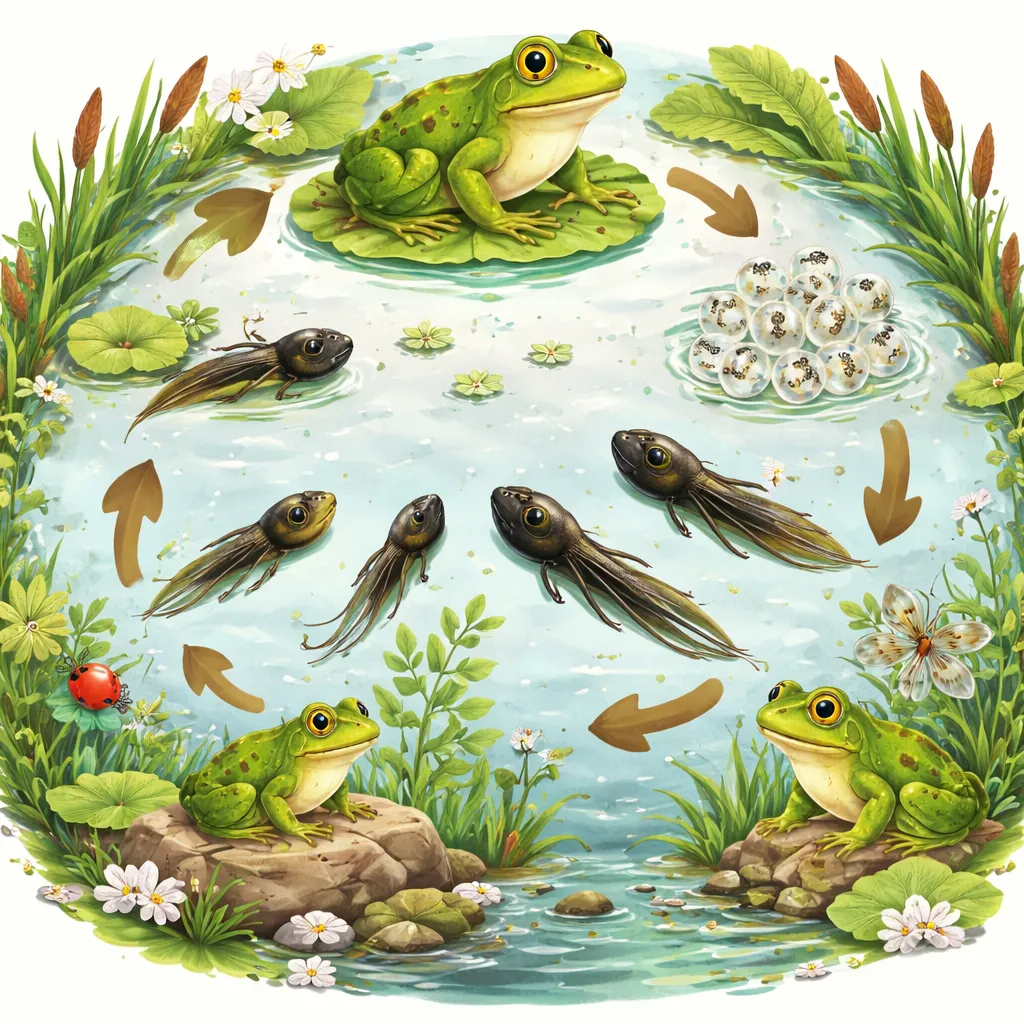
A life cycle is the story of how an animal lives, grows, and changes. A frog has a very special life cycle. It goes through a big change called metamorphosis. This means it changes its form completely. Learning the life cycle of a frog stages names helps us tell this watery tale. The first stage is the egg. A mother frog lays many eggs in the water, often in a pond. The eggs are covered in a soft, clear jelly. This jelly keeps the eggs safe. We call a group of frog eggs frogspawn. Inside each tiny black egg, a new life is growing.
The second stage is the tadpole. After some time, the egg hatches. Out comes a tadpole. A tadpole looks like a little fish. It has a long tail for swimming. It has gills on the side of its head. Gills are like underwater lungs. They help the tadpole breathe in the water. The tadpole's job is to eat and grow. It eats tiny water plants. It swims all day. This is a key part of the life cycle of a frog stages names.
Now comes the amazing change. After a few weeks, the tadpole starts to grow. First, it grows two back legs. Then, it grows two front legs. Its tail starts to get smaller. Its gills disappear. Lungs grow inside its body so it can breathe air. This changing tadpole is now in a new stage. It is called a froglet. A froglet is like a small frog with a tail. It can swim and it can start to hop on land. It uses its new lungs to breathe air. The tail keeps getting smaller and smaller as the froglet uses it for food.
The fourth and final stage is the adult frog. When the tail is completely gone, the froglet becomes an adult frog. The adult frog has strong legs for jumping. It has lungs for breathing air. It has a long, sticky tongue for catching insects. The adult frog lives mostly on land but near water. It will find a mate. The female will lay eggs. And the whole amazing life cycle of a frog stages names starts all over again. Egg, tadpole, froglet, adult. It is a cycle of life, water, and incredible change.
Fun Interactive Learning
Let's act it out! This is the best way to learn the life cycle of a frog stages names. First, curl up in a tiny ball. You are a frog egg in the jelly. Then, hatch! Wiggle on the floor like a little tadpole swimming. Use your arms like a tail. Now, start to grow legs! Push up on your hands and knees. You are a froglet with a tail (maybe wag a foot). Take a big breath of air with your new lungs. Finally, stand up and jump! You are an adult frog. Jump around the room and catch an imaginary fly with your tongue. This game uses your whole body to remember the stages.
Another fun activity is to make a "Life Cycle Diorama." Get a shoebox. Paint the bottom blue for water. Add some green paper for lily pads. Now, use clay or paper to make the four stages. Make little jelly balls with black dots for eggs. Make a wiggly tadpole shape. Make a froglet with little legs and a small tail. Make a big adult frog. Put them in order in your shoebox pond. Label each one with its name. This is a 3D way to see the life cycle of a frog stages names.
You can also play "Stage Charades." Write the stage names on cards: Egg, Tadpole, Froglet, Adult Frog. Put them in a bowl. One player picks a card and acts out that stage. Can you wiggle like a tadpole? Can you jump like a frog? The others guess. This is a lively, fun game for the whole family.
Expanded Learning
Frogs are amphibians. Amphibians are animals that can live both in water and on land. The life cycle of a frog stages names shows this perfectly. They start life in water and move to land. This is different from butterflies, which are insects. In some parts of the world, the names might be a little different, but the stages are the same. The word "tadpole" comes from old words meaning "toad" and "head" because it looks like a little head with a tail.
Frogs are very important for nature. They eat insects. They are food for birds and fish. Their life cycle needs clean, healthy ponds. If the water is dirty, frogs cannot survive. Learning about the life cycle of a frog stages names teaches us to care for ponds and streams. In many stories, frogs are magical, like the frog prince. They are symbols of change and cleansing. Let's make a frog life cycle song. Sing to the tune of "Five Little Ducks."
In a pond, on a sunny day, a mother frog laid eggs in the spray! Eggs in jelly, black and round, in the water they are found! Then the tiny tadpoles hatch, and begin their swimming match! Growing legs, both front and back, becoming froglets on the track! Tail gets small, a hop, a leap, into an adult frog so deep! This is the cycle, round and true, for the frog in pond so blue!
What You Will Learn
You are learning about biology, amphibians, and transformation. You are learning the life cycle of a frog stages names: egg (frogspawn), tadpole, froglet, adult frog. You are also learning words like metamorphosis, amphibian, gills, lungs, and hatch.
You are learning sequential and descriptive sentences. You can say, "The frog starts its life as an egg in the water." You can explain, "A froglet is a young frog that still has a tail." You can narrate, "The adult frog uses its long tongue to catch insects." You are using English to describe a fascinating natural process with clear, step-by-step language.
You are building important knowledge and skills. You are building science vocabulary about animal development. You are building sequencing skills. You understand the order of growth and change. You are building observation skills. You can look for these stages in a real pond. You are building ecological awareness. You understand the needs of amphibians. You are building a sense of wonder. You appreciate a common yet amazing transformation.
You are forming a patient and observant habit. The habit of watching nature over time. You learn that big changes happen slowly, in stages. Learning the life cycle of a frog stages names gives you the words to understand and share the story of a creature that lives in two worlds: water and land.
Using What You Learned in Life
Use your new words when you are near a pond, stream, or even a water garden. If you see jelly with dots, say, "Look, frogspawn! Those are frog eggs." If you see a wiggly swimmer, say, "That's a tadpole. It breathes with gills." Be a nature guide for your friends or family. Remember, frogs are fragile. Look but do not touch. You can also keep a "Tadpole Diary" if you have a safe pond to visit. Draw what you see each week. Write the stage names.
At school, you can do a project on frogs. Draw the life cycle in a circle. Present the stages to your class. Use the new vocabulary words. You can also read books about frogs and point out the stages you know. The more you use the life cycle of a frog stages names, the more you will see the science in the world around you. You are becoming a junior herpetologist, a scientist who studies amphibians.
Closing Encouragement
You are a frog life explorer. You are a metamorphosis mapper. You are a curious and patient nature scientist. I am so proud of you. Learning all about the frog's life cycle shows you have a mind for discovery and a heart for the wonders of nature.
May you always be amazed by the transformations in nature, big and small. You are learning the language of growth, change, and life itself.
You are knowledgeable, you are observant, and you are ready to explore the world of ponds and hopping friends. Great work, my wonderful frog expert.