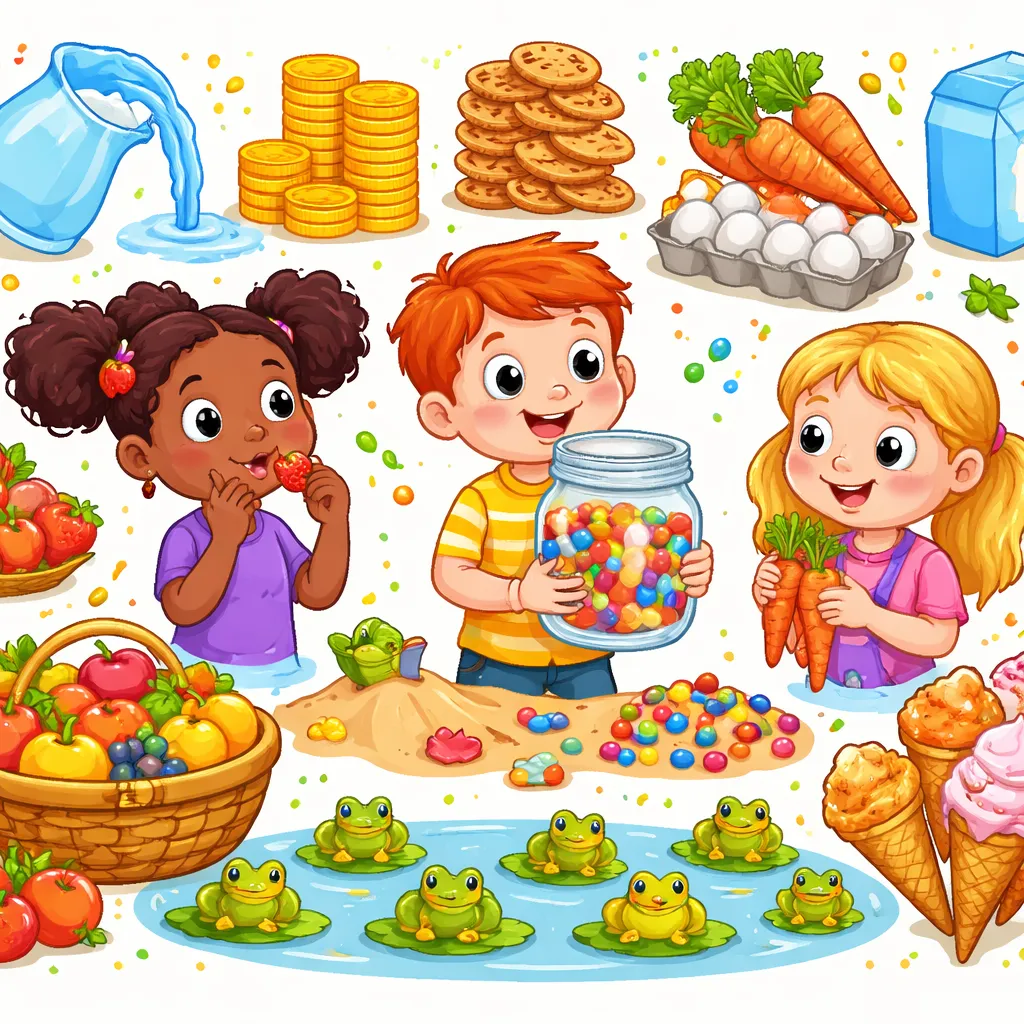

Imagine you are a chef. You need to tell someone how much sugar to add. You don't always say "200 grams." Sometimes you say "a little sugar" or "a lot of sugar." These are expressions of quantity. They are your "Measuring Words." They help you talk about amounts without always using exact numbers. Let's learn how to measure with words.
What Are 'Measuring Words'?
Expressions of quantity are words and phrases that tell us "how much" or "how many." They describe amounts. Some are for things you can count, like cookies. Some are for things you can't count, like milk. At home, you might want "some cookies" or "a little milk." At the playground, you see "many children" and "a lot of fun." In school, you need "several pencils" and "some paper." In nature, a tree has "a few leaves" or "lots of branches." These words paint a picture of amount.
Why Are These Measuring Words So Valuable?
Knowing expressions of quantity makes you a clear communicator. It helps your ears, your voice, your reading eyes, and your writing hand.
First, it helps your listening. Your mom says, "Take a couple of cookies." You know that means about two. A friend says, "I have loads of stickers!" You know they have many. You catch the general amount quickly. You understand instructions and stories better. You know if someone has a little or a lot.
Next, it makes your speaking natural and descriptive. You can share stories vividly. "We saw tons of birds!" is more exciting than "We saw birds." You can ask for things politely. "Can I have a bit of help?" Your words sound fluent. People get a clear picture from your description.
Then, it gives you a reading superpower. You read a recipe: "Add a pinch of salt." You know that means a very small amount. You read a sign: "Limit: two items per person." You know the exact number allowed. This helps you follow directions and understand texts in daily life. You become a skilled reader of the world.
Finally, it makes your writing detailed and engaging. Your stories come alive. Instead of "He had money," you can write "He had a huge amount of money." Your journal entries are more interesting. "I did a little homework, then played a few video games." Your writing shows you can describe the world precisely.
Meet the Measuring Word Groups
Let's organize our Measuring Words. We'll put them in groups by how exact they are and what they describe.
First, the Exact Counters. These are for things you can count. They give a specific number or a small, exact range. Look at these examples. At home: "I have two sisters." "I need a couple of eggs." (A couple often means two). At the playground: "Our team has eleven players." "I took a dozen practice shots." (A dozen is twelve). In school: "I solved several math problems." ('Several' means more than two but not many). In nature: "The bird laid three eggs." "I saw a pair of squirrels." (A pair means two).
Now, the Approximate Bunch. These are for general amounts. They are not exact. For countable nouns, we use words like: many, a few, several, a couple of, a number of. For uncountable nouns, we use: much, a little, a bit of, a great deal of. Look at these examples. At home: "We have many chairs." (Countable). "We don't have much juice." (Uncountable). At the playground: "A few kids are swinging." (Countable). "There's a little sand in my shoe." (Uncountable). In school: "She has a number of ideas." (Countable). "The project requires a great deal of patience." (Uncountable). In nature: "Many stars are out." (Countable). "The plant needs a bit of water." (Uncountable).
Next, the Big Amount Bunch. These words mean a large quantity. For both countable and uncountable, we often use: a lot of, lots of, plenty of. Look at these examples. At home: "We have a lot of books." (Countable). "We have lots of time." (Uncountable). At the playground: "There are plenty of balls to share." (Countable). In nature: "The tree has plenty of shade." (Uncountable).
Then, the Small Amount Bunch. These words mean a small quantity. For uncountable nouns: a little, a bit of. For countable nouns: a few. A very important pair! Look at these examples. At home: "Can I have a little butter?" (Uncountable). "Can I have a few grapes?" (Countable). In school: "I need a bit of quiet." (Uncountable). "I have a few questions." (Countable).
Also, the All-or-Nothing Group. These are extremes. 'All' means 100%. 'No' or 'None' means 0%. 'Some' is in between. Look at these examples. At the playground: "All the swings are taken." "There are no free swings." "Some kids are running."
Your Detective Tool: How to Choose the Right Word
Choosing the right expression is a two-step puzzle. Step one: Ask, "Can I count this thing?" Is it cookies (countable) or milk (uncountable)? Step two: Ask, "What is the amount?" Is it big, small, exact, or approximate? Use your answers to pick from the groups. The pattern is: Countable Noun? -> Use many/a few/several. Uncountable Noun? -> Use much/a little/a bit of. For large amounts, 'a lot of' works for both.
How to Use Your Measuring Words Correctly
Using them is about the noun that follows. The golden rule is: match the expression to the type of noun (countable or uncountable). The formula is: Expression of Quantity + Noun. Make sure they agree. Do not say "many water." Say "much water" or "a lot of water." Do not say "a few money." Say "a little money" or "a bit of money." 'A lot of' and 'lots of' are friendly and work with both types in informal speaking.
Oops! Let's Fix Common Mistakes
Everyone mixes these up. Let's fix common errors. The biggest mistake is using 'much' with countable nouns. A child might say, "I have much friends." This is wrong. 'Much' is for uncountable nouns. For countable nouns, use 'many': "I have many friends." In questions and negatives, 'much' is okay: "I don't have much time." "Do you have much homework?"
Another mistake is confusing 'a few' and 'a little'. Do not say, "I need a few advice." 'Advice' is uncountable. Say, "I need a little advice." Or, "I need a few suggestions." (suggestions are countable).
A third mistake is using 'a lot of' in very formal writing. It's great for speaking and stories. For a formal report, 'many' or 'much' might be better. "The study required much effort."
A fourth mistake is with 'less' and 'fewer'. Use 'fewer' for countable things. "Fewer cars on the road." Use 'less' for uncountable things. "Less traffic on the road."
Are You Ready for a Measuring Challenge?
Test your skills. Look in your fridge. Describe three things using expressions of quantity. Example: "We have a lot of eggs." Now, look at your toys or books. Describe them. Use 'many', 'a few', and 'several'. Imagine you are making a snack. Write instructions using 'a little', 'a bit of', and 'a couple of'. Finally, write a short story about a trip to a store. Use at least five different expressions of quantity. Be a word measurer!
You Are Now a Master of Measuring Words
You have learned all about expressions of quantity. You know they are Measuring Words for "how much" or "how many." You met the Exact Counters, the Approximate Bunch, the Big Amount Bunch, and the Small Amount Bunch. You learned the golden rule to match them with countable or uncountable nouns. You have tools to choose the right word. You can even fix common mistakes. You can now describe amounts like a pro.
You can learn many things from this article. You now know that expressions of quantity are words and phrases that describe amounts, like "a few," "many," "a little," and "a lot of." You understand the crucial difference between using them with countable nouns (things you can count) and uncountable nouns (things you can't count individually). You learned groups of these expressions for exact numbers, approximate amounts, large quantities, and small quantities. You saw how to choose the correct expression based on the noun that follows. You also know how to avoid common errors like mixing up "a few" and "a little."
Now, try using your new knowledge in real life. Here are two fun ideas. First, play the "Quantity Detective" game at the supermarket. As you walk, describe items using expressions of quantity. "There are many cereal boxes." "We need a little cheese." Second, make a "Snack Recipe" for a friend. Write simple instructions using measuring words. Example: "Take a couple of crackers. Spread a little peanut butter. Add a few raisins." Share your recipe. Have fun measuring your world with words!