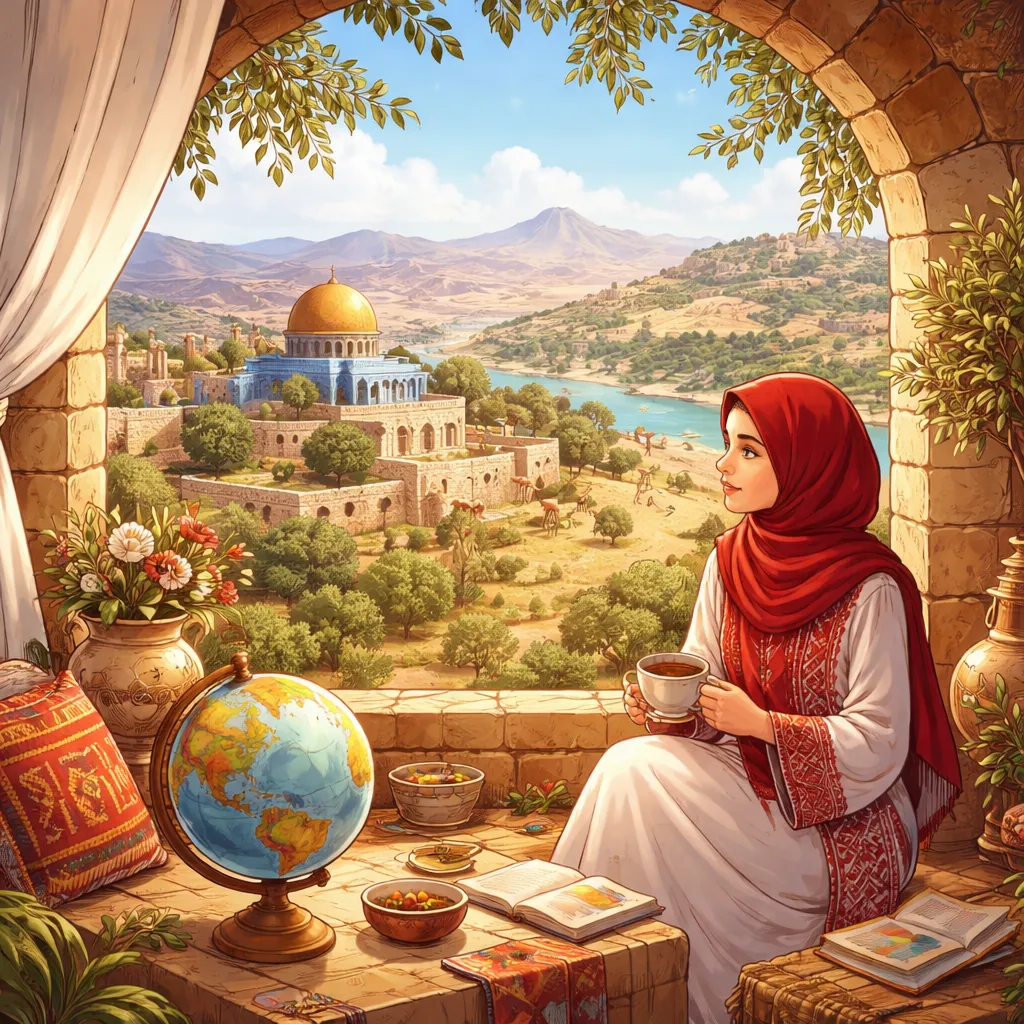

Introduction to Palestine
Language learning transports us to a land with deep historical and cultural roots. Today we explore a region in the Middle East known for its ancient cities and olive groves. This land holds stories that stretch back thousands of years. Children will discover the art of embroidery that has been passed down through generations. They will learn about olive trees that have stood for centuries. Exploring Palestine builds reading skills while revealing a culture of resilience, tradition, and connection to the land. Every fact uncovers a story. Every word invites young readers to understand this historic land.
Where Is Palestine?
Palestine lies in the Middle East along the eastern coast of the Mediterranean Sea. It shares borders with Lebanon to the north, Syria to the northeast, Jordan to the east, and Egypt to the southwest. The Mediterranean Sea forms its western boundary. The region includes the West Bank and the Gaza Strip. East Jerusalem serves as the capital. The land covers about two thousand four hundred square miles in the West Bank and about one hundred forty square miles in Gaza. The Jordan River flows along the eastern edge. The Dead Sea sits at the lowest point on Earth. Finding Palestine on a map shows a land at the crossroads of Asia, Africa, and Europe. Its location made it a meeting place for civilizations.
Interesting Facts About Palestine
Palestine offers many remarkable facts for young learners. It is home to some of the oldest olive trees in the world. Some trees in the West Bank are believed to be over two thousand years old. Families pass olive groves from generation to generation. Another interesting fact involves embroidery. Palestinian embroidery called tatreez features intricate cross-stitch patterns. Each region has its own designs and colors. Girls learn these patterns from their mothers and grandmothers.
Palestine also has a rich culinary tradition. Maqluba is a famous dish made with rice, meat, and layered vegetables cooked upside down. When served, the pot flips to reveal a colorful layered dish. Another fun fact involves the Dead Sea. The Dead Sea lies at the lowest point on Earth, over fourteen hundred feet below sea level. Its water is so salty that people float without effort.
The country also holds ancient cities. Bethlehem marks the birthplace of Jesus. The Church of the Nativity stands there. Hebron holds the Ibrahimi Mosque, a site sacred to multiple faiths. Another interesting fact involves music. Palestinian musicians play the oud, a string instrument similar to a lute. Traditional songs tell stories of love, family, and land. Palestine also has a thriving literary tradition. Poets and writers have earned international recognition. These facts show children a land of ancient roots, artistic traditions, and deep cultural identity.
Key Vocabulary About Palestine
Let us build vocabulary for this historic land. These words help children describe what they learn.
Embroidery: the art of decorating fabric with needle and thread.
Olive: a small fruit from the olive tree, used for oil and food.
Tatreez: traditional Palestinian embroidery with cross-stitch patterns.
Oud: a pear-shaped string instrument used in Middle Eastern music.
Maqluba: a traditional dish with rice, meat, and vegetables cooked upside down.
Keffiyeh: a traditional checkered scarf worn in the region.
Intricate: having many small details or patterns. Introduce these words with pictures and stories. Show a piece of embroidery with colorful patterns. Show an olive tree with its gnarled trunk. Let children say each word aloud. These vocabulary words give children the language to explore Palestine's cultural traditions.
Simple Sentences for Reading Practice
Short sentences help new readers build confidence. Use these sentences about Palestine for practice.
Palestine is a land in the Middle East.
The Mediterranean Sea borders Palestine to the west.
East Jerusalem serves as the capital.
Ancient olive trees grow in the hills.
Women create beautiful embroidery called tatreez.
The Dead Sea lies at the lowest point on Earth.
Maqluba is a traditional dish cooked upside down. Read each sentence together. Let children point to the words. Encourage them to repeat after you. Use pictures to show each fact. These simple sentences prepare young readers for longer passages.
Short Reading Passage About Palestine
Here is a short passage for children to read together.
“Palestine sits along the eastern Mediterranean coast. Hills roll down toward the sea. Ancient olive trees stand in these hills. Some trees have watched over families for over two thousand years. Families harvest the olives each season. They press them into oil used for cooking and light. In villages, women gather to embroider. They stitch tatreez patterns passed down through generations. Each region has its own colors. Red for Jerusalem. Orange for Jaffa. The keffiyeh, a checkered scarf, has become a symbol of Palestinian identity. In the kitchen, families prepare maqluba. They layer rice, chicken, and eggplant in a pot. When cooked, they flip the pot onto a large tray. The dish comes out in beautiful layers. In the south, the Dead Sea shimmers. Its salty water makes swimmers float like boats. Palestine holds traditions that connect families to the land and to each other.”
Read this passage slowly together. Pause to talk about each idea. Ask children to find vocabulary words in the text. This activity builds reading fluency and deepens understanding.
Fun Questions About Palestine
Questions make reading interactive and engaging. Use these to start conversations with young learners.
What sea borders Palestine to the west?
What ancient trees grow in the hills?
What is the traditional embroidery called?
What dish is cooked upside down?
What body of water lies at the lowest point on Earth?
What instrument is used in Palestinian music? Let children answer in complete sentences. Encourage them to use new vocabulary. Ask them to imagine learning embroidery from a grandparent. What patterns would they stitch? Creative questions make the topic personal and exciting.
Tips for Learning English with This Topic
Use Palestine to create rich English learning experiences. Start with a map activity. Let children find Palestine on the eastern Mediterranean coast. Point out the Jordan River and the Dead Sea. Discuss how the land connects three continents.
Next, introduce the vocabulary through a hands-on activity. Create a simple embroidery activity using paper with holes punched in patterns. Let children stitch with yarn or string. For maqluba, cook or assemble a layered dish in a pot. Flip it to reveal the layers. Use the words "tatreez," "embroidery," and "maqluba" during the activity.
Read the passage aloud with warmth and appreciation for tradition. Let your voice reflect the care taken in embroidery and cooking. After reading, let children draw a scene from Palestine. One child might draw an olive tree with a family harvesting. Another might draw a woman embroidering with colorful threads. Let them label their drawings with vocabulary words. Add green for the hills and blue for the sea.
Incorporate a cultural connection. Talk about why traditions like embroidery and cooking are passed down in families. Ask children about traditions in their own family. Discuss how food, art, and clothing tell stories about a culture.
Use music and movement to enhance the experience. Listen to Palestinian music with oud and percussion. Let children move like olive harvesters or pretend to stitch embroidery. Physical activity reinforces learning in joyful ways.
Encourage children to share their knowledge. Let them tell a family member about the ancient olive trees or the dish cooked upside down. They can explain what tatreez means. Teaching others builds confidence and deepens understanding.
Connect Palestine to your child's world. Ask, “What traditions does our family pass down?” Compare to embroidery and olive harvest. Ask about foods your family cooks for special occasions. Compare to maqluba. These connections help children see that language learning reading is about understanding how families preserve culture. By exploring Palestine together, you give children a rich experience. They learn new words, discover traditions that span generations, and grow their love for reading. This ancient land becomes a meaningful part of their learning journey.