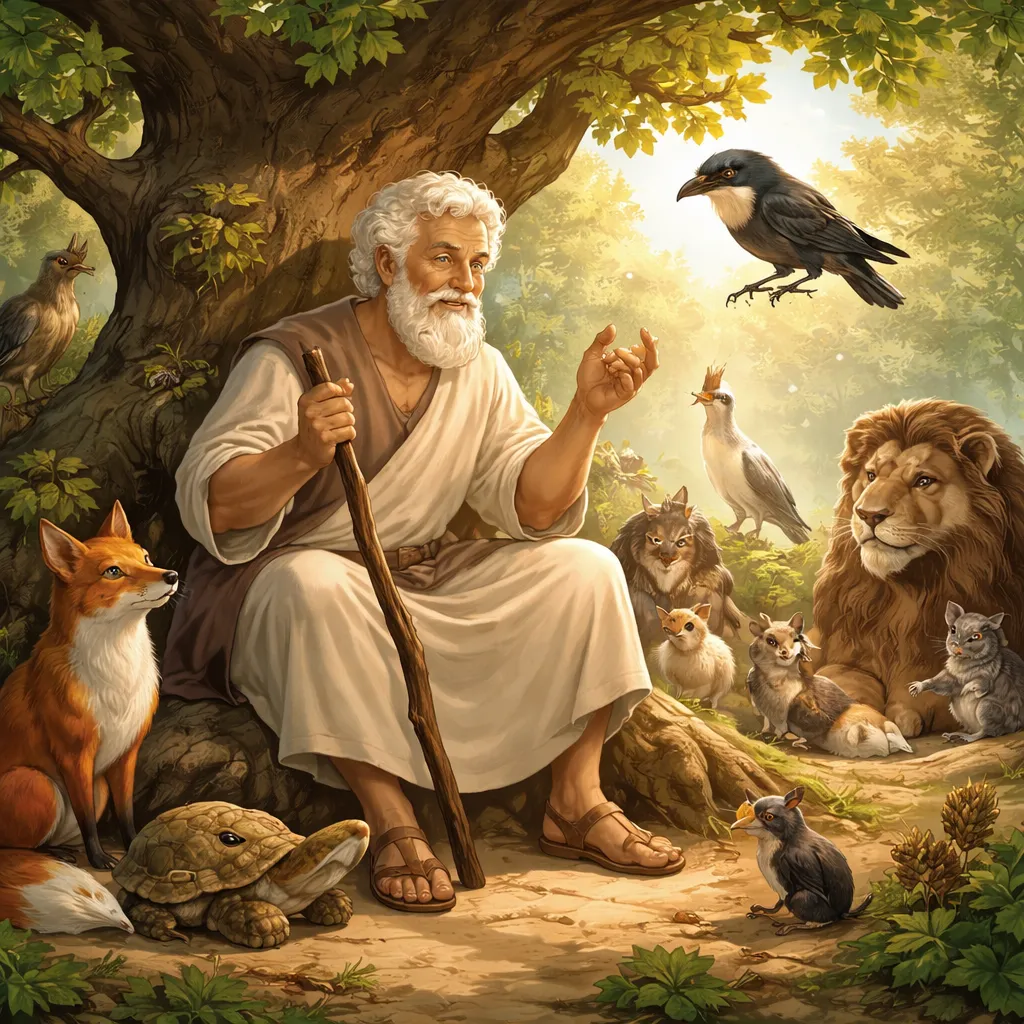

Introduction to Aesop
Aesop was an ancient Greek storyteller. He is famous for writing short stories called fables, each with a moral lesson. This celebrity story: Aesop shows that you do not need a long book to teach something important. Aesop may have been a slave. He may have had a disability. He spoke truth to power through animal tales. Children can learn that wisdom can come from unexpected places. Parents can use his story to teach ethics, critical thinking, and the power of brevity. Aesop's fables include "The Tortoise and the Hare," "The Boy Who Cried Wolf," and "The Lion and the Mouse." These stories are over 2,500 years old. People still tell them today. His life proves that a person with nothing but words can leave a mark on the world that lasts forever.
Early Life and Background
Almost nothing is certain about Aesop's life. Historians disagree on almost every detail. He was likely born around 620 BCE. He probably came from Thrace, Phrygia, or Ethiopia. Some sources say he was born in Phrygia, a region in modern-day Turkey. The name "Aesop" may come from the Greek word for "Ethiopian." Some scholars believe he was from Africa. According to legend, Aesop was a slave. His first master was a man named Xanthus. Aesop was not handsome. Descriptions call him deformed, with a large head, a flat nose, and bowed legs. He also had a speech impediment. He could barely speak. But he was very clever. One story says that Aesop helped his master solve a series of riddles. He proved so valuable that Xanthus freed him. Another story says that the gods gave Aesop the power to tell fables. In return, he lost his ability to speak. Then a priestess of the goddess Isis cured him. She gave him back his voice and the gift of storytelling. Aesop traveled to the court of King Croesus of Lydia. Croesus was famous for his wealth. He hired Aesop as his advisor. Aesop used fables to advise the king on matters of justice and wisdom.
Career Highlights and Achievements
Aesop's career was not like a modern career. He did not publish books or give paid lectures. He told stories. People remembered them. They wrote them down later. According to legend, Aesop traveled to Delphi, a major Greek city. He angered the citizens there. He told a fable comparing them to a piece of driftwood. The people of Delphi accused him of stealing a gold cup from the temple of Apollo. They sentenced him to death. They threw him off a cliff. That was around 564 BCE. After his death, his stories spread across Greece. Socrates, the famous philosopher, spent time in prison turning Aesop's fables into poetry. Plato, another great philosopher, wrote that Socrates did this to pass the time. The first written collection of Aesop's fables appeared around 300 BCE. Demetrius of Phalerum, a Greek philosopher, compiled them. That collection is lost. But later writers quoted from it. In the first century CE, a Roman poet named Phaedrus wrote Latin versions of the fables. In the second century CE, a Greek writer named Babrius wrote Greek versions. These collections survived. They became the basis for all later Aesop's fables.
Famous Works or Performances
Aesop's most famous work is his collection of fables. No one knows exactly how many he told. The standard collection includes over 700 fables. Some of the most famous include "The Tortoise and the Hare." A fast rabbit makes fun of a slow turtle. They race. The rabbit takes a nap. The turtle keeps walking. The turtle wins. The moral is "Slow and steady wins the race." "The Boy Who Cried Wolf" tells of a shepherd boy who tricks villagers into thinking a wolf is attacking. He does this for fun. When a real wolf comes, no one believes him. The wolf eats the sheep. The moral is "Nobody believes a liar, even when he tells the truth." "The Lion and the Mouse" is about a tiny mouse who wakes a sleeping lion. The lion spares the mouse. Later, the mouse gnaws through a net trapping the lion. The moral is "Even the smallest friend can be a great help." "The Fox and the Grapes" features a fox who tries to reach grapes on a high vine. He gives up. He says, "Those grapes are probably sour anyway." The moral is "It is easy to despise what you cannot have." "The Ant and the Grasshopper" tells of an ant who works all summer storing food. A grasshopper plays music all summer. When winter comes, the grasshopper starves. The moral is "Prepare today for the needs of tomorrow."
Personal Life and Fun Facts
Aesop's personal life is mostly legend. But the legends are fascinating. A fun fact is that Aesop may have been mute as a child. The gods gave him the power to tell fables. Another fun fact is that Aesop used fables to solve real problems. One story says that a slave ran away from his master, Xanthus. Xanthus asked Aesop what to do. Aesop told a fable about a wolf who ate a sheep. The shepherd did not punish the wolf. The wolf ate another sheep. The shepherd killed him. Xanthus understood. He punished the slave lightly. The slave did not run away again. Another legend says that Aesop was invited to a banquet. His master asked him to prepare the best dish possible. Aesop served tongue. He served tongue cooked in different ways. He said, "The tongue is the best thing in the world. It can teach, praise, and persuade." His master then asked for the worst dish. Aesop again served tongue. He said, "The tongue is also the worst thing in the world. It can lie, curse, and start wars." Aesop never owned property. He never had a family. He never held political power. He had only his stories. That was enough. He died poor and hated by the people of Delphi. But his stories outlived their anger.
Legacy and Influence
Aesop changed the world more than many kings and generals. His fables created a whole genre of literature. The "Aesopic fable" became a standard form. Every culture has its own version of his stories. In India, the Panchatantra draws on Aesop. In the Arab world, the stories of Luqman resemble Aesop's fables. In the Middle Ages, European monks copied and translated Aesop's fables. They used them to teach Latin. In the Renaissance, artists illustrated the fables. William Caxton, the first English printer, printed an English translation of Aesop's fables in 1484. Jean de La Fontaine, a French poet, wrote his own versions in the 1600s. They became classics of French literature. In the 1900s, Walt Disney made animated shorts based on Aesop's fables. "The Tortoise and the Hare" became a cartoon. "The Grasshopper and the Ants" also became a cartoon. Today, almost every child learns "The Boy Who Cried Wolf" or "The Lion and the Mouse." The phrase "sour grapes" comes from Aesop. The phrase "crying wolf" comes from Aesop. The phrase "slow and steady wins the race" comes from Aesop. His legacy proves that short stories can carry the biggest truths. He did not write a book. He told tales to anyone who would listen. Those tales traveled across centuries and oceans. They are still traveling.
Quotes or Famous Sayings
Aesop wrote many famous morals. One famous moral from "The Tortoise and the Hare" is "Slow and steady wins the race." Another from "The Boy Who Cried Wolf" is "Nobody believes a liar, even when he tells the truth." From "The Lion and the Mouse" comes "No act of kindness, no matter how small, is ever wasted." From "The Fox and the Grapes" comes "It is easy to despise what you cannot have." Children might like this one from "The Ant and the Grasshopper": "It is best to prepare for the days of necessity." Families can read these morals together. Ask children, "Which moral do you think is most important?" Parents can help children see that Aesop did not tell children what to think. He showed them a story. They figured out the lesson themselves. That is the power of fables. His quotes remind us that wisdom does not need long explanations. Sometimes a short story says it all.
How to Learn from Aesop
Children can learn several lessons from Aesop. First, listen to stories. Aesop collected tales from everywhere. He turned them into lessons. Second, tell your own stories. You do not need to write a whole book. A short fable can teach a big idea. Third, look for the moral. Every situation in life has a lesson hidden inside it. Try to find it. Parents can encourage young children to make up a fable with animals. Choose two animals. Make them argue about something. End with a lesson. Older children can take a problem at school or home. Turn it into a fable. Change the people into animals. See what the animals learn. Families can also act out an Aesop fable. Someone plays the tortoise. Someone plays the hare. Race across the living room. Another activity is to pick a moral for the week. "Slow and steady wins the race." Post it on the refrigerator. Look for chances to use it. Aesop lived over 2,500 years ago. He was a slave. He had no power. He had no money. He had stories. Those stories taught Greek kings, Roman senators, French poets, and American schoolchildren. A short tale with a small lesson can travel farther than any army. Every child has a story inside them. It does not need to be long. It does not need to be fancy. It just needs to be true. Tell it. Someone needs to hear it. That is the Aesop way. That is the way of wisdom.