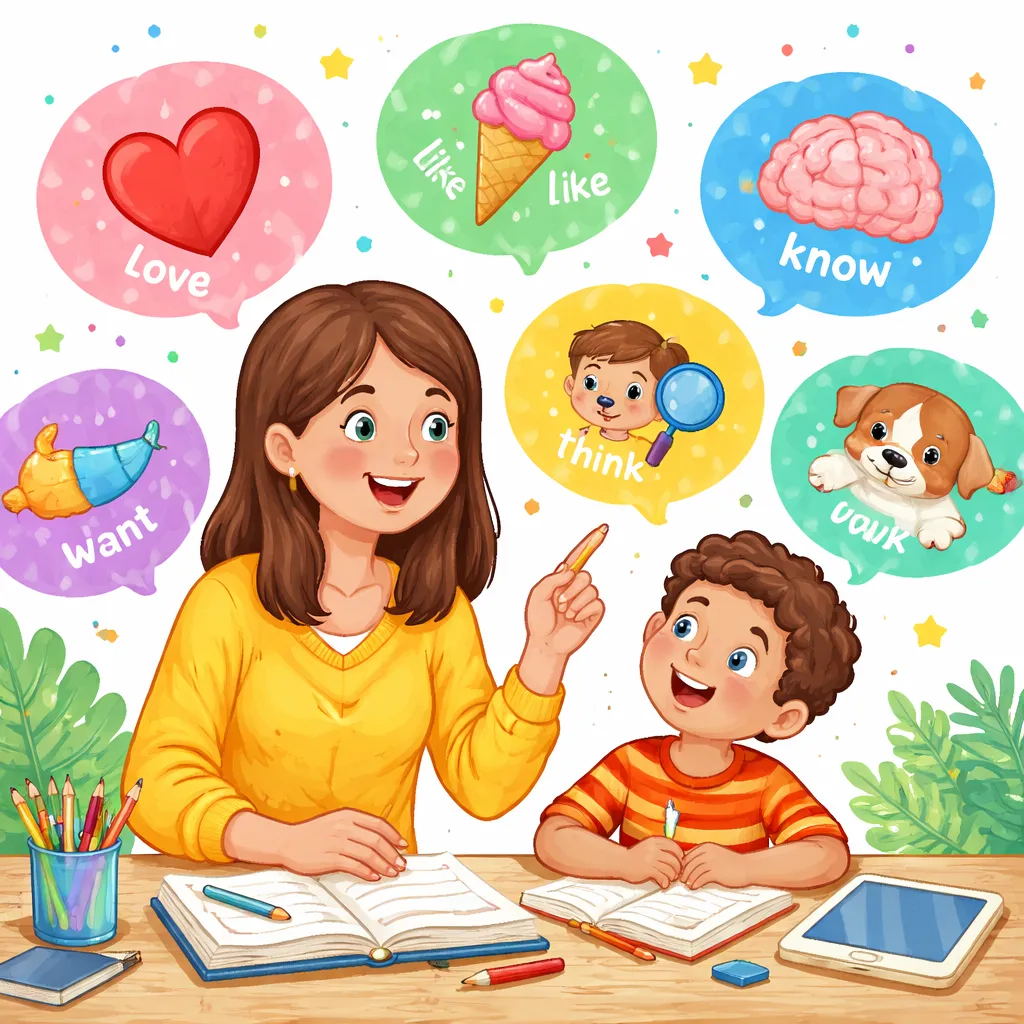

What Are Stative Verbs?
In English, verbs can be divided into two main categories: action verbs and stative verbs. While action verbs describe things that people do, stative verbs describe states or conditions. Stative verbs are used to talk about things that are static, unchanging, or ongoing in a particular moment.
For example, when we use stative verbs, we’re describing something that is true over a period of time. These verbs typically describe feelings, thoughts, senses, and possession. Examples of stative verbs include love, know, belong, need, understand, and believe.
Unlike action verbs, stative verbs don’t describe actions that can be seen or measured. Instead, they describe situations that are constant or lasting, making them crucial for conveying meaning about how things are, rather than what is being done.
Rules of Stative Verbs
When using stative verbs, there are a few important rules to keep in mind. Understanding these rules helps children use stative verbs correctly and confidently.
No Continuous Tense: Most stative verbs are not used in the continuous (progressive) tense. This means you don’t say, for example, "I am knowing," or "She is believing." Instead, you use the simple tense: Correct: "I know the answer." Incorrect: "I am knowing the answer." Stative Verbs Can Express States: These verbs describe conditions that are not actions. This could be an emotional state, a mental state, or something permanent about a subject: Example: "She has a car." Here, the verb "has" shows possession, which is a state, not an action. Some Verbs Can Be Both Stative and Action Verbs: Some verbs, like think, see, and have, can function as both stative and action verbs. The difference depends on the meaning of the sentence: Stative Use: "I think she is right." (Here, think means to believe something.) Action Use: "I am thinking about the problem." (Here, thinking means to use your brain to focus on something.) Describing Feelings and Opinions: Many stative verbs are used to describe how someone feels or what someone thinks. For instance: "I like pizza." "They belong to this team."
By understanding these rules, children can learn when to use stative verbs and avoid errors in their writing and speaking.
How to Use Stative Verbs
Using stative verbs is simple once you grasp the basic rules. Here's a guide on how to use stative verbs correctly in sentences:
Express Feelings: Stative verbs can describe emotions or feelings. Example: "I love my dog." In this case, "love" is a stative verb expressing a permanent or ongoing feeling. Express Opinions or Beliefs: Many stative verbs are used to describe thoughts or beliefs. Example: "I believe in kindness." Here, "believe" shows a belief or opinion. Describe Possession: Stative verbs can indicate that someone owns or possesses something. Example: "He has a new bike." "Has" shows possession, which is a state of ownership. Indicate Knowledge or Understanding: Some stative verbs express knowledge or understanding of something. Example: "She knows the answer." "Knows" describes a state of knowing, not an action. Indicate Relationships: Stative verbs are also used to describe relationships or connections. Example: "They belong to the same team." "Belong" shows a connection or relationship between people and the team.
By practicing these uses, children can better understand how stative verbs function and how to use them in their own speech and writing.
Examples of Stative Verbs
Here are some examples of sentences using stative verbs to help clarify how they work:
Love: "I love reading books." (Here, "love" describes a lasting emotional state.) Know: "She knows how to play the piano." (In this sentence, "knows" expresses knowledge, which is a static condition.) Belong: "This book belongs to me." (Here, "belongs" shows possession, not an action.) Need: "We need more pencils." (The verb "need" expresses a state of necessity.) Understand: "I understand the instructions." ("Understand" refers to a mental state of comprehension.) Have: "He has a red ball." ("Has" is used to indicate possession, a static state.) Prefer: "I prefer chocolate to vanilla." (Here, "prefer" is used to express a preference, which is a stable state.)
These examples show how stative verbs are used to express feelings, knowledge, possession, and opinions.
Common Mistakes with Stative Verbs
As children learn about stative verbs, they may make a few common mistakes. Being aware of these mistakes can help prevent confusion and improve their grammar skills.
Using Stative Verbs in Continuous Tenses: One common mistake is trying to use stative verbs in the continuous form. As mentioned earlier, stative verbs are rarely used in continuous tenses. Incorrect: "I am loving ice cream." Correct: "I love ice cream." Confusing Stative and Action Verbs: Some verbs, like have, think, and see, can be both stative and action verbs. Children might use them incorrectly depending on the context. Incorrect: "I am having a car." (If you're talking about ownership, use "have" in the simple tense: "I have a car.") Correct: "I have a car." Using Stative Verbs in Questions: Sometimes, stative verbs don’t sound correct when used in questions, especially in the continuous form. Incorrect: "Are you knowing the answer?" Correct: "Do you know the answer?" Forgetting to Change Pronouns: Sometimes, children forget to change the pronouns when using stative verbs in sentences. Incorrect: "She know the answer." Correct: "She knows the answer."
Understanding these common mistakes will help your child use stative verbs more confidently.
Practice Exercises
Here are a few practice exercises to help your child use stative verbs correctly. Try rewriting the following sentences, changing the verb tense or form as needed.
"I am loving the movie." "She is knowing the answer." "They are having lunch." "I am thinking about the problem." "He is liking the new book." Answers and Explanations
Let’s go over the answers to the practice exercises:
Incorrect: "I am loving the movie." Correct: "I love the movie." (Remember, "love" is a stative verb and is not used in the continuous tense.) Incorrect: "She is knowing the answer." Correct: "She knows the answer." ("Know" is a stative verb, so it should be used in the simple present tense.) Incorrect: "They are having lunch." Correct: "They have lunch." (If referring to possession, use "have" in the simple present tense.) Incorrect: "I am thinking about the problem." Correct: "I think about the problem." (In this case, "think" expresses a state of thinking, not an ongoing action.) Incorrect: "He is liking the new book." Correct: "He likes the new book." ("Like" is a stative verb, so it should not be used in the continuous form.) Learning Tips
To help your child master stative verbs, here are some helpful tips:
Reinforce with Real-Life Examples: Use everyday situations to practice stative verbs. For example, when talking about something they like, help them use the verb love or like correctly. Use Stories: Encourage your child to write or tell stories, incorporating stative verbs. This helps them learn how to express opinions, feelings, and knowledge. Flashcards: Create flashcards with stative verbs on one side and examples of their use on the other. This helps children visualize how the verbs are used in context. Practice with Questions: Give your child simple questions where they must answer using stative verbs. For example: "What do you think about the new movie?" or "What do you know about animals?"
By regularly practicing these tips, children can improve their understanding of stative verbs and use them correctly in their conversations and writing.