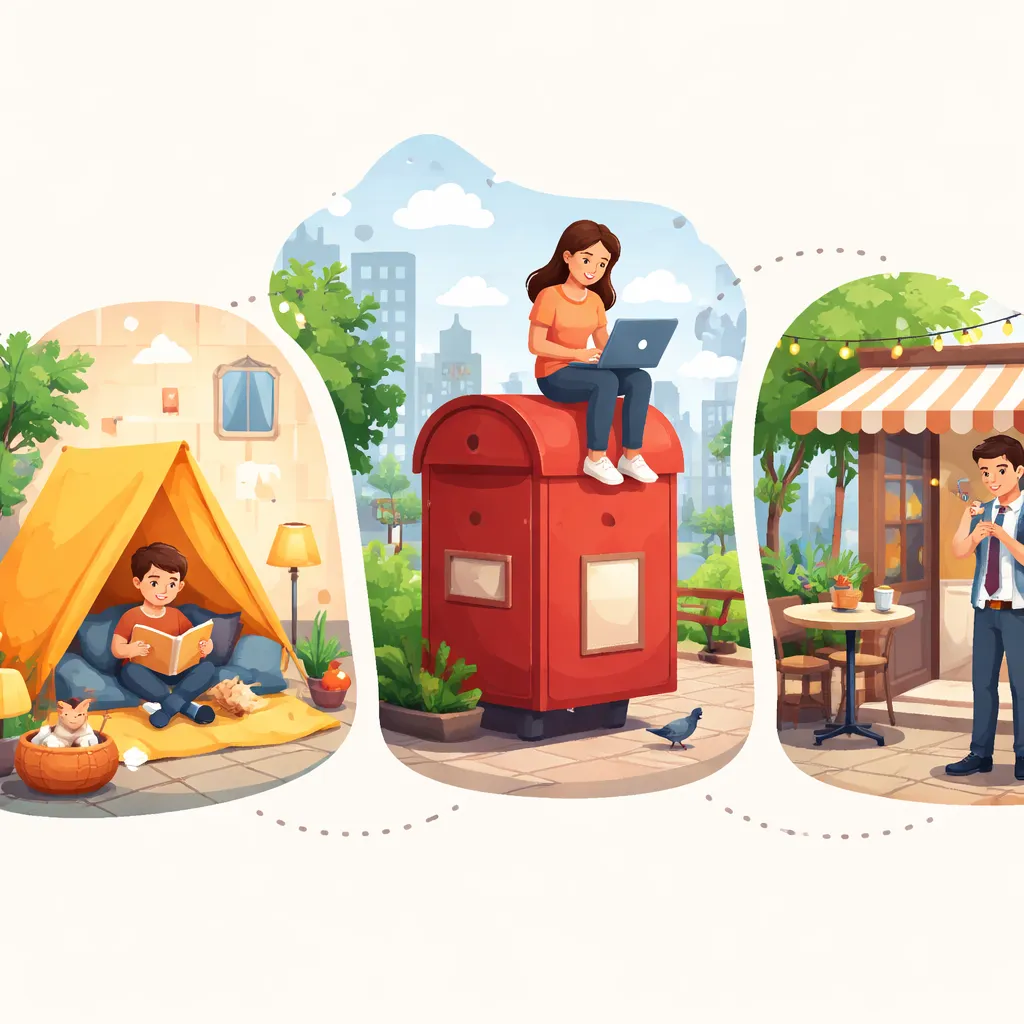

A small word tells us exactly where something sits. It tells us if a toy is inside a box. It tells us if a book rests on a table. It also tells us if someone waits at a bus stop.
These small words are prepositions of place: 'in', 'on', 'at'. Children hear them every day. “Put your toys in the box.” “Place your cup on the table.” “Meet me at the door.”
Many learners mix them up. That feels frustrating. But the rules are clear. Each word has a special job. 'In' means inside something. 'On' means touching a surface. 'At' means a specific point or location.
Parents can guide children through simple examples. You will both learn to choose the right word automatically. No more guessing. No more mistakes.
Let us explore where things belong.
What Are Prepositions of Place: 'in', 'on', 'at'? Prepositions of place show position. They answer the question “where?” They connect a noun to a location.
Think of three different cameras. An 'in' camera zooms into enclosed spaces. An 'on' camera focuses on surfaces. An 'at' camera targets a specific point.
'In' means inside or within boundaries. A fish lives in water. A toy stays in a drawer. A child sits in a car. The space has walls, edges, or borders.
'On' means touching a surface. A book lies on a desk. A picture hangs on a wall. A sticker sticks on a laptop. The surface can be flat or vertical.
'At' means a precise point. Someone stands at the front door. A bus stops at the corner. A family eats at a restaurant. The location feels exact, not general.
Children understand these differences through physical play. Put a ball in a box. Place a ball on a table. Stand at a line on the floor. Each action uses one preposition.
Parents can ask simple questions. “Is the milk in the fridge or on the fridge?” “Are you sitting on the couch or at the couch?” The answers teach the rules naturally.
Rules of Prepositions of Place: 'in', 'on', 'at' Rules help us choose correctly every time. Learn these patterns.
Rule for 'in': Use for enclosed or surrounded spaces A space has boundaries. Walls. Edges. Borders. Examples: in a room, in a building, in a pool, in a forest, in a line, in a row, in a car, in a taxi.
Countries and cities use 'in'. “She lives in Canada.” “He works in Tokyo.” Water uses 'in'. “The fish swims in the ocean.” Groups use 'in'. “She sits in the team.”
Rule for 'on': Use for surfaces Something touches a surface. Examples: on the table, on the floor, on the wall, on the ceiling, on the door, on the page, on the screen.
Transportation uses 'on' for large vehicles. “He rides on a bus.” “She sleeps on a train.” “They sit on a plane.” But small vehicles use 'in'. More on that later.
Body parts use 'on'. “A ring sits on her finger.” “A hat rests on his head.” Media uses 'on'. “The picture is on TV.” “The song plays on the radio.”
Rule for 'at': Use for specific points or addresses Think of a dot on a map. Examples: at the bus stop, at the front door, at the traffic light, at the top, at the bottom, at the end of the street.
Addresses use 'at' with house numbers. “She lives at 25 Maple Street.” But cities use 'in'. “She lives in Chicago.” Events use 'at'. “We met at the party.” Shops and public places use 'at'. “He waits at the bank.”
These rules work most of the time. Practice each rule separately. Master 'in' first. Then add 'on'. Then add 'at'.
How to Use Prepositions of Place: 'in', 'on', 'at' Use these prepositions in daily conversations. Here are common situations for each one.
Using 'in' for rooms and containers “The milk is in the refrigerator.” “Your shoes are in the closet.” “I left my keys in my bag.” “The baby sleeps in her crib.”
Using 'in' for geographical areas “We vacationed in Florida.” “She studies in London.” “They live in a small village.” “The treasure hides in the forest.”
Using 'on' for furniture and appliances “The remote sits on the sofa.” “Dinner cooks on the stove.” “Papers pile on the desk.” “A vase stands on the piano.”
Using 'on' for floors and levels “My office is on the third floor.” “The restaurant is on the ground level.” “She lives on a busy street.” “The bedroom is on the left.”
Using 'at' for exact addresses “Meet me at 123 Main Street.” “The store opens at 5th Avenue.” “He works at 10 Downing Street.”
Using 'at' for public places and events “She waits at the bus stop.” “They ate lunch at the park.” “We saw him at the concert.” “I left my coat at school.”
Parents can create a “Where is it?” game. Ask your child to look around. “Is the lamp in the corner, on the table, or at the window?” Answer together. This builds real-world connections.
Children can draw pictures. Draw a fish in a bowl. Draw a book on a desk. Draw a person at a door. Label each drawing with the correct preposition.
Examples of Prepositions of Place: 'in', 'on', 'at' Read these examples aloud. Group them by preposition. Notice the patterns.
Examples with 'in'
The pencil sits in the case.
We swam in the warm pool.
She found a coin in her pocket.
The cat hid in the cardboard box.
They live in a small apartment.
I read about it in a magazine.
The children played in the garden.
He believes in magic.
Examples with 'on'
The coffee cup rests on the coaster.
She hung a calendar on the wall.
Dirt collected on his shoes.
The cat sleeps on the warm radiator.
We drove on a bumpy road.
The picture appears on page ten.
He has a scar on his knee.
She works on a big project.
Examples with 'at'
Someone knocked at the door.
They sat at the kitchen table.
I will meet you at the library.
The taxi stops at the corner.
She smiled at the camera.
He works hard at his job.
We arrived at the airport early.
The dog barked at the stranger.
Mixed examples for practice
The bird is in the tree. (Tree encloses the bird)
The apple is on the tree. (Apple grows from the surface)
She waits at the tree. (Tree as a meeting point)
He lives in Paris. (City as an area)
He arrives at Paris. (City as a destination point)
Read each mixed example twice. Discuss why each preposition changes the meaning. This deepens understanding.
Common Mistakes These three prepositions cause frequent errors. Recognize them. Fix them kindly.
Mistake one: Using 'at' for enclosed spaces Wrong: “She is at the kitchen.” Right: “She is in the kitchen.” 'At' needs a specific point. A kitchen is a room with walls. Use 'in'.
Mistake two: Using 'in' for surfaces Wrong: “The book is in the table.” Right: “The book is on the table.” 'In' means inside. A table has a flat surface. Use 'on'.
Mistake three: Using 'on' for exact addresses Wrong: “She lives on 25 Maple Street.” Right: “She lives at 25 Maple Street.” Addresses with house numbers use 'at'. Streets without numbers use 'on'. “She lives on Maple Street” is correct. Add a number? Change to 'at'.
Mistake four: Mixing transportation prepositions Wrong: “She rides in a bus.” Right: “She rides on a bus.” Large public transport uses 'on'. Bus, train, plane, ship. Small private vehicles use 'in'. Car, taxi, truck. “She sits in a car.”
Mistake five: Forgetting that 'at' shows specific points Wrong: “Meet me in the bus stop.” Right: “Meet me at the bus stop.” A bus stop is a point. Not an enclosed building. Use 'at'.
Write these mistakes on cards. Shuffle them. Ask your child to spot the wrong preposition. Then say the correct sentence. This active learning sticks better than worksheets.
Comparison: 'in' vs. 'on' vs. 'at' Compare these prepositions side by side. See how they change meaning.
'In' vs. 'on' for location
In the box (inside, surrounded by walls)
On the box (on top of the surface)
In the wall (inside the wall structure)
On the wall (attached to the outer surface)
'In' vs. 'at' for scale
In London (large area, general location)
At London (specific point like the airport or station)
In school (inside the building)
At school (on the school grounds, possibly outside)
'On' vs. 'at' for points
On the corner (on the surface of the corner area)
At the corner (the exact intersection point)
On the bus stop (on top of the shelter)
At the bus stop (waiting near the sign)
Special cases: Water
In the water (swimming, submerged)
On the water (floating, sailing)
At the water (standing by the edge)
Special cases: Addresses
In Maple Street (British English, meaning along the street)
On Maple Street (American English, standard)
At 25 Maple Street (specific house number)
Parents can draw pictures for each comparison. A box with an arrow inside says 'in'. A box with an arrow on top says 'on'. A box with an arrow pointing to a corner says 'at'. Visuals help children remember.
Practice Exercises Complete these exercises together. Take your time.
Exercise one: Fill in the blank Choose 'in', 'on', or 'at'.
The keys are ______ my pocket.
She lives ______ 42 Park Avenue.
The cat sleeps ______ the sofa.
We met ______ the museum entrance.
He writes ______ a small notebook.
The picture hangs ______ the wall.
They arrived ______ the station late.
The fish swims ______ the bowl.
I left my bag ______ the floor.
She works ______ a hospital.
Exercise two: Correct the mistakes Each sentence has one wrong preposition. Rewrite correctly.
The milk is on the refrigerator.
She waits in the bus stop.
He rides in a bus to school.
They live at Chicago.
The book is in the desk.
Exercise three: Choose the best answer Select the correct preposition for each situation.
A restaurant (in / on / at) the corner of the street.
A stain (in / on / at) your shirt.
A meeting point (in / on / at) the library door.
A city (in / on / at) France.
A number (in / on / at) page five.
Exercise four: Write three sentences Write one sentence for each preposition. Describe your current room.
Use 'in'
Use 'on'
Use 'at'
Answers and Explanations Check your answers. Read each explanation.
Exercise one answers:
in (pocket is enclosed)
at (specific address with number)
on (sofa surface)
at (specific point, entrance)
in (notebook has pages inside)
on (wall surface)
at (station as arrival point)
in (bowl encloses water)
on (floor surface)
at (hospital as institution point)
Exercise two answers: 11. The milk is in the refrigerator. (Inside, not on top) 12. She waits at the bus stop. (Point, not enclosed) 13. He rides on a bus to school. (Large transport uses 'on') 14. They live in Chicago. (City as area, not point) 15. The book is on the desk. (Surface, not inside)
Exercise three answers: 16. at (the specific corner point) 17. on (stain touches the fabric surface) 18. at (exact point, the door) 19. in (country as large area) 20. on (page surface)
Explanations for tricky ones: Number 11 confuses many people. Milk belongs inside the refrigerator. “On the refrigerator” means on top of the machine.
Number 16 uses 'at' because a corner acts as a point. But “on the corner” also works in some dialects. Both are acceptable. Teach your child 'at' for precision.
Number 20 always uses 'on'. Information appears on a page. Not in a page.
Celebrate every correct answer. Review mistakes as learning moments. Do not rush.
Learning Tips Make prepositions of place part of your daily routine. These tips work for busy families.
Tip one: Use physical objects Take a cup and a ball. Put the ball in the cup. Say “The ball is in the cup.” Put the ball on the cup. Say “The ball is on the cup.” Put the ball at the cup. Say “The ball is at the cup.” Move the ball. Say the sentence. Repeat.
Tip two: Play “I Spy” with prepositions Say “I spy something on the wall.” Your child guesses. “I spy something in the drawer.” Take turns. This game teaches location words naturally.
Tip three: Draw a room map Draw your living room. Label objects. “Lamp in the corner.” “Rug on the floor.” “Picture on the wall.” “Dog at the door.” Seeing the words with positions builds memory.
Tip four: Narrate your movements While cooking, say “I put the eggs in the fridge.” “I chop onions on the cutting board.” “I stand at the stove.” Children learn by hearing correct grammar in real time.
Tip five: Read picture books and point Open any children's book. Point to a picture. Ask “Is the bear in the boat or on the boat?” Let your child point and answer. Books provide endless examples.
Tip six: Create a preposition poster Take a large paper. Write IN, ON, AT at the top. Cut pictures from magazines. Glue a fish picture under IN. Glue a book picture under ON. Glue a bus stop picture under AT. Hang the poster on the wall.
Tip seven: Practice for two minutes each day Set a timer. Look around your room. Say three sentences with 'in'. Three with 'on'. Three with 'at'. “Phone in my hand.” “Shoes on the floor.” “Mom at the table.” Quick practice builds automatic skill.
Learning prepositions of place takes time. Do not expect perfection in one week. Celebrate small improvements. One day your child will say “The spoon is in the drawer” without thinking. That is success.
Now look around where you sit. Say one sentence with 'in'. One with 'on'. One with 'at'. You just practiced. Keep going. You are doing great.