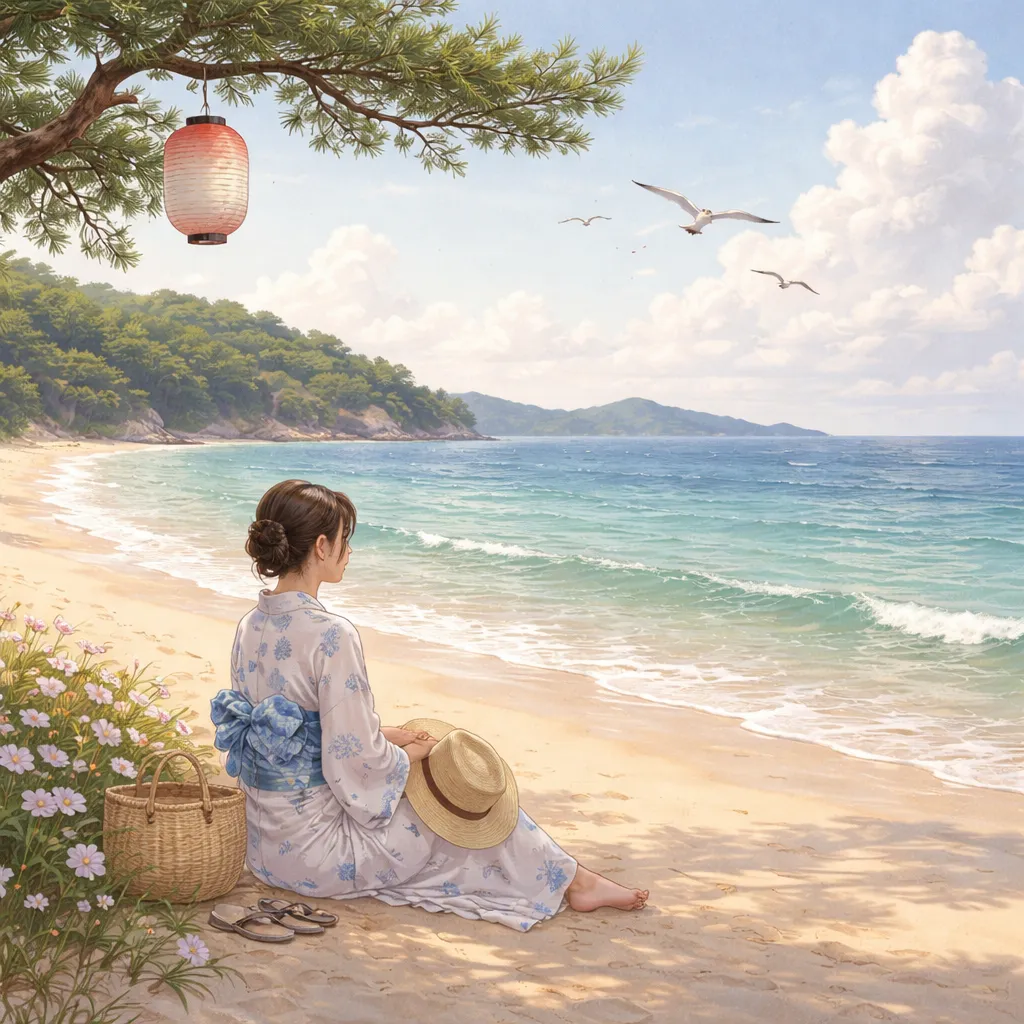

Do you remember the feeling of sand between your toes? The sound of waves, in and out, like the world is breathing? The way the sun makes the water sparkle like a million tiny diamonds? The beach is a place of magic, peace, and wonderful memories. There is a famous song from Japan that captures this exact feeling. Let’s listen to the gentle Japanese Song: The Beach (浜辺の歌).
About the Song Here is the beautiful first verse of this classic song in Japanese and English: あした浜辺を さまよえば (Ashita hamabe o samoyoeba) If I wander the beach tomorrow 昔のことぞ しのばるる (Mukashi no koto zo shinobaruru) I will remember things of long ago
かもめのなく ねぞ (Kamome no naku ne zo) The sound of the seagulls crying はるばると きこゆる (Harubaruto kikoyuru) Can be heard, far, far away
The song’s original Japanese name is “浜辺の歌” (Hamabe no Uta), which means “Song of the Beach.” It is a very old and beloved Japanese children’s song. The singer is talking to the beach as if it were a wise, quiet friend who holds all their memories. The soft, flowing melody feels like gentle waves washing over the sand, bringing back thoughts of happy, quiet times long past. It’s a musical picture of peaceful remembering.
What the Song is About The song paints a quiet, thoughtful picture. Someone is walking slowly along the shore very early in the morning. The sand is still cool under their feet. They look down and see little shells and smooth stones left by the tide. As they walk, old, happy memories start to float into their mind, like boats coming back to shore. Far away, they hear the lonely, beautiful cry of a seagull flying over the sparkling blue water. The whole scene—the wide sky, the endless sea, the soft wind—makes them feel calm, a little sad, but mostly grateful for all the beautiful days they remember. The beach is listening to all their quiet thoughts.
Who Made It & Its Story A poet named Hayashi Ryouha (林柳波) wrote the words, and a composer named Narita Tamezou (成田為三) wrote the music for this song a long time ago. Narita Tamezou wrote it after he returned to Japan from studying music in Germany. He missed the simple, natural beauty of his home, especially the sea. In Japan, an island nation, the beach is a very important and special place. It’s where people go to play, to think, to watch beautiful sunsets, and to feel connected to nature. This song became famous because it perfectly captures that feeling. First, its melody is incredibly gentle and easy to hum, making you feel calm right away. Second, the words are simple but create a very strong, clear picture in your mind. Third, the feeling of the song—a mix of happiness for memories and a little sadness that the past is gone—is something people everywhere can understand and feel in their hearts.
When to Sing It You can hum this song softly on a quiet morning, looking out your window and remembering a happy day from last week. It’s perfect to sing during a long car ride to the real beach, imagining the sea getting closer with every mile. You could also sing it as a quiet lullaby before bed, thinking of all the peaceful and happy things that happened during your day.
But this Japanese Song: The Beach (浜辺の歌) is more than just a pretty tune. It is like a quiet teacher, waiting to show us new words, how to build better sentences, and how to see the world with calm, thoughtful eyes. When we listen closely, we can learn so much from its gentle waves of sound and meaning.
What Children Can Learn
Vocabulary This song is a treasure chest of beautiful, descriptive words about the sea and feelings. Shore/Beach: The land right next to the sea or a lake, often with sand or rocks. “We built a sandcastle on the shore.”
Wander: To walk slowly without a hurry, not going straight to one place. You wander when you are exploring. “I love to wander through the park and look at flowers.”
Glimmer: To shine with a soft, gentle, moving light. The stars glimmer at night. A shiny rock under water might glimmer.
Foam: The white, bubbly top on waves or on your hot chocolate. The sea foam tickles your feet.
Horizon: The line far, far away where the sky seems to touch the land or sea. The sun disappears below the horizon at sunset.
Memory: A picture or feeling from the past that you keep in your mind. Your last birthday party is a happy memory.
Language Skills This song is a wonderful example of using Adjectives (Describing Words). Adjectives are words that paint colors, sizes, feelings, and more onto other words. They make our sentences vivid and interesting! What Are They?: Think of adjectives as the “color crayons” for your nouns (the names of things, people, or places). Without them, the world is like a black-and-white drawing. With them, it’s a colorful painting!
Types of Color Crayons (Adjectives):
◦   Color: “blue sky,” “golden sand.”

◦   Size/Shape: “tiny shells,” “smooth stones.”

◦   Feeling/Texture: “gentle waves,” “cool sand,” “happy memories.”

◦   Sound: “quiet morning,” “lonely cry.”
Finding the Secret: Ask the questions “Which one?” or “What kind of?” about a noun. The word that answers is often an adjective. “I hear the seagull’s cry.” What kind of cry? A lonely cry. “Lonely” is the adjective.
Using Them: You can put adjectives right before the noun they describe. The formula is: [Adjective] + [Noun]. “gentle waves,” “old memories.” You can also use them with “is/am/are”: [Noun] + is/am/are + [Adjective]. “The sea is calm.” “My memories are happy.”
Sounds & Rhythm Fun The magic of this Japanese Song: The Beach (浜辺の歌) is in its smooth, flowing sound. The Japanese words have soft sounds that flow into each other, like water. In the English version, listen for the long ‘o’ and ‘a’ sounds in “shore,” “wander,” “morning,” and “far.” These open sounds make the song feel slow and peaceful. The rhythm is not a jumping, happy beat. It is slow and smooth, like the gentle rising and falling of waves on a calm day. This slow, even rhythm is very calming and helps the words and melody stick in your mind easily. You can use this same slow, wave-like rhythm to write your own calm song about a peaceful place, like a forest or your quiet bedroom.
Culture & Big Ideas In Japan, the beach (“浜辺” or hamabe) is a place for “散策” (sansaku), which means a leisurely, thoughtful walk. People go there to clear their minds, to appreciate nature’s beauty, and to think. This song connects to a big Japanese idea of finding beauty and calm in simple, everyday natural things. The song teaches us three important things. First, Mindful Observation: It shows us how to slow down, use all our senses (sight, sound, touch), and really notice the small details around us. Second, Cherishing Memories: It tells us that memories are precious treasures we carry inside us, and quiet places can help us remember them. Third, Connection to Nature: It reminds us that we are part of the natural world, and being in places like the beach can make us feel peaceful and whole.
Values & Imagination This song asks you to use your imagination like a movie director. Close your eyes. Can you feel the cool, wet sand between your toes? Can you smell the salty, fresh air? Can you see the seagull as a tiny white dot against the big, big blue sky? The song encourages you to love and appreciate the quiet, simple beauties of nature—not just the big, exciting waves, but the tiny glimmer on a shell, the pattern of foam, the endless line of the horizon. It suggests that sometimes, being quiet and thoughtful is a wonderful adventure for your heart. A simple idea: The next time you are in a park or even your backyard, sit quietly for one minute. Try to notice five small, beautiful things you normally run past. That is your own “beach” of beauty.
Your Core Takeaways The Japanese Song: The Beach (浜辺の歌) is a gentle lesson in peace, observation, and memory. You learned descriptive words like “glimmer” and “horizon” to paint better pictures with your words. You discovered how adjectives work as your language’s color crayons. You felt the slow, wave-like rhythm that makes music calming. You also learned about the Japanese appreciation for quiet, thoughtful walks in nature and the cultural importance of the seaside. Most of all, the song teaches you to value quiet moments, to cherish your memories, and to find deep beauty in the simple, natural world all around you.
Your Practice Missions
- Be an Adjective Detective. Go to a window or step outside for two minutes. Your mission is to find three things (a tree, a cloud, a car) and describe each one with two adjectives. Say them in a sentence: “I see a tall, green tree.” You are collecting descriptive words just like the song does.
- Create Your Own “Quiet Place” Song Line. Think of your own calm, happy place (your reading nook, under a tree, grandma’s kitchen). Write one line about it using the song’s slow, smooth rhythm. Try this pattern: “In my [place], so [adjective] and [adjective], I feel [feeling] and [feeling].” For example: “In my cozy nook, so soft and warm, I feel safe and calm.” Whisper your new line to yourself like a secret.