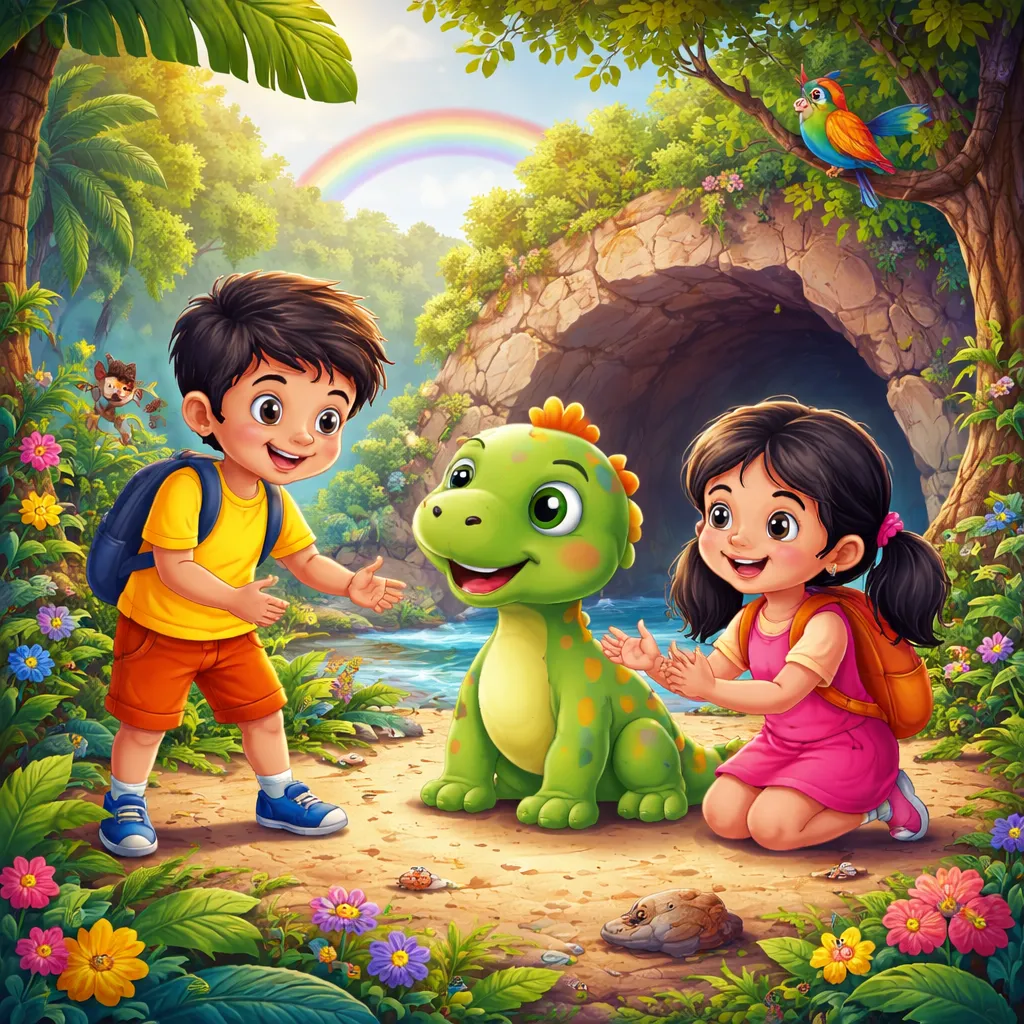

Have you ever seen a huge skeleton in a museum and tried to imagine what it was like when it was alive? Have you held a smooth, cool stone and wondered if a giant creature once walked on it millions of years ago? Dinosaurs capture our imagination like nothing else! In India, a land of ancient stories and modern wonders, there’s a fun song that brings a dinosaur to life. Let’s travel back in time with the Hindi Song: The Little Dinosaur (डायनासोर).
About the Song Here is a playful verse from this imaginative children’s song in Hindi and English: ओ छोटा डायनासोर, तू कहाँ से आया? (O chhota dinosaur, tu kahaan se aaya?) Oh little dinosaur, where did you come from? तेरी लंबी गर्दन, ऊपर आसमान को जाती (Teri lambi gardan, upar aasman ko jaati) Your long neck goes up to the sky चलो दोस्त बन जाए, आओ खेलें खेल (Chalo dost ban jaaye, aao khelen khel) Come on, let's be friends, come let's play a game डायनासोर, डायनासोर, तू है अनोखा (Dinosaur, dinosaur, tu hai anokha) Dinosaur, dinosaur, you are unique
This song’s original name is “डायनासोर” (Dinosaur), the Hindi word borrowed from English. It is a popular, modern Indian children’s song. The song talks directly to a little dinosaur, asking it friendly questions. The singer notices the dinosaur’s amazing features, like a long neck that touches the sky, and immediately wants to be its friend and play. It’s a musical bridge between our world and the ancient past, making a mysterious creature seem friendly and fun.
What the Song is About The song is a friendly conversation with a prehistoric visitor! First, we see the dinosaur and ask the big question: “Where did you come from?” We are curious about its ancient home. Then, we look closely at its amazing body. “Your long neck goes up to the sky!” We imagine it munching on leaves from the tallest trees. Instead of being scared, we feel excited. We say, “Come on, let’s be friends, let’s play a game!” The song imagines running and playing with this gentle giant. We end by celebrating how special the dinosaur is: “You are unique!” The Hindi Song: The Little Dinosaur (डायनासोर) turns fear into curiosity and wonder, inviting a giant from the past to be our playmate.
Who Made It & Its Story This song comes from the creative world of contemporary Indian children’s media. While specific creators aren’t widely listed, it reflects a global childhood fascination that India warmly embraces. India has a rich tradition of storytelling with mythical creatures and a growing interest in science. This song blends that love for stories with a sense of scientific wonder. The Hindi Song: The Little Dinosaur (डायनासोर) is a hit for three main reasons. First, it takes a topic all kids love—dinosaurs—and makes it friendly and musical. Second, it encourages curiosity and questions, which is the heart of learning. Third, its tune is playful and bouncy, making it easy and fun to sing and act out, perhaps stomping like a giant, friendly dino.
When to Sing It You can sing this song in the backyard or park, stomping your feet and stretching your arms like a dinosaur’s long neck. It’s perfect to hum while visiting a natural history museum, looking at the dinosaur fossils and imagining them singing along. You could also sing it during a craft time when you’re drawing or making your own dinosaur out of clay or paper.
Now we’ve met our dino friend from the Hindi Song: The Little Dinosaur (डायनासोर). But this song is like a fossil—it has layers of learning hidden inside! Let’s be paleontologists of language and dig up lessons about new words, how to ask questions, and the big ideas that connect all of us, past and present.
What Children Can Learn
Vocabulary This song helps us build words about science, size, and discovery. Prehistoric: Belonging to the time in history before written records. Dinosaurs are prehistoric animals.
Unique: Being the only one of its kind; very special and different. Your fingerprint is unique. Every dinosaur species was unique.
Gigantic: Extremely large, huge. A dinosaur’s footprint was gigantic.
Paleontology: The science of studying fossils to learn about ancient life. Scientists who study dinosaur bones work in paleontology.
Fossil: The remains or impression of a prehistoric plant or animal, turned into stone, found in rock. We find dinosaur fossils.
Extinct: When a type of plant or animal no longer exists anywhere on Earth. Dinosaurs are extinct, but we learn about them from fossils.
Language Skills This song is a wonderful example of using Question Words (also called “Wh words”). We use these to ask for information. What Are They?: Think of Question Words as the keys that unlock answers. They start questions that need more than a “yes” or “no” reply.
Types of Keys (Question Words):
◦   Who?: Asks about a person. “Who found the fossil?”

◦   What?: Asks about a thing or an idea. “What did dinosaurs eat?”

◦   Where?: Asks about a place. “Where did you come from?” (from the song!).

◦   When?: Asks about a time. “When did dinosaurs live?”

◦   Why?: Asks for a reason. “Why did they become extinct?”

◦   How?: Asks about manner, way, or condition. “How big was it?”
Finding the Secret: Look for a sentence that starts with one of these “Wh-” words and ends with a question mark. It’s asking for a specific piece of information.
Using Them: The formula is: [Question Word] + [helping verb/is/are/do/etc.] + [subject] + [main verb]?
◦ Examples: “Where did you come from?” (Song) “What is your name?” “How do birds fly?”
Sounds & Rhythm Fun Get ready for some heavy, fun stomps! The Hindi Song: The Little Dinosaur (डायनासोर) has a playful, bouncy, but also slightly heavy rhythm. It might sound like the “thump, thump, thump” of big dinosaur feet walking. The melody is curious and friendly, going up and down like a dinosaur’s long neck. Words like “Dinosaur, dinosaur” are repeated, making them stick in your mind. This catchy, weighty rhythm makes it fun to move to and easy to remember the curious questions the song asks. You can use this bouncy, heavy rhythm to make up a song about another big animal, like an elephant or a whale.
Culture & Big Ideas India has a treasure trove of ancient stories and a strong modern scientific community. A fun connection is the ancient Indian collection of animal fables, the Panchatantra, which uses animal characters to teach lessons. This dinosaur song is like a modern Panchatantra tale, using a dinosaur to teach about friendship and curiosity. The Hindi Song: The Little Dinosaur (डायनासोर) teaches three big ideas. First, Curiosity Over Fear: When we meet something big and unknown, asking questions is better than being scared. Second, Learning from the Past: Fossils and bones are like nature’s history books, telling us amazing stories about Earth. Third, Universal Wonder: The fascination with giant, ancient creatures is a feeling shared by children all over the world, connecting us across cultures.
Values & Imagination Close your eyes and imagine the little dinosaur. What color is it? What kind of happy sound does it make? If you could play a game with it, what would you play? This song teaches you to use your imagination to explore the unknown. It tells you that science starts with a question: “Where did you come from?” A simple idea: Go outside and find a interesting rock. Imagine it is a fossil. What kind of dinosaur left it behind? Draw a picture of that dinosaur. You are being a scientist and a storyteller, just like the song.
Your Core Takeaways The Hindi Song: The Little Dinosaur (डायनासोर) is a joyful celebration of curiosity, friendship, and ancient wonders. You learned science words like “fossil” and “prehistoric.” You discovered how to use “Wh-” question words like “Where?” and “What?” to ask for information. You moved to the song’s bouncy, heavy rhythm. You also connected the song to India’s tradition of storytelling and the global language of scientific curiosity. Most importantly, the song teaches that asking questions is the first step to discovery, that the past is full of amazing stories, and that our imagination is a powerful tool to befriend the unknown.
Your Practice Missions
- Be a “Question Word” Detective. With a grown-up, look at a picture of a dinosaur or a large animal. Take turns asking each other questions about it using different “Wh-” words. “What is it eating?” “Where does it live?” “How does it move?” See how many different questions you can ask.
- Create Your Dinosaur’s “Friendship Card.” Draw a picture of your own friendly little dinosaur. On the card, write or tell two sentences: 1) One thing that is unique about it (Example: “My dino has rainbow spots!”). 2) One game you would play with it (Example: “We would play hide-and-seek behind volcanoes!”). Share your card with someone.