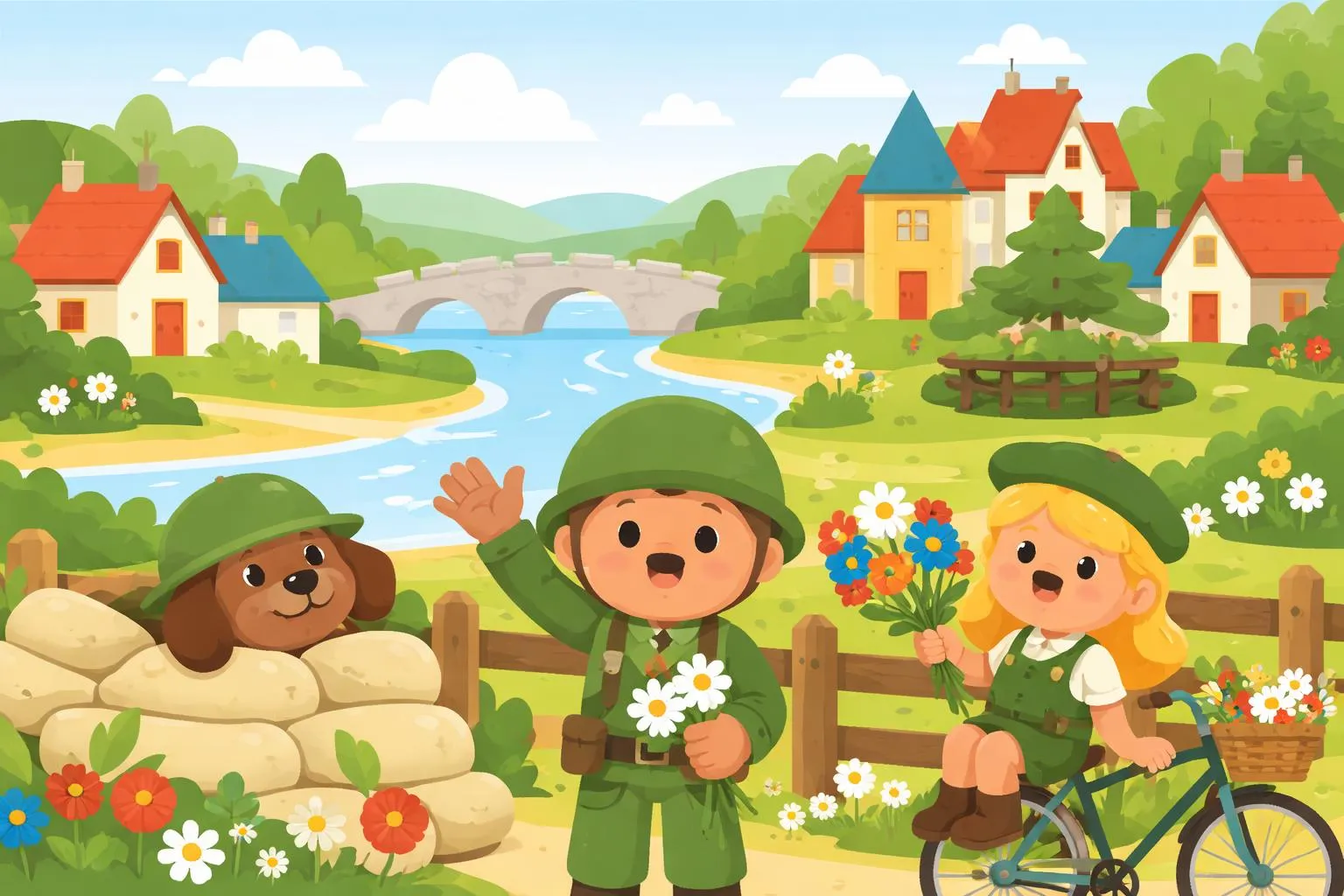

Original Poem:
Trees in the old days used to stand
And shape a shady lane
Where lovers wandered hand in hand
Who came from Carentan.
This was the shining green canal
Where we came two by two
Walking at combat-interval.
Such trees we never knew.
The day was early June, the ground
Was soft and bright with dew.
Far away the guns did sound,
But here the sky was blue.
The sky was blue, but there a smoke
Hung still above the sea
Where the ships together spoke
To towns we could not see.
Could you have seen us through a glass
You would have said a walk
Of farmers out to turn the grass,
Each with his own hay-fork.
The watchers in their leopard suits
Waited till it was time,
And aimed between the belt and boot
And let the barrel climb.
I must lie down at once, there is
A hammer at my knee.
And call it death or cowardice,
Don’t count again on me.
Everything’s all right, Mother,
Everyone gets the same
At one time or another.
It’s all in the game.
I never strolled, nor ever shall,
Down such a leafy lane.
I never drank in a canal,
Nor ever shall again.
There is a whistling in the leaves
And it is not the wind,
The twigs are falling from the knives
That cut men to the ground.
Tell me, Master-Sergeant,
The way to turn and shoot.
But the Sergeant’s silent
That taught me how to do it.
O Captain, show us quickly
Our place upon the map.
But the Captain’s sickly
And taking a long nap.
Lieutenant, what’s my duty,
My place in the platoon?
He too’s a sleeping beauty,
Charmed by that strange tune.
Carentan O Carentan
Before we met with you
We never yet had lost a man
Or known what death could do.
Analysis and Interpretation of the Poem
This poignant poem vividly captures the haunting memories of soldiers during wartime, focusing on the Battle of Carentan in World War II. The imagery of trees shaping a shady lane and lovers wandering hand in hand contrasts sharply with the brutal reality of combat, where soldiers march "at combat-interval," highlighting the tension between peace and war.
The poem’s setting is early June, with soft, dew-brightened ground and a blue sky, yet the distant sound of guns and the smoke hanging over the sea remind readers of the ever-present threat of violence. The peaceful natural surroundings are juxtaposed with the deadly reality of war, symbolized by "watchers in their leopard suits" who wait and shoot with deadly precision.
The speaker’s personal experience is conveyed through lines expressing pain and fear: "I must lie down at once, there is a hammer at my knee," and the struggle to maintain courage despite the threat of death. The poem also reflects on the silence and helplessness of military leaders—the Sergeant, Captain, and Lieutenant—who are either silent, sickly, or "charmed by that strange tune," suggesting confusion or disillusionment among the ranks.
The closing stanza mourns the loss and the harsh awakening to the reality of death brought by Carentan, a place where the soldiers first truly faced the cost of war.
Background and Author Introduction
This poem is inspired by the Battle of Carentan, a key conflict during the Normandy campaign in 1944. Carentan, a small town in France, was strategically important for the Allied forces after the D-Day landings. The battle was fierce and costly, marking many soldiers’ first encounter with death and combat’s harsh realities.
The author, whose identity is not specified here, likely served or was closely connected to soldiers who fought in this battle. The poem serves as a tribute to those who endured the horrors of war, reflecting on the innocence lost and the brutal lessons learned.
Reflections and Insights
Reading this poem evokes deep empathy for soldiers who face the terrifying uncertainty of war. It reminds us of the stark contrast between the beauty of nature and the devastation of human conflict. The poem encourages reflection on the cost of war—not just in lives lost but in the loss of innocence and peace.
Educational Value and Learning Points for Children and Students
Students can learn several important lessons from this poem:
- Historical Awareness: Understanding the significance of World War II battles like Carentan helps students appreciate history and the sacrifices made by soldiers.
- Literary Devices: The poem uses imagery, contrast, and symbolism effectively, offering a rich example for literary analysis.
- Emotional Intelligence: The poem invites readers to empathize with soldiers’ experiences, fostering emotional growth and compassion.
- Vocabulary Building: Words like “combat-interval,” “sergeant,” “platoon,” and “barrel” introduce military terminology in context.
- Moral Lessons: The poem teaches about courage, fear, loss, and the reality of death, encouraging discussions about bravery and the human cost of conflict.
Practical Applications and Learning Challenges
- In Classroom Discussions: Teachers can use this poem to introduce World War II history and discuss the emotional impact of war on individuals.
- Creative Writing: Students can write their own poems or stories inspired by historical events, practicing descriptive language and emotional expression.
- Critical Thinking: Analyzing the poem’s tone and message helps develop interpretive skills.
- Challenges: Some students might find the themes of death and war difficult to approach. Sensitive guidance is necessary to help them understand the poem’s message without distress.
Reading Comprehension Questions
- What natural setting does the poem describe at the beginning?
- How does the poem contrast the peaceful environment with the reality of war?
- What emotions does the speaker express when injured?
- How are the military leaders portrayed in the poem?
- What is the significance of Carentan in the poem?
- What literary devices can you identify in the poem?
- What message do you think the poet wants to convey about war?
Answers
- The poem describes trees shaping a shady lane, a green canal, and a soft, dew-brightened ground under a blue sky.
- The poem contrasts the peaceful, beautiful natural surroundings with the distant sounds of guns and the presence of smoke, symbolizing war’s danger.
- The speaker expresses pain, fear, and a sense of helplessness but also tries to reassure his mother and himself.
- The military leaders are portrayed as silent, sickly, or distracted, suggesting confusion or helplessness.
- Carentan represents the harsh reality of war where soldiers first experience loss and death.
- Imagery, contrast, symbolism, and repetition are some of the literary devices used.
- The poet conveys the tragic cost of war and the loss of innocence experienced by soldiers.
This poem is a powerful educational tool that combines history, literature, and emotional learning, helping students understand the complex human experience behind historical events.