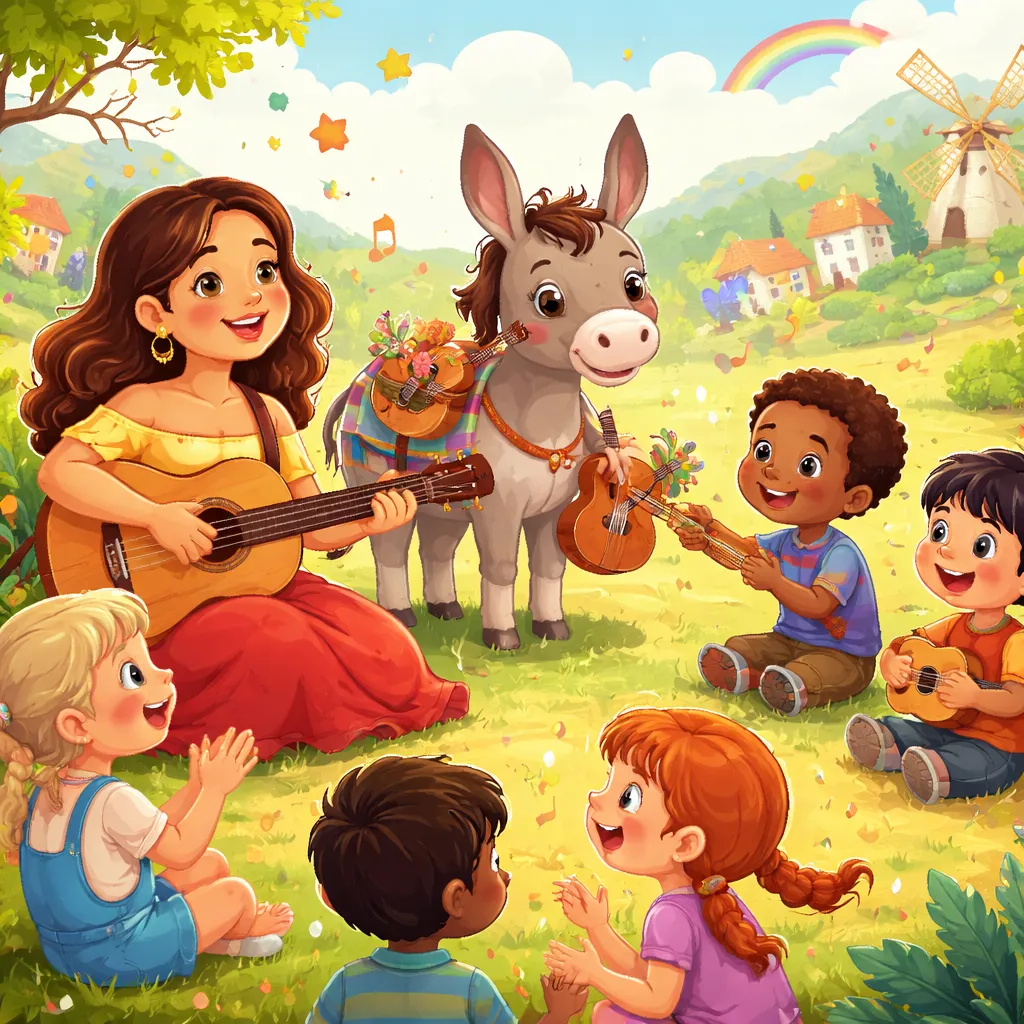

Music speaks to children in a way that words alone cannot. It carries emotion, rhythm, and repetition. When we introduce a new language through song, we give children a gentle invitation. Today, we explore a traditional Portuguese rhyme called “O Burrinho,” which means “The Little Donkey.” This song tells a simple story. It follows a small donkey on a journey. We will use this melody to learn English words, practice sounds, and discover grammar in a natural way. The goal is not to teach a lesson but to share an experience. Together, we will sing, move, and play with language.
What is the rhyme? “O Burrinho” is a beloved children’s song in Portuguese-speaking countries. It describes a little donkey walking along a path. The song is slow and steady, just like the donkey’s pace. It often includes actions like swaying or tapping to the beat. Children enjoy pretending to be the donkey. They walk slowly and carry an imaginary load. This rhyme creates a calm, focused atmosphere. It is perfect for moments when children need to settle down or for a gentle learning activity. The repetition in the lyrics builds confidence. Children can quickly join in, even if they do not know all the words. When we bring this song to English learning, we keep its gentle spirit. We use the familiar melody as a comfortable space for new sounds and vocabulary.
The lyrics of nursery rhymes To understand the heart of this song, we first look at the original Portuguese words. Then we see how they translate into English. This approach shows children that a single idea can live in different languages. You do not need to speak Portuguese to enjoy the rhythm. Simply listen to the flow of the words. Notice how the English version can follow the same gentle beat.
Original Version (Portuguese)
O burrinho, o burrinho Vai andar, vai andar Pela estrada, pela estrada Vai cansar, vai cansar
English Version
The little donkey, the little donkey Will walk, will walk Along the road, along the road Will get tired, will get tired
Another verse often follows, giving the story a sweet ending.
Original Version (Portuguese)
O burrinho, o burrinho Vai parar, vai parar Na sombrinha, na sombrinha Vai descansar, vai descansar
English Version
The little donkey, the little donkey Will stop, will stop In the little shade, in the little shade Will rest, will rest
As you read these lines, feel the steady rhythm. The repetition is a gift for young learners. It gives them time to absorb each word. The story is simple: a little donkey walks, gets tired, finds shade, and rests. This sequence is easy for a child to understand and remember.
Vocabulary learning This song introduces a lovely set of words that connect to daily life and simple actions. We can explore these words through conversation and play. Start with the main character: the donkey. In Portuguese, it is burrinho. In English, we say “little donkey.” The word “little” adds a sense of affection. It makes the character feel small and friendly.
Here are the key words to focus on from the song:
Donkey: An animal that carries things. You can look at pictures of donkeys together. Compare them to horses. Ask your child what sounds a donkey makes.
Walk: A slow, steady movement. This is different from running. Walk slowly around the room together. Let your child lead the pace.
Road: The path where the donkey walks. You can draw a winding road on a large piece of paper. Use toy animals to walk along it.
Tired: How we feel when we need rest. Yawn and stretch. Ask your child to show you a tired face.
Stop: To pause or cease moving. This is a useful word in many situations. Play a game where you walk until someone says “stop.”
Shade: A cool area away from the sun. On a sunny day, point to the shade under a tree. Explain that the donkey rests there.
Rest: To relax and regain energy. This is a comforting word. After a busy day, we all need to rest.
Use these words throughout your day. When you go for a walk, say “we are walking, just like the little donkey.” When your child seems tired, say “are you feeling tired? Let us rest.” This connection makes the vocabulary meaningful.
Phonics points Phonics helps children understand the building blocks of spoken English. This song gives us several sounds to explore in a relaxed way. We can point them out without turning play into a lesson.
First, notice the ‘l’ sound in “little.” This is a light sound made with the tongue touching the roof of the mouth. Practice by saying “la la la” together. Then say “little” slowly. Feel the tongue tap. This sound appears in many common words like “like,” “love,” and “leaf.”
Next, focus on the ‘w’ sound in “walk.” This is a voiced sound made with rounded lips. Say “w w w” like a soft wind. Then say “walk.” Compare it to the word “talk.” They share the same ending sound. This helps children hear patterns in English.
The word “tired” contains the ‘ire’ sound. This is a combination of vowel sounds. Say “fire,” “wire,” and “tired.” Notice how the mouth moves from one shape to another. This is called a diphthong. It is a common pattern in English.
Finally, look at the ‘sh’ sound in “shade.” This is a quiet, airy sound. Put your finger to your lips and say “shhh.” This is the same sound. Practice with “ship,” “shop,” and “shade.” The song also has “rest,” which ends with the ‘st’ blend. Say “s” and then quickly add “t.” This blend appears in “stop” as well, giving us two chances to practice.
Grammar patterns Even simple songs contain grammar that we can introduce gently. We do not need to use complex terms. Instead, we show how words work together through examples and play.
The song uses the future tense with the word “will.” “Will walk” means the donkey plans to walk. You can explain this simply. “Will” is a word that tells us something is going to happen. You can practice by making predictions about your day. “We will have a snack.” “We will read a story.” This gives children a tool to talk about the future.
Notice the repetition of phrases. “The little donkey, the little donkey” repeats the noun. This repetition is common in English songs and stories. It adds rhythm and emphasis. It makes the phrase memorable. Children can use this pattern themselves. They might say “my toy, my toy” to show something important.
Also, look at the preposition “along” in “along the road.” “Along” means moving in a continuous line. You can show this with a toy car. Move it along the edge of a table. Say “the car goes along the edge.” This teaches spatial concepts in a concrete way. Another preposition is “in” in “in the shade.” This shows a location. You can practice by putting toys in a box. Say “the toy is in the box.”
Learning activities Activities bring the song to life. They transform listening into active participation. These ideas are simple and require little preparation. They work well at home or in a small group.
The Donkey Walk Play the song and pretend to be little donkeys. Walk slowly around the room. When the song says “will walk,” take steady steps. When it says “will get tired,” slow down even more and sigh. When it says “will stop,” freeze in place. When it says “will rest,” lie down on the floor. This activity builds listening skills. It also connects words to physical actions.
Shade Discovery Take the song outdoors. On a sunny day, go outside and find different places with shade. Stand under a tree. Sit beside a building. Talk about how the shade feels cool. Then sing the part about resting in the shade. This connects the song to the natural world. It gives children a real experience of the vocabulary.
Story Sequencing Draw four simple pictures: a donkey walking, a donkey looking tired, a donkey stopping, and a donkey resting under a tree. Ask your child to put the pictures in order. Then sing the song while pointing to each picture. This builds sequencing skills. It also helps children understand the narrative structure of the song.
Printable materials Printable resources offer a quiet way to reinforce the song’s vocabulary. They are perfect for moments when children want to create or focus quietly.
Flashcards Create a set of flashcards. One card shows the donkey. One shows the action “walk.” One shows a winding road. One shows a tired face. One shows a shady tree. Use these cards for a matching game. Sing a line from the song and ask your child to find the matching card. This builds word recognition in a playful way.
Coloring Page Draw a simple scene from the song. Show the little donkey walking on a road. Draw a sun and a shady tree nearby. Children can color while listening to the song. As they color, talk about the scene. “What color is the little donkey?” “Where will he rest?” This keeps the language flowing naturally.
Song Mini-Book Print the lyrics on several small pages. Leave space for drawings. On the page for “will walk,” your child can draw footsteps. On the page for “will rest,” they can draw a sleeping donkey. Fold the pages together to make a book. Read and sing the book together. This gives children ownership of the song.
Educational games Games encourage repetition without monotony. They invite children to use the language in new and creative ways.
Donkey Says Play a game similar to “Simon Says.” Give commands using the song’s vocabulary. “The donkey says walk slowly.” “The donkey says find the shade.” “The donkey says rest.” If you give a command without saying “the donkey says,” the child does not move. This game builds listening comprehension and makes the vocabulary active.
Pathway Game Create a path on the floor using tape or pieces of paper. At the start, place a picture of the donkey. At the end, place a picture of a shady tree. Take turns rolling a die and moving a toy donkey along the path. As you move, say the words. “The donkey walks along the road.” “The donkey is getting tired.” “The donkey stops to rest.” This combines movement with language practice.
Memory Matching Create two sets of cards. One set has the English words. The other set has simple pictures. Lay the cards face down. Take turns flipping two cards to find a match. When you find a match, sing the part of the song that uses that word. This reinforces vocabulary and builds memory skills.
As you share “O Burrinho” with your child, remember that you are doing more than teaching words. You are creating a shared language experience. You are showing that learning English can be gentle, slow, and full of joy. The little donkey walks at his own pace. Your child can learn at their own pace too. Let the song be a companion on your journey. Sing it when you walk together. Hum it when you rest in the shade. Let the steady rhythm of the little donkey guide you both into the world of English.